US delegation walks out as Iran’s Pezeshkian angrily responds to Trump at UN General Assembly - live
Before we hear from Zelenskyy this late afternoon European time, we are expecting to hear from Iran’s president Masoud Pezeshkian, who will speak as the fifth leader in the first session.
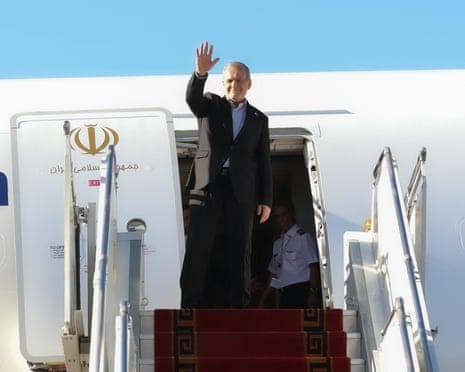
His intervention will come a day after US president Donald Trump confirmed his representatives held three-hour talks with Iran on the margins of the UN general assembly and when said he would make a decision on whether to “annihilate the Islamic Republic.”
Here is Patrick Wintour with the latest:
“Iran has pushed back on claims that it dropped former preconditions for reopening the strait of Hormuz in surprise talks held in New York under the mediation of Qatar between Tehran’s foreign minister, Abbas Araghchi, and Donald Trump’s envoys Steve Witkoff and Jared Kushner.
Trump said the three-hour talks held in a room at the UN headquarters had gone very well and been very productive.
He suggested further talks were possible imminently, which led to the price of a barrel of Brent crude to fall to below $100 (£75) for the first time in two weeks. Witkoff said the talks had been “encouraging, constructive and successful”.
In his speech to the UN general assembly, Trump said he had a decision to make very soon on whether to “annihilate the Islamic Republic” or help turn it into one of the great countries of the Middle East, the kind of bombastic threat Trump often deploys during talks with Iran.
Read Patrick’s latest dispatch from New York here:
Key events
Latvia's Rinkēvičs warns against hybrid threats 'as dangerous as conventional wars'
'We are all in the same boat' as 'the world order is breaking down', Latvia's president warns
UN general assembly debate resumes
Kremlin hits back at Burnham over UN speech
A Russian helicopter violated Polish airspace for 42 seconds, Poland says
Trump’s threat to annihilate Iran to UN general assembly is stunning, even for him - analysis
Iran's president Pezeshkian to address UN general assembly
'This Russian terror never stops,' EU ambassador to Kyiv reacts to strikes on capital
Two dead, 22 injured in Russian attacks on Kyiv, city mayor says
Kyiv faces 'particularly severe' attacks disrupting daily life
'The world has changed, so should the UN,' Finland's Stubb says
Burnham navigates diplomatic rapids in first Trump meeting, but turbulent waters lie ahead
New UK agency to fight ‘information warfare’ from likes of Russia, Burnham tells UN
Macron's final UN speech condemns 'return to the law of the jungle' with focus on Ukraine, Gaza, West Bank
At least one dead, seven injured in Russian strikes on Kyiv this morning
Morning opening: Zelenskyy to present Ukraine's case to UN leaders
Latvia’s Rinkēvičs also pointedly talks about the heightened state of alert in eastern Europe amid growing concern about Russia’s actions, as reported by my colleague Shaun Walker the other day.
The Latvian president says that “not every attack on the international order looks like war,” as he recalls “drones carrying explosives at airports” like in Leipzig or other hybrid incidents involving drones, airspace violations, and damaged power stations.
“We sometimes call them hybrid threats, but it sounds as innocent as hybrid cars. In reality, those threats to international peace and security are as dangerous as conventional wars.”
He also joins a growing chorus of leaders calling for the reform of the UN, saying the organisation “cannot take its relevance for granted.”
Latvia’s Edgars Rinkēvičs is up next.
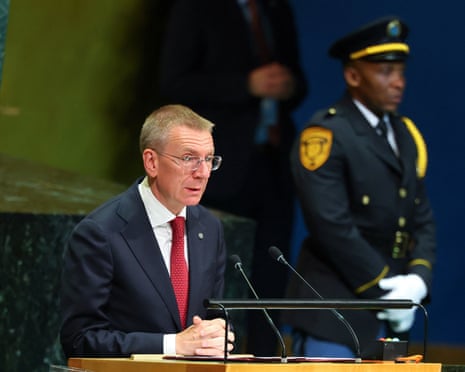
He begins by repeating warning that “the world order is breaking down,” as “the rules-based order that brought stability is under growing strain.”
But he says the threats once far away from home are now coming increasingly close: whether the Russian aggression on Ukraine, or the worsening landscape in the Middle East.
He also warns about climate change threats:
“Nature respects no borders either. Heatwaves do not stop at checkpoints. Rising seas threaten to rise. … That threat means that those island nations may disappear from the face of the earth, and far from the ocean.
The danger is just as real in the mountains. A river can turn into a deadly flood. It may happen in seconds. These floods sweep away homes, roads and lives. We just witnessed a catastrophic flood wave in Nepal, where also 33 Latvian citizens disappeared.
Global climate change does not have borders or citizenship.”
Rinkēvičs says that the main lesson appears to be that “none of us can face [the threats] alone.”
“We are in the same boat. Perhaps Noah’s Ark is no longer just a biblical story.”
Drawing on Latvia’s own history, he pivots to Ukraine and Russian attempt to deny its sovereignty and territorial integrity.
“Russia’s war against Ukraine strikes at the very heart of the United Nations charter,” he says.
Rinkēvičs urges leaders “not to look away” from Russian actions in Ukraine.
“Russia is violating the very principles it is entrusted to uphold. Russia started this brutal war. Russia can end it. It can stop its attacks. It can withdraw its forces. It can leave Ukraines sovereign territory.”
Al-Sharaa’s speech focuses on the reconstruction of Syria after the fall of the Assad regime, listing what he says are the achievements of the current government on the return of refugees and internally displaced people, education, and the rule of law.
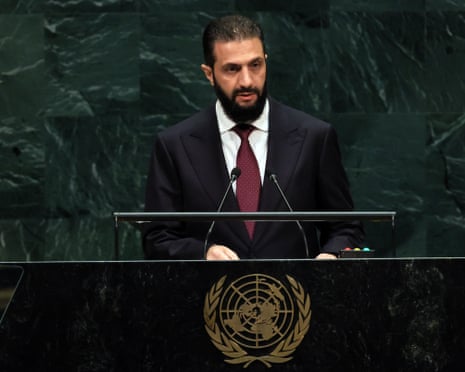
He also condemned Israel’s attacks against Syria, calling for the withdrawal of Israeli forces to the lines agreed in December 2024 – and insists Golan will remain Syrian.
The morning session at UN general assembly is now under way, with Syria’s Ahmed Al-Sharaa the first speaker of the day.
You can watch it here:
The Kremlin has responded to Andy Burnham’s speech at the UN general assembly, accusing the UK prime minister of “stoking anti-Russian sentiment”.
Burnham told the UN yesterday that his government would set up a new national centre to tackle information attacks by foreign powers and singled out Russia over what he described as the spread of disinformation.
The Kremlin’s spokesman, Dmitri Peskov, said Burnham’s address aimed at “stoking anti-Russian sentiment and fostering an atmosphere of total Russophobia”.
And now, presumably in unison with Britain, the Germans, the French and a number of other European states are doing the same thing,” Peskov told reporters, according to Reuters.
“From our point of view, this is an utterly short-sighted policy. It in no way brings us any closer to any steps that might, in the long term, lead to a reduction in tensions and de-escalation on the European continent.”
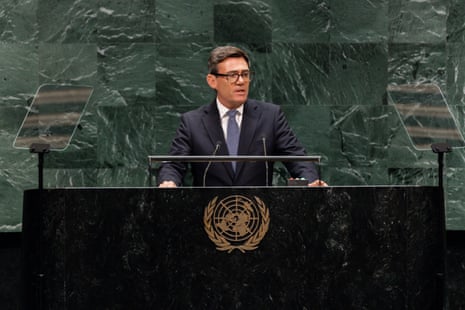
The flurry of diplomatic meetings around the UN general assembly also brought the Iranian foreign minister, Abbas Araghchi, together with his French counterpart, Jean-Noël Barrot, in New York
In a statement on his Telegram channel, Araghchi said he criticised what he described as France’s “interventionist” approach towards Iran.
He said:
France cannot claim to be compassionate about human rights while it remained silent about the inhuman crimes of the US and the Zionist regime against the Iranian nation and the killing of Iranian women and children, and has also cooperated in implementing the illegal US sanctions against the Iranian people.”
A Russian military helicopter briefly violated Polish airspace on Wednesday morning, Poland’s army said.
The Mi-8 helicopter of the Russian Armed Forces crossed 300 meters into Polish airspace from the Russian exclave of Kaliningrad and remained there for 42 seconds, the army’s statement said.
“The aircraft’s flight was monitored by the Polish Armed Forces’ radar systems. Fighter jets were scrambled, while ground forces and assets remained on standby.
The nature of the incident suggests that Russia is once again testing the readiness of our air defence.”
Donald Trump has a habit of discomfiting delegates to the United Nations general assembly. But this year, he may have upstaged the ghost of Nikita Khrushchev by openly contemplating the annihilation of a fellow UN member state.
Eleven minutes into a 40-minute address, the US president announced he had “a big decision to make” over Iran, which has staged a much more determined resistance than Trump anticipated when he decided to go to war against the country in February.
“Will a deal be made with Iran that lets them rebuild, and create a far greater country than it ever was before?” he asked. “Or do I annihilate the Islamic Republic and do it quickly, never giving them a chance to kill and destroy people and countries again? Do I drive them into hell with no chance of survival and no hope of future greatness or generations?”
Possibly not since Khrushchev, the late Soviet leader, brandished his shoe and allegedly banged it on a desk in 1960 in protest at a fellow delegate’s speech has the annual gathering witnessed such a display of bellicosity from a superpower leader.
But this seemed more shocking.
The world may have become inured to Trump’s dire threats to send Iran “to the stone age” or end its civilization – so often have they been issued, only to sometimes be followed by a ceasefire or negotiations. But hearing them voiced in a forum created in the aftermath of the second world war, with the explicit aim of preventing future conflicts, was disconcerting.
Iran was the focal point of much of Trump’s speech, which began with a catalogue of familiar boasts of his supposed achievements that seemed better fitted to a domestic audience.
Whether or not the latest threat should be taken literally, little of what he said about Iran seemed reassuring. He appeared to play fast and loose with the facts, consciously or otherwise.
Before we hear from Zelenskyy this late afternoon European time, we are expecting to hear from Iran’s president Masoud Pezeshkian, who will speak as the fifth leader in the first session.
His intervention will come a day after US president Donald Trump confirmed his representatives held three-hour talks with Iran on the margins of the UN general assembly and when said he would make a decision on whether to “annihilate the Islamic Republic.”
Here is Patrick Wintour with the latest:
“Iran has pushed back on claims that it dropped former preconditions for reopening the strait of Hormuz in surprise talks held in New York under the mediation of Qatar between Tehran’s foreign minister, Abbas Araghchi, and Donald Trump’s envoys Steve Witkoff and Jared Kushner.
Trump said the three-hour talks held in a room at the UN headquarters had gone very well and been very productive.
He suggested further talks were possible imminently, which led to the price of a barrel of Brent crude to fall to below $100 (£75) for the first time in two weeks. Witkoff said the talks had been “encouraging, constructive and successful”.
In his speech to the UN general assembly, Trump said he had a decision to make very soon on whether to “annihilate the Islamic Republic” or help turn it into one of the great countries of the Middle East, the kind of bombastic threat Trump often deploys during talks with Iran.
Read Patrick’s latest dispatch from New York here:
Meanwhile, the EU ambassador to Kyiv, Katarína Mathernová, has taken to social media to share her experience of this morning’s strikes.
She said:
“Just entered my office and heard a very loud bang. A jet powered drone hit an object just behind a building seen from my office windrow.
This follows on earlier hits this morning, also close to [the EU] Delegation.
Also two gasoline station were hit in Kyiv city.
This russian terror never stops…”
In a separate update, she showed how her staff worked on the corridor to stay away from windows, and in the last few minutes she added:
“A little while ago, in a span of fifteen or twenty minutes we heard three enormous, deafening explosions. These were followed huge plumes of smoke.
We could see that from our offices. We immediately moved from our offices into the corridor. The photo shows how we are working right now. russians do not let us sleep, breathe or work.”
KioskNews shows a cleaned-up reading view extracted from the publisher’s page — the original always lives on their site, not ours.