Talks are the only way out, China tells Iran as US threat hangs over Middle East
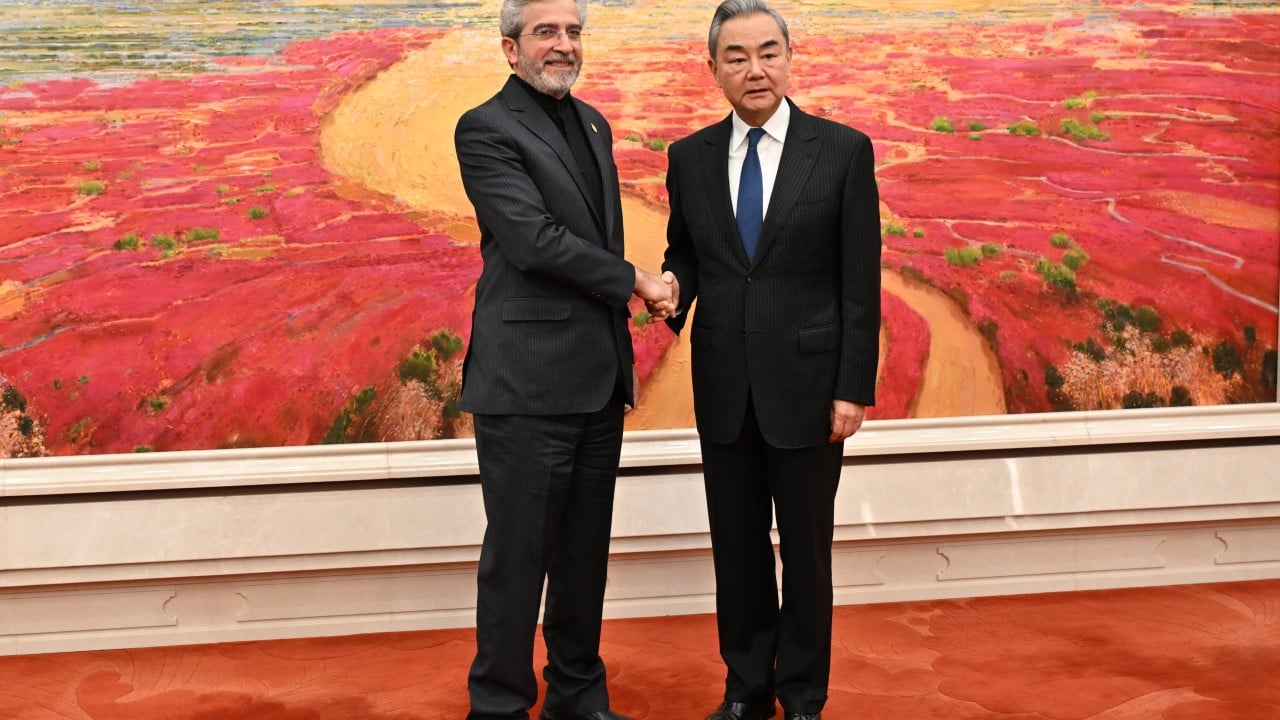
China’s top diplomat has again stressed the need for a political settlement to strife in the Middle East, telling a senior Iranian official in Beijing on Monday that armed conflict was not the way out.
“As conflicts in the Middle East drag on and risk further spillover, dialogue and negotiation remain the only viable path forward,” Wang Yi told Ali Bagheri Kani, deputy secretary of Iran’s Supreme National Security Council.
“All parties should … focus on a political settlement in a rational and pragmatic spirit instead of resorting once again to armed conflict.”
According to the Chinese foreign ministry, Bagheri Kani outlined Iran’s position on the regional situation, saying that Tehran would firmly safeguard its security, sovereignty and territorial integrity against pressure and threats, while remaining open to negotiations with all parties.
01:01
Houthi attack on Saudi airport kills 12, injures hundreds
Also on Monday, China announced that three special envoys would make a series of trips across the Middle East, the Red Sea and the Horn of Africa.
Ministry spokeswoman Mao Ning said Zhai Jun, special envoy on the Middle East, would travel to Iran, Oman, and Saudi Arabia between early and mid-November.
Liu Xianfa, special representative on African affairs, will also visit Ethiopia, Djibouti and Egypt, while Hu Changchun, special envoy for the Horn of Africa affairs, will travel to Eritrea in early November.
“Concurrent missions of Chinese envoys and special representatives to regional countries aim to promote talks for peace, de-escalate tensions and play a constructive role in maintaining regional peace and stability,” Mao said.
US President Donald Trump has repeatedly suggested that military operations against Iran could resume after the vote.
Iranian Supreme Leader Mojtaba Khamenei warned last week of “immediate, impactful” retaliation “without geographical limitations” if new strikes occurred.
Several Gulf Arab nations have reportedly been alerted by the US administration to prepare for a potential “short and intense” military campaign against Iran after the midterm elections.
Meanwhile, the conflict between Saudi Arabia and Yemen’s Iran-backed Houthi forces has escalated sharply following a series of cross-border missile and drone strikes on Saudi infrastructure, threatening vital shipping routes through the Red Sea.
Geographically, Egypt anchors the northern gateway of the Red Sea at the Suez Canal, while Eritrea and Djibouti in the Horn of Africa flank the Bab el-Mandeb Strait in the southern Red Sea, directly opposite Yemen and Saudi Arabia’s coast.
Djibouti hosts bases for various foreign armed forces, including China.
00:45
First PLA live ammunition drill in Djibouti
Ethiopia – the world’s most populous landlocked country with an estimated population of roughly 138 million people – is situated in the Horn’s interior and depends heavily on the Red Sea for maritime access.
The November missions will build on intensive diplomatic schedules in Beijing last month with key stakeholders in the conflict, including the United Arab Emirates presidential special envoy Khaldoon Al Mubarak and Saudi Arabian foreign ministry adviser Prince Khalid bin Bandar bin Sultan.
Two weeks ago, Wang met with his Djibouti counterpart Abdoulkader Houssein Omar and both countries called for secure international shipping routes through the Red Sea, the Horn of Africa and the Bab el-Mandeb Strait.
KioskNews shows a cleaned-up reading view extracted from the publisher’s page — the original always lives on their site, not ours.