China’s fifth plenum: cadre promotion rules overhauled, focusing on problem-solving
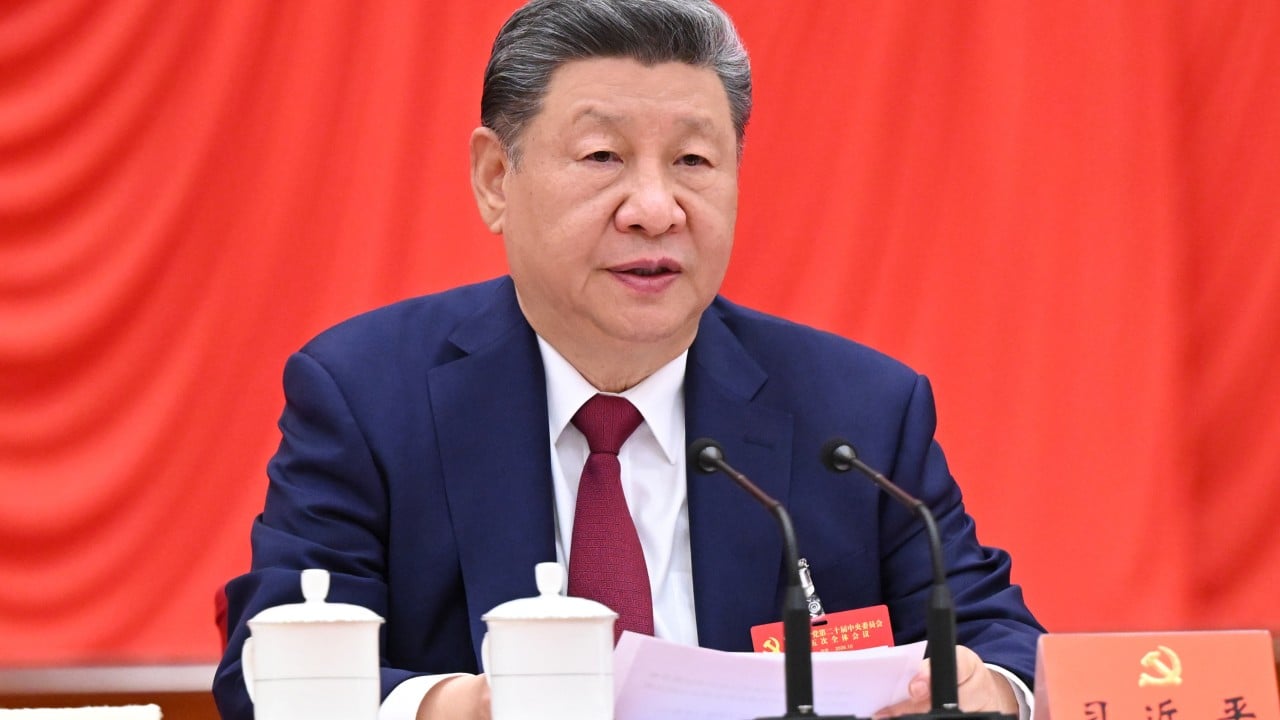
China’s ruling Communist Party has introduced sweeping rules to scrutinise officials’ crisis-tested experience and disciplinary records ahead of next year’s major leadership reshuffle.
The rules were included in a resolution adopted at the 20th Central Committee’s fifth plenum last Thursday and published by state news agency Xinhua on Sunday.
Analysts said that as provincial and ministerial reshuffles begin ahead of the 21st party congress, the fifth plenum sent a clear message: Beijing wants proven crisis managers and not credential-chasing bureaucrats steering the world’s second-largest economy through headwinds.
The personnel shake-up comes at a sensitive juncture for Beijing. Policymakers are trying to revive domestic consumer confidence, defuse local government debt risks and stabilise a bruised property sector, all while confronting a geopolitical and technological blockade led by Washington.
03:00
China’s fifth plenum focuses on discipline and loyalty to Xi
The policy blueprint on “certain major issues concerning persevering with full and rigorous party self-governance” called for forging a “high-calibre cadre team capable of shouldering the mission of national rejuvenation”.
The fifth plenum document instructed evaluators to judge officials based on their track record during “major critical junctures and when facing difficult challenges”.
Crucially, it directed the party’s personnel departments to abandon dogmatic promotion benchmarks. Cadres must not be judged solely on their “age, academic credentials or seniority”, the document stated.
It cautioned against appointments aimed merely at fulfilling demographic quotas in leadership teams at the expense of individual competence or leaning on paper qualifications while overlooking practical problem-solving skills.
The resolution also called for strict enforcement of term limits so that leadership posts and official assignments would not be constantly shuffled.
It urged tougher background checks before promoting officials. Vetting will require disclosing family ties and personal wealth, securing approval from anti-corruption investigators and evaluating any history of disciplinary warnings or citizen complaints.
While the party must maintain a healthy generational ladder spanning older, middle-aged and younger officials – as well as developing female cadres, members of ethnic minority groups and non-party figures – it cautioned against lowering vetting standards just to achieve structural balance on paper.
To stamp out factionalism, the plenum reiterated zero tolerance for “small circles”, patronage networks, nepotism and the buying and selling of official positions. It pledged to hold personnel departments strictly accountable.
In an accompanying explanatory note released on Sunday, President Xi Jinping said the decision to dedicate the plenum to party governance was an “inevitable requirement” to preserve the party’s ideological purity and secure its long-term rule.
The note also revealed that Xi personally led the high-profile team that drafted the document, joined by Politburo Standing Committee members Wang Huning, Cai Qi and anti-corruption chief Li Xi. The team formally began work in early February.
Xi highlighted a critical generational shift within one of the world’s largest political parties, noting that an increasing share of cadres and party members were born after the launch of the reform and opening-up era in late 1978. While the mainstream of the cadre corps was sound, Xi said, “many hidden dangers and problems” persisted.
“In particular, the issues of impure ideology, impure organisation and impure conduct have not yet been fundamentally resolved, while new problems continue to emerge,” he warned, adding that relentless self-scrutiny was needed to ensure the party “never changes its nature, its colour or its flavour”.
Beijing has long noticed a problem with “resume-burnishers, untested rapid risers to fill overly rigid age quotas and sycophants and flatterers” and sought to prioritise battle-tested administrators who have been rotated and have proper track records on various portfolios to higher offices of party and state, said Xie Maosong, a senior researcher at the National Institute of Strategic Studies at Tsinghua University.
“Previously, some cadres were put under faster rotations and promotion tracks,” he observed. “This has encouraged officials to pursue short-term, debt-fuelled vanity projects rather than seeing difficult structural reforms through to completion, leaving successors to clean up the mess.”
Xie described the comprehensive reform of the party’s human resource management as another “key pillar” of Xi’s party-building thought.
“Coupled with the postmortem anti-corruption drive and the party’s tightening of conduct and discipline measures, the new pre-mortem recruiting, evaluating, selecting and promoting officials forms a more complete process so that cadres ‘dare not, cannot and will not engage in corruption’,” he added.
KioskNews shows a cleaned-up reading view extracted from the publisher’s page — the original always lives on their site, not ours.