Economist Stephen Roach warns the US and China are in a ‘conflicted co-dependency’

A leading economist warned on Thursday that the United States and China are in a “conflicted co-dependency” that this year’s two bilateral summits failed to address.
“I think there’s a good chance that we’re in a temporarily more stable place. But to say that has solved the deep-rooted problems between us, I think is a real stretch,” said Stephen Roach, a veteran China-watcher and the former chairman of Morgan Stanley Asia, at the China Institute of America.
“You mentioned the two summits that we’ve had this year. Does that address these problems of what I would call a conflicted co-dependency? And you know, my answer is no, not at all.”
At the New York event titled “China’s Economy, America’s Risks – What Lies Ahead?”, Roach discussed the drivers reshaping the world’s economic landscape, touching on topics ranging from tariffs to artificial intelligence.
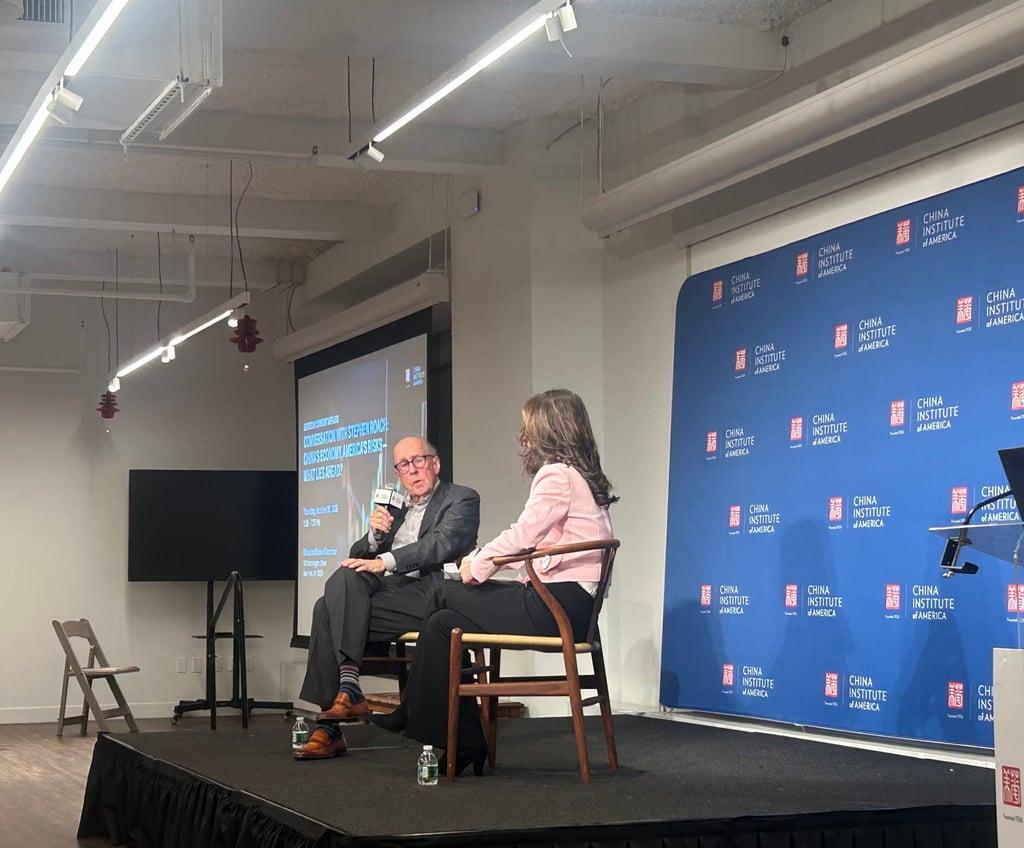
In Roach’s co-dependency analogy, both countries get feedback from one another, but changing perceptions can fuel tensions.
“You get your feedback from your partner, and when your partner changes his view of yours, that can lead to disagreement, friction, and inevitably conflict and a break-up,” said Roach, also a faculty member at Yale University and a contributor to the South China Morning Post.
This pattern became visible through tensions over China’s growing strength, followed by tariffs, sanctions, and the trade war, according to Roach.
“They’re both, I think, a visible manifestation of two countries that are fundamentally still at odds with one another,” he added.
Answering a question about the two countries’ “strategic, constructive stability”, Roach said: “The one word in that phrase, stability, is probably appropriate in terms of what Xi Jinping and Donald Trump would like for the next couple of years.”
04:30
China’s fourth plenum: party leaders call for boosting self-reliance against ‘raging storms’
Both leaders entered the summit facing economic hurdles at home. The US is contending with sky-high petrol prices due to the ongoing war in Iran, while China is dealing with high youth unemployment, a sluggish housing market and an export-driven growth model that continues to spur global trade tensions.
SCMP Plus is a new premium news platform that gives you an
all-inclusive edge to stay ahead on China news.
To access our exclusive content you’ll need to subscribe.
Already a subscriber?
LOG IN
Among its outcomes, the visit produced a tariff ceasefire extension and plans for targeted tariff reductions.
The White House released lists of non-sensitive goods worth US$30 billion recommended for tariff reductions on each side – US$60 billion in total – coordinated under the US-China Board of Trade, a bilateral body established during Trump’s state visit to Beijing in May.
The pair are due to meet twice more this year, at Apec in Shenzhen in November and the G20 in Miami in December, marking an unprecedented number of visits in just one year.
KioskNews shows a cleaned-up reading view extracted from the publisher’s page — the original always lives on their site, not ours.