Play that funky Turbine Hall! How artist Tarek Atoui aims to take the Tate on a sonic odyssey

Tarek Atoui is drumming the fingers of his right hand against the table. Listen! His left hand waves a cigarette at the surrounding world. So I listen. I can hear a busker on the riverside in front of Tate Modern and the hum of people walking the promenade. The low rumble of a plane flying over London and the wash of a boat under the bridge. You can identify a city by how it sounds, the artist is telling me, as much as by how it looks. And not only that! You can play a city, just like he is playing the table, so that it sings.
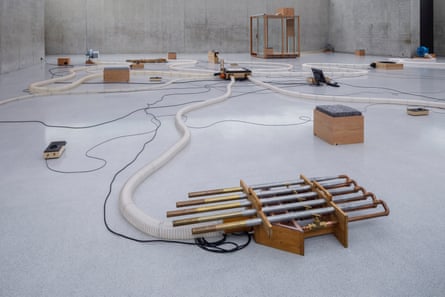
This is what Atoui, a musician and an impresario as much as an artist, does. He listens to the world around him, then he coaxes a tune out of it. Previous exhibitions have resembled recording studios in the midst of an especially far-out improvisation session, littered with instruments seeming to have been built out of scavenged materials on the instructions of a dream: someone might be playing a tentacular wind organ; wires might snake across the floor from a bleeping synthesiser; a glass booth may function like a walk-in flute, whistling around your body; marble boulders could emit woozy pulses, while drums beat to shifting patterns and your footsteps are picked up by microphones and fed back into the music. A world in miniature, made of sound.
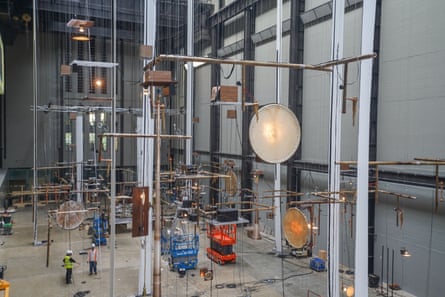
Tate Modern’s cavernous Turbine Hall – with its shifting audience of chattering day-trippers, overstimulated schoolkids and echoing acoustics – strikes me as a daunting venue for any artist working with sound. But Atoui, whose latest work is about to fill this space, is not “too worried” about these unpredictable elements, because his creations are less about the “ideal execution” of a finished piece of music than about giving a stage to the process. Transforming this enormous hall into one of his trademark “places for listening and playing” (ahead of the opening, he can’t divulge details) would mark only “the latest stage” in the movement of his work away from concert halls and “on to the street and into the market”.
It’s been a winding road. Having left Lebanon to study experimental music in France, Atoui fell under the spell of experimental composers such as Iannis Xenakis and György Ligeti. But this charming and inveterately curious figure “didn’t want to work in the music industry”, stuck on the treadmill of “making albums and touring”. Instead, he wanted to travel, meet people and learn from these encounters. One model for this way of living (and making art) was provided by Fluxus, a global network of artists and musicians that in the 1960s was heavily influenced by the composer John Cage. It’s a reminder that the open field of contemporary art has long offered space to musicians whose work exceeds the auditorium.
And so Atoui’s career can be charted by the places he has been and the people he has met, from revered Korean drum-makers to Palestinian children in refugee camps (for whom he developed software to compose sound through PlayStation joysticks). Perhaps the most transformative of these encounters was with students at the Amal School for the Deaf in Sharjah in the UAE through workshops that began with him using bass speakers to play frequencies so low that they are registered through the body. “I learned from working with deaf people that there is more than one way of hearing,” he says. Similarly, every space contains many worlds of sound.
Think about the “mosquito alarms” that deter teenagers from loitering by emitting an irritating whine beyond the range of adults, or the silent whistle that summons a dog. These arenas of sound overlap – and the one you live in is conditioned not only by the design of your body (the density of your skull, for example) but also by your emotions (how different a song sounds when you are happy). Then there’s your attention (that electrical buzz you do not hear until your partner mentions it). Atoui is interested in all of these worlds, and how they coexist.
His idea that we can “understand the world through sound” resonates with artists such as Lawrence Abu Hamdan. The joint winner of the 2019 Turner prize uses everything from gunshots to pirated mixtapes to reveal hidden stories. For his project Waters’ Witness, Atoui similarly records the ambient noise of the seas surrounding harbour cities from Istanbul to Sharjah. Of Athens, he says, “the waters around the Battle of Salamis are quiet now”, while Singapore’s marina is busy with “underwater explosions, military exercises, the noise of ships in the bay”. History is recorded in sounds as much as in pictures and words.
Atoui’s exhibitions fulfil several functions. When no one is performing in the space, the handmade instruments are sculptures that can be appreciated for their craftsmanship. During the improvisation sessions and workshops integral to Atoui’s work, the exhibition becomes something more like a “concert hall or educational space”. What’s key is the idea that hearing cannot be separated from the other senses: what we see and feel in the space is as important as what we hear.
Indeed, for all that Atoui works with instrument-makers, experimental musicians and sound researchers, his most important collaborator is the audience. Visitors to his recent exhibition in Milan could stay for five minutes or an afternoon, could sit still or move through a space crowded with sounds. The artist in Atoui’s mould doesn’t spoonfeed you a song or an image, but instead provides a space to explore and some tools to be used. He makes no attempt to “anticipate” or to “determine” the visitor’s experience. You must make of it what you will.
For Atoui, the process of composition is as much about bringing people together to improvise as it is about arranging harmonious patterns. He tells me that he hopes to transform the Turbine Hall into “a realm in which people can listen, can play”. Not as an escape from the everyday routine, but as something that might enliven it. “I want to encourage people to play in their own lives,” he says, because everything in Atoui’s life finds its way into his work: every place, person, conversation. “Even this one?” I ask. “Including this one!” says Atoui with a laugh, and lights another cigarette.
-
Tarek Atoui’s Hyundai Commission is at Tate Modern’s Turbine Hall, London, from 13 October until 11 April 2027
KioskNews shows a cleaned-up reading view extracted from the publisher’s page — the original always lives on their site, not ours.