Israel’s match with Republic of Ireland will be an eerie occasion as political debate rages on

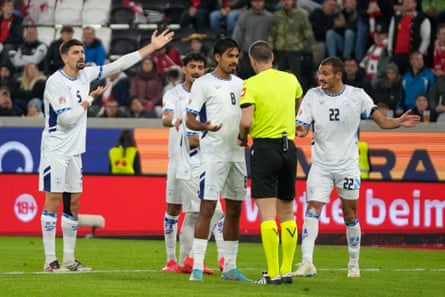
The match is being played in a neutral country and the stands are likely to be empty but Sunday’s Nations League fixture between Israel and the Republic of Ireland will nonetheless have the eyes of the world upon it.
Since February’s draw paired the sides against each other, voices across Irish society have demanded a boycott of the match. The Republic of Ireland’s government says Israel is committing genocide through its military action in Gaza, and the Football Association of Ireland (FAI) wants Israel suspended from international competition. But unless Ireland’s players decide not to take the field in the Hungarian city of Debrecen, the match will go ahead.
The debate over these two upcoming games, with Ireland to “host” Israel in a return fixture behind closed doors in the Serbian town of Backa Topola on Sunday week, has continued for months. But the temperature has risen as the first fixture approaches. Remarks made by the Ireland head coach, Heimir Hallgrímsson, that his side were “playing against genocide” prompted a stern response this week from the Israel Football Association (IFA), which accused the Icelander of “ignorance, hypocrisy and stupidity”. Hallgrímsson was then backed publicly by the Taoiseach, Micheál Martin, who described the IFA’s remarks as “unacceptable” and said they should be withdrawn.
At the same time as Martin’s intervention his government faced protests by Irish fans who want the game called off. One organisation, Stop the Game, criticised the “hypocrisy” of Irish sports ministers announcing they would refuse to attend the fixture on principle, while also failing to support a boycott. Another group, Irish Sport for Palestine, published an open letter signed by more than 160 athletes calling for the players to act where their leaders wouldn’t. “Not playing the game would be the most sporting thing you could do,” the letter said. “Through your leadership and courage it would show the power of sport to unite, remind us of the shared values that connect us all, and have an impact far beyond the game.”
It is clear that all this scrutiny is being felt by Hallgrímsson’s squad. Before Thursday night’s Nations League defeat in Kosovo, Dara O’Shea said the squad had found themselves in a “difficult” and “unusual” position, and had agreed to decide a collective approach to the match in Debrecen. “It’s something that can’t be brushed over,” O’Shea said. “Whatever decision that we go through as players is taken as one and everybody’s view is respected as well.” That decision is expected to stop short of a boycott, however. The midfielder Jason Knight, speaking after Thursday’s game, said: “I don’t think the game should be going ahead but it is going ahead.”
It has been a winding road for the FAI to get to this point. Last November its general assembly voted to request that Uefa suspend Israel from its competitions for a breach of its statutes. At the same time its president, Paul Cooke, said Ireland would play Israel if drawn against them in Uefa competition. In June the FAI said Uefa had granted a request that its home fixture be played in a “neutral venue and behind closed doors” owing to the “operational challenges” of delivering a fixture against Israel on home soil. In July, at an extraordinary general meeting, FAI delegates confirmed their support for playing the fixture, voting in favour by 68% to 32%. The given justification related to concerns over “the profound impact that any non-fulfilment of Uefa fixtures would have on Irish football as a whole”.
Those calling for a boycott have pushed back on the concerns “nonfulfilment” would have had on Irish prospects, pointing to recent punishments meted out to Latvia, Lithuania and Estonia. Those three each boycotted fixtures against Belarusian teams and Uefa responded with the traditional sanction of a 3-0 walkover and, in one case, a €5,000 fine.
after newsletter promotion
Irish media will limit their engagement with the match, with the broadcaster RTÉ showing the game live but with no studio coverage and with commentary from the international feed. Israel, meanwhile, are expecting no more than 100 supporters to attend this “home” match, with the tickets largely purchased by fans living in Hungary. Each of these elements will further contribute to what is likely to be an eerie encounter in Debrecen. Both teams need a win after opening defeats, Israel losing in Austria, but there can have been few international matches where the result has been of less import to those watching.
KioskNews shows a cleaned-up reading view extracted from the publisher’s page — the original always lives on their site, not ours.