Millions of hacking attempts as companies, governments rush to patch PHP flaws
Already have Rappler+?
to listen to groundbreaking journalism.
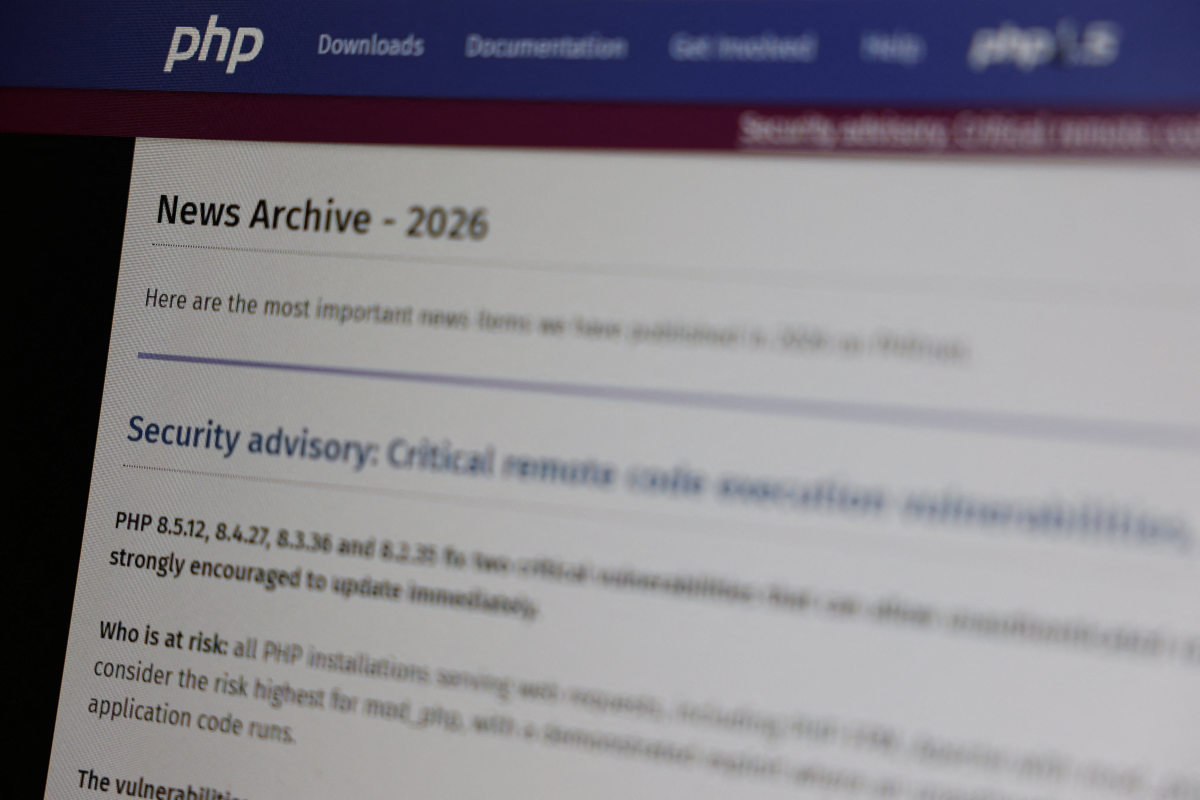
PHP SECURITY ADVISORY. A security advisory is displayed at the PHP website on a computer in Guernica, Spain, October 22, 2026.
Vincent West/Reuters
The emergency shutdowns of banking, airline, rail, tax and government services show how much public and corporate systems rely on PHP, and how hard it is to fix such flaws quickly once they are made public
AT A GLANCE
- Companies and governments globally rushed to patch critical vulnerabilities in the PHP programming language after millions of hacking attempts were reported following the disclosure of these flaws.
- Emergency shutdowns of various services, including banking and government websites, were implemented as a precaution, highlighting the reliance on PHP and the challenges in quickly addressing such vulnerabilities.
- Cybersecurity firms reported a surge in hacking attempts, with companies urged to update their systems immediately, while several governments initiated inspections and raised cybersecurity alert levels in response to the vulnerabilities.
This is AI-generated. Read the article for full context. Report any errors.
Companies and governments worldwide rushed on Thursday, October 22, to patch critical flaws in the widely-used PHP programming language, as a cybersecurity company reported millions of hacking attempts after the vulnerabilities were disclosed.
The push came after governments in Europe and elsewhere took websites offline as a precaution on Wednesday while website operators scrambled to secure systems running the software.
The emergency shutdowns of banking, airline, rail, tax and government services from Tokyo to Helsinki showed how much public and corporate systems rely on the software, and how hard it is to fix such flaws quickly once they are made public.
“It was a long day and a long night, I know for all the IT and security folks … I’ve not seen anything like this in a long, long time,” Microsoft CEO Satya Nadella said at a company event in Cologne, Germany, on Thursday.
He said the episode underscored the importance of building digital systems that can be maintained securely.
PHP developers released urgent fixes on Wednesday for vulnerabilities that had lurked in the software for years until they were uncovered using AI, urging users to “update immediately”.
“Details of these flaws became public before fixes were ready, and attacks have since been reported,” said Madeline Lawrence, co-founder of Belgian cybersecurity firm Aikido Security.
“So companies are racing to update against attackers who can use AI to exploit them. That’s the whole race.”
As companies and governments deployed patches and suspended websites as a precaution, hacking attempts surged into the millions, according to cloud services firm Cloudflare.
“In the 10 hours before it was publicly announced, across the network we saw thousands of attempts to exploit it,” Cloudflare CEO Matthew Prince said in a post on X late on Wednesday.
“That jumped to tens of thousands in the 45 minutes post announcement, hundreds of thousands within 2 hours, and millions now.”
From Japan to Finland
Japanese companies including brokerage Nomura, lender Mitsubishi UFJ Financial Group, airline ANA, and East Japan Railway said on Thursday they were temporarily suspending some internet services as part of emergency measures.
Insurer Tokio Marine Holdings said it had suspended the website of a group company.
Japan’s Ministry of Finance and Meteorological Agency partially suspended online services to implement safety measures, while Japan’s National Tax Agency temporarily took down its service.
The precautionary shutdowns underscore growing concerns over cybersecurity in Japan, which recorded more cyber incidents in the first nine months of the year than in all of last year, according to data from TrendAI.
French telecoms group Orange said it had temporarily suspended access to certain PHP-based websites and applications across several subsidiaries as a precaution.
Tencent Cloud, one of China’s largest cloud-computing providers, urged customers to install updated PHP versions but stopped short of calling for widespread website shutdowns.
Finland’s state IT services provider Valtori said it had continued installing PHP security patches overnight and was gradually lifting precautionary service blocks after shutting down government public web services a day earlier.
“Restoring services can take days or even weeks, as in addition to updates, the systems need to be carefully tested,” Valtori Director General Hannu Naumanen said in a statement.
Valtori said the outages were not caused by exploitation of the vulnerabilities or by a cyber breach, and that it was not aware of any active exploitation of the flaws.
Several Asian governments ordered cybersecurity inspections related to the PHP vulnerabilities on Thursday.
China’s industry ministry urged organizations and users to inspect systems immediately and upgrade to the latest secure version of PHP. It also recommended strengthening cybersecurity monitoring and changing accounts, passwords and keys where necessary.
South Korea raised its private-sector cybersecurity alert level and activated emergency response measures, citing concerns over an increased risk of hacking attacks. – Rappler.com
KioskNews shows a cleaned-up reading view extracted from the publisher’s page — the original always lives on their site, not ours.