Taiwan in Time: Making the Grand Hotel grand
From a two-story, 36-room structure to an iconic Taipei landmark, the hotel expanded and grew increasingly extravagant as it hosted presidents, kings and other visiting dignitaries
By Han Cheung / Contributing reporter


Sept. 21 to Sept. 27
When the Shah of Iran became the Grand Hotel’s (圓山大飯店) first head-of-state guest in 1958, it was hardly the landmark it is known as today.
A Chinese-style, two-story structure with just 36 rooms built on the former site of the Taipei Shinto Shrine, the hotel was still referred to as its original name, the Taiwan Hotel (台灣大飯店), in an official newsreel detailing Mohammad Reza Pahlavi’s visit.
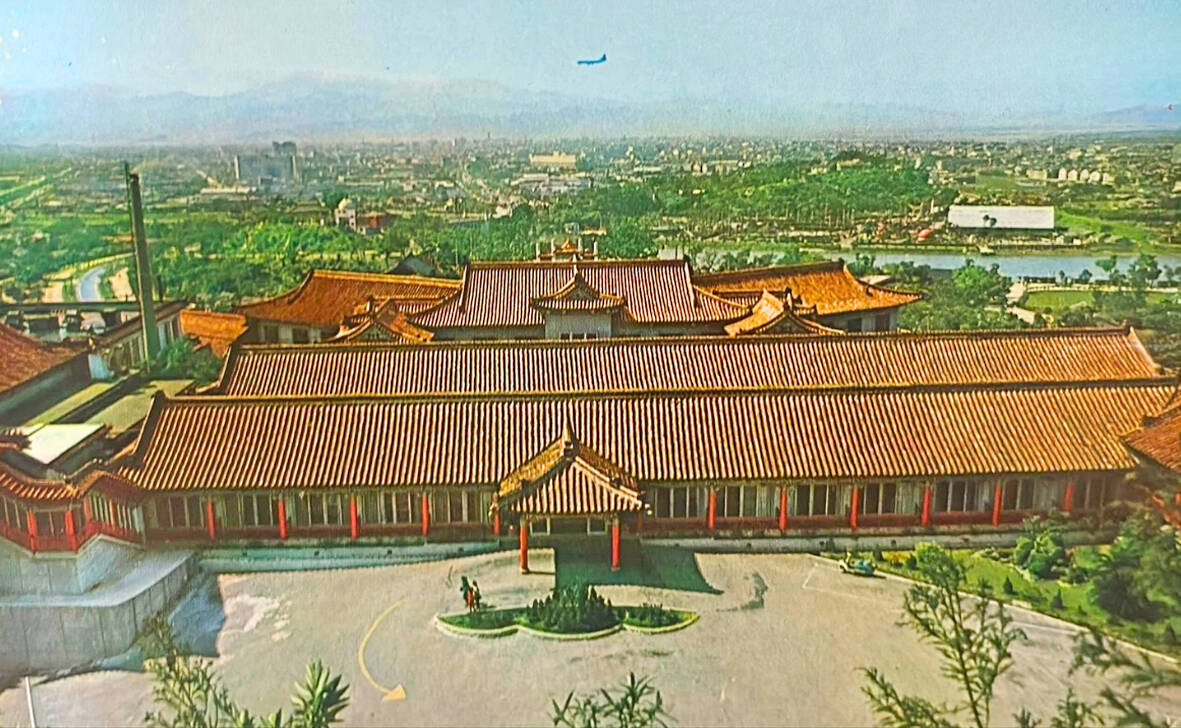
An undated vintage postcard showing the Golden Dragon Hall.
Photo courtesy of Stephen Liu
The video lavished praise on the hotel, pointing out its “beautiful architecture and magnificent appearance” and noting that it had just been renovated.
After being greeted personally by then-president Chiang Kai-shek (蔣介石) at the airport and receiving a military welcome, foreign dignitaries typically rode with Chiang in a motorcade, with guard cars and motorcycles leading the way. They traveled down Dunhua N Road, east on Nanjing E Road and then north on Zhongshan N Road for the 9.5km journey to the Grand Hotel.
Tens of thousands of spectators lined the route waving flags and cheering, while music and folk performances, including dragon dances and stilt walking, were staged.
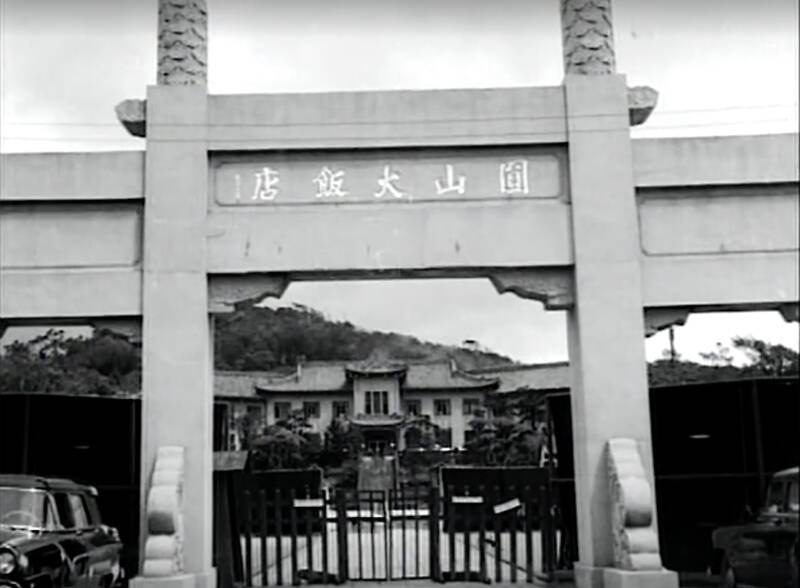
The archway to the original, two-story Grand Hotel in 1959.
Photo courtesy of Taiwan Film and Audiovisual Institute
On the last night of his six-day stay, the Shah held a banquet for Chiang and his wife Soong Mei-ling (宋美齡) at the larger Golden Dragon Hall (金龍廳), which had been added in 1956. The ornate, palace-style Qilin Hall was completed in 1963, featuring a luxurious presidential suite. In 1967 or 1968, Fortune magazine named the Grand Hotel one of the world’s top 10 hotels.
But there was still room to grow. In 1973, the bright-red, 14-story main building replaced the original hotel, adding 640 rooms and state-of-the-art facilities.
FROM SHRINE TO GUESTHOUSE
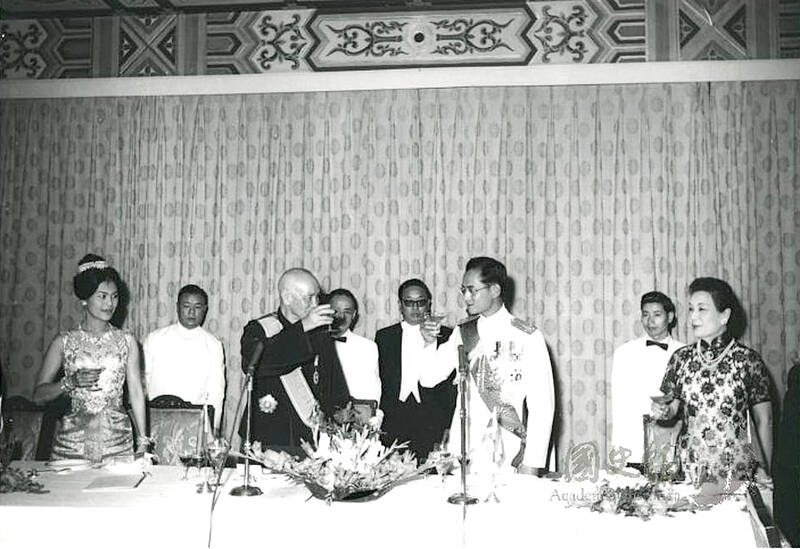
Then-President Chiang Kai-shek and then-King of Thailand Bhumibol Adulyadej raise their glasses during a banquet at the Grand Hotel on June 7, 1963.
Photo courtesy of Academia Historica
The site of the Grand Hotel originally hosted the shinto Taiwan Grand Shrine. Built in 1901 by the colonial government to honor Prince Kitashirakawa Yoshihisa, who died during the 1895 Japanese campaign to take control of Taiwan, it was upgraded to Grand Shrine status in 1944. But before its inauguration, it was heavily damaged when an aircraft crashed into it.
A bronze dragon fountain that once stood outside the shrine was preserved and moved to the Golden Dragon Hall. In 1987, it was gilded with 24-karat gold leaf.
After the war, the Chinese Nationalist Party (KMT) dismantled the remains of the shrine. The exact chronology of the postwar years is unclear, but the government began developing the former shrine site as a place to host foreign dignitaries.
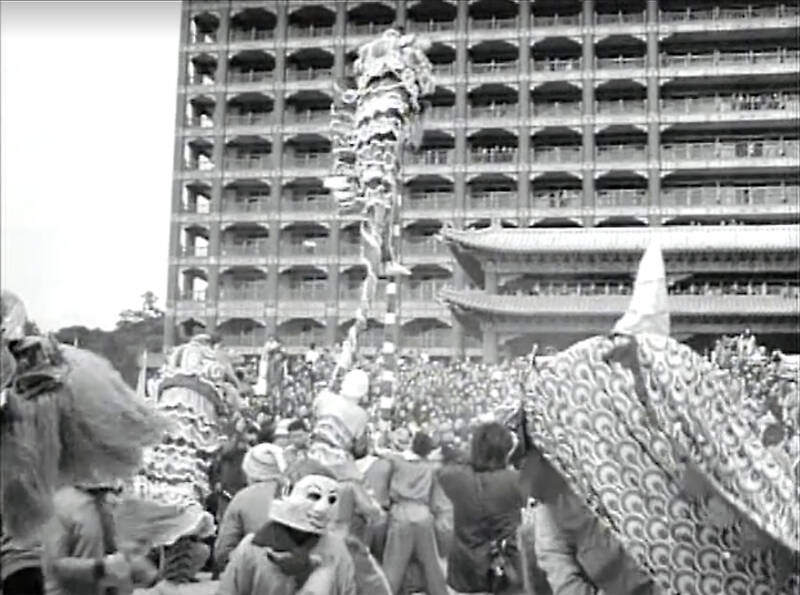
To celebrate the inaugural Tourism Day, traditional folk performances were staged in front of the Grand Hotel on Feb. 21, 1978.
Photo courtesy of Taiwan Film and Audiovisual Institute
Most sources indicate that a small, 36-room Taiwan Hotel was completed around 1951 and initially managed by the state-run Taiwan Travel Agency. In 1952, it was taken over by the The Duen-Mou Foundation of Taiwan (台灣敦睦聯誼會), led by Soong, and renamed the Grand Hotel.
Soong appointed her niece and goddaughter, Kung Ling-wei (孔令偉), as the hotel’s general manager. Kung enjoyed considerable privilege growing up and reportedly was a headache even for Chiang Kai-shek. She wielded considerable authority over hotel affairs, even after a board of prominent political figures was established in 1961.
Kung resided in a house on the complex, accessible through the eastern escape tunnel. Both the house and tunnel were opened to the public in 2021.
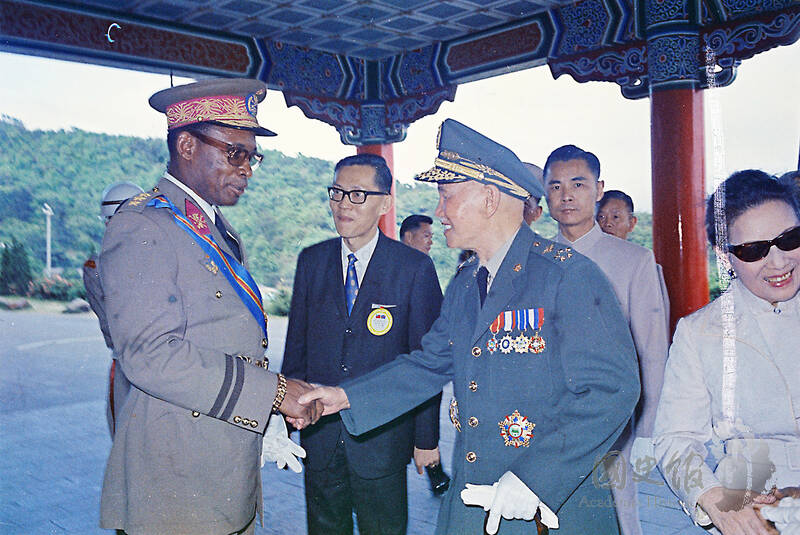
Then-President Chiang Kai-shek shakes hands with Mobutu Sese Seko, then-president of the Democratic Republic of the Congo, in front of the Grand Hotel in April 1971.
Photo courtesy of Academia Historica
LAVISH EXPANSION
With US support and aid growing and more countries opening diplomatic missions in Taipei, the hotel expanded its facilities, writes Lee Jung-chien (李榮建) in the book Memories of Yuanshan (記憶園山). The Golden Dragon Hall was added in 1956, followed by the Cui Feng Hall in 1958. Both were designed by Yang Cho-cheng (楊卓成), who later used a similar fusion of traditional palace-style and modern architecture in his designs for Chiang Kai-shek Memorial Hall and the National Theater and Concert Hall.
According to the book’s anecdotes, later dignitaries began staying at the Golden Dragon Hall, including then-US president Dwight D. Eisenhower, whose entourage booked 90 rooms for his two-day stay in 1960.
The next expansion was the opulent, three-story Qilin Hall (麒麟閣), which was built by Chinese Civil War veterans on a flattened hill. Opening in May 1963, it had 70 rooms — including a presidential suite designed specifically for heads of state. It was connected to the Golden Dragon Hall via skybridge.
The first heads of state to stay there were then-King of Thailand Bhumibol Adulyadej and Queen Sirikit, who spent three nights there in June 1963.
In 1970, the original main building was torn down to make way for the 14-story current structure. Yang was enlisted for the job once more. Legend has it that Kung, who also oversaw previous expansions, found the original 12-story, 200-room design insufficiently grand and ordered it torn down mid-construction and rebuilt on a larger scale.
Not only was it lavishly adorned with traditional palace-style motifs and decorations, but each room also had an AM radio and a 19-inch color television. In addition to dim sum, Chinese banquet and an American-style barbecue restaurant, there was also a bar and two 24-hour coffee shops. The presidential suite had a private entrance, a dining room for 10 to 12 people and a kitchen.
NOTABLE EVENTS
On Dec. 15, 1978, the US and China announced that they would establish diplomatic relations and break ties with Taiwan. The news sparked outrage in Taiwan. When then-deputy US Secretary of State Warren Christopher landed at Songshan Airport to meet with officials, his passage to the Grand Hotel was anything but smooth.
Once his car left the airport gates, protesters began pelting it with tomatoes, eggs and other objects. A bamboo stick smashed through a window and scratched Christopher. Alarmed, he ordered the car to drive instead to the US military residences in Yangmingshan, avoiding the angry protesters waiting at the foot of the hill leading to the Grand Hotel. Only after the protesters had dispersed was he able to check in.
On Sept. 28, 1986, with Taiwan still under martial law, the Democratic Progressive Party defied the ban on new political parties and held its inauguration ceremony at the Grand Hotel. Although the Chinese Nationalist Party (KMT) refused to recognize the new party, it did not take drastic action to suppress it.
Filipino opposition politician Benigno Aquino also spent his final nights at the Grand Hotel in July 1983. He was assassinated upon arriving in Manila.
On June 27, 1995, a huge fire broke out on the top floor of the Grand Hotel. A flame ignited during repair work on the tiles of the penthouse’s glass room and, fanned by strong winds, soon spread across the roof, engulfing the top floor. A total of 104 fire trucks, ambulances and aerial ladders rushed to the scene, while about 100 military police also joined the effort. Three hours later, the fire was extinguished, but the top three floors were completely damaged, along with valuable artifacts and furniture in the presidential suite.
A lawmaker reportedly proposed rebuilding the hotel as the new Legislative Yuan, but the idea was quickly shot down. During the three years it took to repair the damage, international dignitaries and important banquets and conferences were moved to other hotels, breaking the Grand Hotel’s monopoly.
However, it reopened in June 1998 with a fireworks ceremony and a newly illuminated roof, making the hotel even more grand.
Taiwan in Time, a column about Taiwan’s history that is published every Sunday, spotlights important or interesting events around the nation that either have anniversaries this week or are tied to current events.
KioskNews shows a cleaned-up reading view extracted from the publisher’s page — the original always lives on their site, not ours.