Measure food systems progress not only by productivity but also ability to deliver healthy diets – AGRA
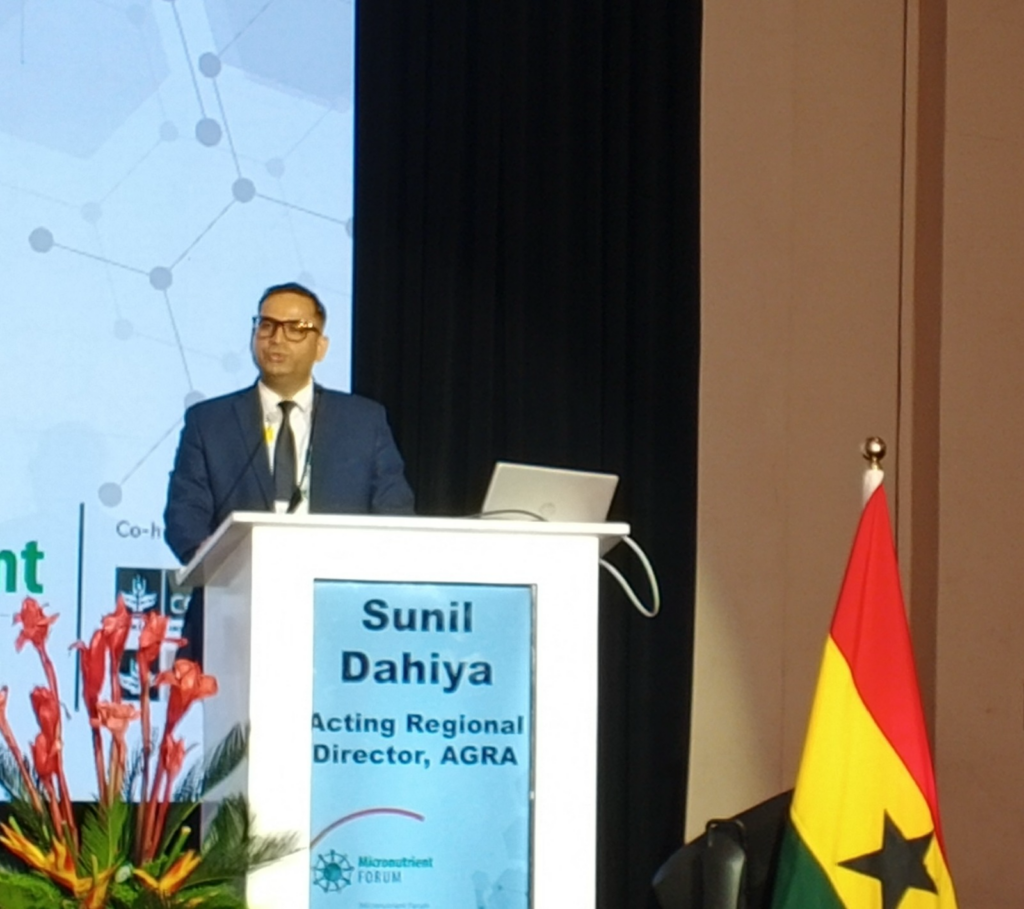
AGRA West Africa’s acting Regional Director and Senior Program Officer for Inclusive Markets, Trade and Finance, Sunil Dahiya, says food systems progress should be measured not only by their productivity but also by their ability to deliver healthier diets.
Speaking at the Micronutrient Forum’s 7th Global Conference in Accra, Ghana, he said, “At AGRA, we no longer see nutrition as the end of the food systems story. We see it as a measure of success. If we raise productivity but diets stay poor, we have fallen short.”
Held under the theme “Nutrition at the Frontiers of a Changing Environment,” the four-day conference brings together stakeholders from around the world to advance collective action on nutrition and micronutrient deficiencies.
The conference is being held at the official invitation of the Government of Ghana, with backing from the African Union (AU), and co-hosted by the CGIAR.
https://youtu.be/4SjNVlZyjb8
Mr. Dahiya recounted how after a failed rainy season, families in the Sahel may still have staple crops for calories but often lose access to nutrient-rich foods such as vegetables, beans, eggs, fish and milk. “Climate change is not only shrinking Africa's harvests. It is emptying our plates of nutrients,” he said.
Adding that as nutritious foods become scarce and expensive, households rely more heavily on cheaper staples, increasing the risk of hidden hunger and micronutrient deficiencies, particularly among children.
“Even the crop is changing. Research shows that higher carbon dioxide levels reduce the zinc and iron in staples like rice and wheat. The bowl looks the same, but there is less nutrition in it,” Mr Dahiya added.
He noted the Intergovernmental Panel on Climate Change (IPCC) estimates that climate change has already cut Africa's agricultural productivity growth by about a third since 1961, more than in any other region.
“We have limited irrigation, storage, insurance and social protection. And Africa contributes less than 4% of global emissions. So this is a question of fairness as well as science,” he said.
Drawing on lessons from discussions at the recently concluded Africa Food Systems Forum, the AGRA official called for the development of resilient, nutritious seeds, enhanced trade to move nutritious foods across borders, better management of post-harvest losses, and more financing for nutrition projects.
“Climate-adapted and biofortified varieties, like iron-rich beans and vitamin A maize, must reach farmers through strong commercial seed systems, not only through pilots,” Mr. Dahiya said.
“When one zone fails, open borders could bring food from surplus areas to deficit areas. In West Africa, every barrier removed along a trade corridor is also a nutrition measure,” he added.
He called on stakeholders to invest in micronutrient resilience as much as they invest in climate resilience, to help ensure that every African child, every woman, and every family can get the nutrition they need to thrive, whatever the weather brings.
Vice President Prof. Jane Naana Opoku-Agyemang, who also spoke at the conference, said that at a time when many countries face fiscal pressures compounded by climate shocks, sustainable financing and strong partnerships will be essential to improving nutrition for people around the globe.
She called for sustained investment, stronger public institutions, and greater international cooperation in the fight against malnutrition.
DISCLAIMER: The Views, Comments, Opinions, Contributions and Statements made by Readers and Contributors on this platform do not necessarily represent the views or policy of Multimedia Group Limited.
Tags:
DISCLAIMER: The Views, Comments, Opinions, Contributions and Statements made by Readers and Contributors on this platform do not necessarily represent the views or policy of Multimedia Group Limited.
KioskNews shows a cleaned-up reading view extracted from the publisher’s page — the original always lives on their site, not ours.