When fever, dizziness point to something more
SINGAPORE - Tan Zi Ting was just six months old when she began experiencing repeated episodes of intestinal obstruction – blockage that prevents food or liquid from passing through the small or large intestine – in addition to other issues such as feeding difficulties and persistent constipation.
When she was taken to hospital, doctors told her parents that she had slow gut motility, referring to muscle movements within the gastrointestinal tract that move food through the digestive process.
The 23-year-old told The Straits Times that over the years her symptoms expanded to include a variety of ailments such as nausea, vomiting and high fevers, often requiring medical intervention.
Her condition meant she could not participate in activities such as physical education classes in school and going out with friends. She sometimes had to miss out on school entirely.
“Since it was there all my life, I kind of thought it was normal,” she said.
When Tan was 13 however, the obstructions became more intense, to the point that she could not walk when they occurred, resulting in her missing more than 40 days of school.
“I think that was when we realised that something was severely wrong, because it wasn’t just something that I could push through anymore,” she said.
Another patient, Louisa Lim began experiencing a persistent fever in 2021, shortly after getting married.
While tests showed it was not Covid-19, doctors were unable to determine the cause of her consistently high body temperatures, which reached temperatures of around 39 deg C for months on end, the 34-year-old said.
They diagnosed it only as a pyrexia, or fever, of unknown origin, she recalled, adding that other symptoms – including pain, dizziness and a burning sensation across her back – soon emerged, though tests and scans were unable to provide a cause.
“I was wondering, if my fever is a way of my body telling me something, then what is it?” said Lim, who was working in sales at the time.
Diagnosis and relief
Previously undergoing paediatric care at KK Women’s and Children’s Hospital, in 2021 Tan, who turned 18 that year, decided to continue her treatment at the National University Hospital (NUH).
At NUH Kewin Siah – a senior consultant with the hospital’s gastroenterology and hepatology division – worked together with Amanda Chan, a senior consultant from the neurology division, and others from different specialities to piece together the various symptoms Tan was facing in order to better understand her condition.
In 2021 Tan was diagnosed with small fibre neuropathy (SFN), a form of peripheral neuropathy – referring to conditions where nerves beyond the brain and spinal cord are damaged or dysfunctional.
Symptoms are varied and can be vague, and include painful tingling or burning sensations in the hands and feet, as well as heart palpitations and numbness.
The following year, following a clinical assessment and confirmatory skin biopsy, Lim was also found to have SFN.
She described the diagnosis as a relief.
“To finally know what it is meant I could get treatment,” she said.
As only small nerves in the body are affected, tests for large nerve fibres or the central nervous system can often appear normal, said the neurologist.
“It’s very hard to diagnose because not everybody has the access to these small fibre tests, and at the same time, it’s a relatively newly defined condition,” Chan added.
Siah said that SFN can often be identified only by piecing together the various symptoms a patient may be facing.
“Unless you think about it and put the symptoms together, a lot of patients won’t be getting the right diagnosis,” he said.
Chan noted that while current medical literature suggests that SFN is rare – affecting up to 50 per 100,000 people – its prevalence has gone up since the Covid-19 pandemic, with some studies suggesting anywhere between 25% to 50% of those with long Covid have the condition.
“It’s actually much more common than we think,” Chan said.
She added that this could be a result of the immune system going into overdrive when responding to an infectious disease and attacking the small nerve fibres as a result.
Lim said though she used to be very active – frequenting the gym up to twice a day – her condition put a stop to her physical activity, and she now relies on a walking aid to get around.
She was originally treated with oral medication to manage her pain, later progressing to intravenous immunoglobulin (IVIG) therapy, which involves the infusion of antibodies from healthy donors.
Though IVIG provided relief, the frequency of infusions was disruptive and its effects short-lived.
Lim said the disruptive nature of her treatments, coupled with brain fog, made it difficult for her to concentrate on her job and she opted to stop working.
In 2023, she was started on rituximab – a targeted immune therapy used to treat certain autoimmune diseases and cancers – which helped improve her condition, though her symptoms gradually return between treatment cycles.
For Tan, Siah oversees the severe constipation caused by her condition, working with the colorectal surgery team to develop a treatment plan, which improved her bowel function over time.
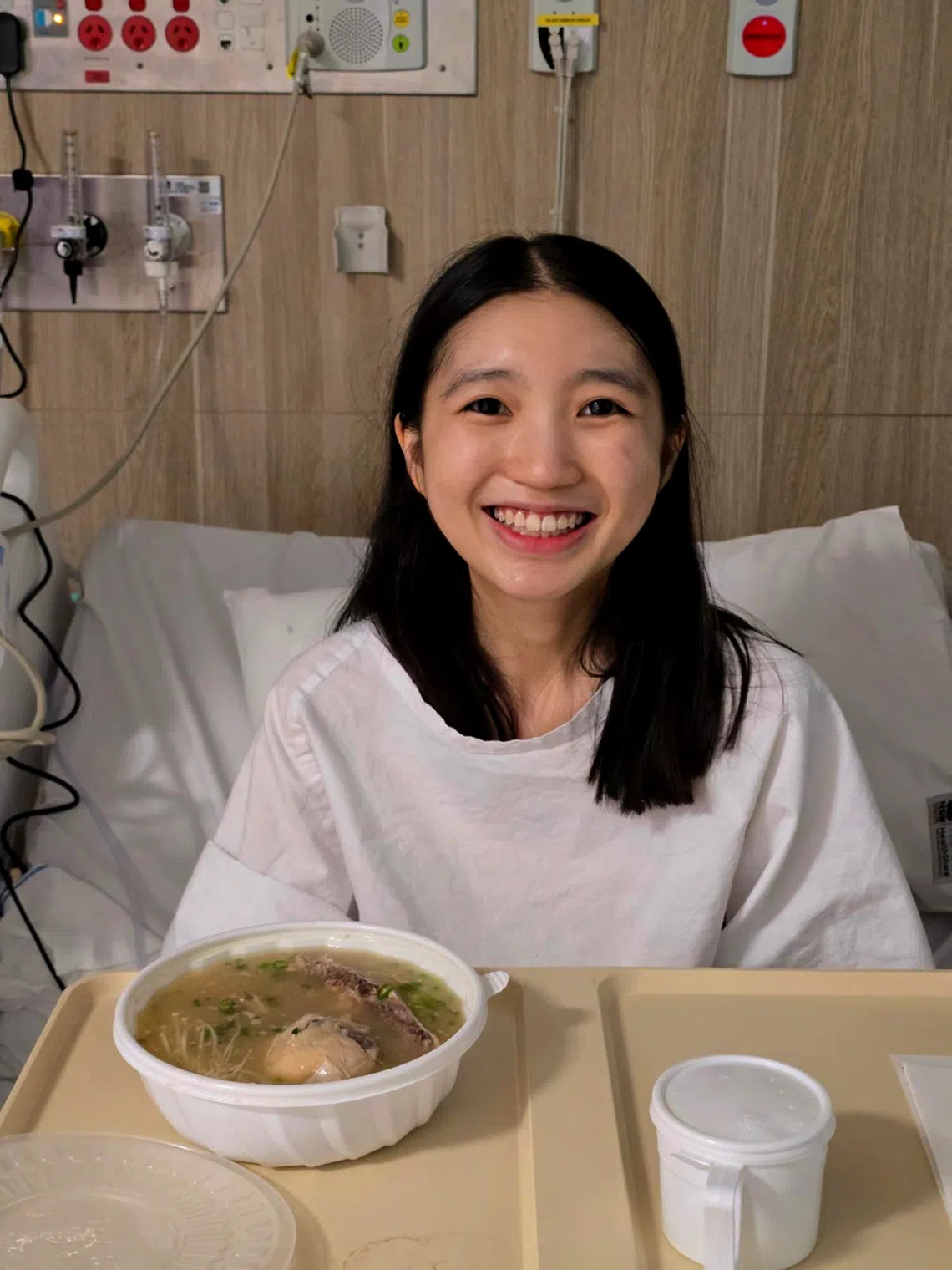
Small fibre neuropathy patient Tan Zi Ting in the hospital in April after her enteral tube revision surgery.
PHOTO: COURTESY OF TAN ZI TING
Both doctors are also contributing to research on how SFN is treated and understood.
Siah said that while Tan and Lim are faring relatively well, not all those with SFN are in a similar position, adding that up to 20% of patients “don’t do that well at all”.
Chan noted that in severe cases, the symptoms of SFN could including cardiovascular dysautonomia – a nervous system disorder which results in irregular heart rate or heart rhythms – which could lead to death.
Lim hopes to eventually return to her previous line, which she described as “quite fun” as she frequently travelled for work, though she understands her condition might necessitate something less hectic.
“I’m going to manage my expectations,” she said.
For Tan, learning more about her condition made her passionate about the science behind it, and she is now studying medicine at the University of New South Wales in Sydney, Australia.
She hopes to eventually specialise in gastroenterology, and in November will return to Singapore for an attachement at NUH.
“I think my condition gave me a very strong sense of purpose to be a doctor who shows patients that there is life beyond their diagnosis,” she said.
KioskNews shows a cleaned-up reading view extracted from the publisher’s page — the original always lives on their site, not ours.