2026 Elections: Referendum reignites debate over ‘non-nuclear homeland’ policy
A supporter of ending Taiwan’s “non-nuclear homeland” policy argued yesterday that restarting reactors could buy time for renewable energy to develop, while a government representative questioned the need for a referendum when restart assessments were already underway under existing law.
The two spoke at the second of five televised forums organized by the Central Election Commission ahead of the Nov. 28 referendum, which coincides with local elections. The ballot asks voters whether they support the government ending the “non-nuclear homeland” energy policy and using nuclear power to revitalize the economy.
Speaking in favor of the proposal, Chen Jong-shun (陳中舜), an associate research fellow at the Chung-Hua Institution for Economic Research’s Center for Green Economy, said Taiwan had grown too reliant on natural gas as renewable energy development fell short of expectations.
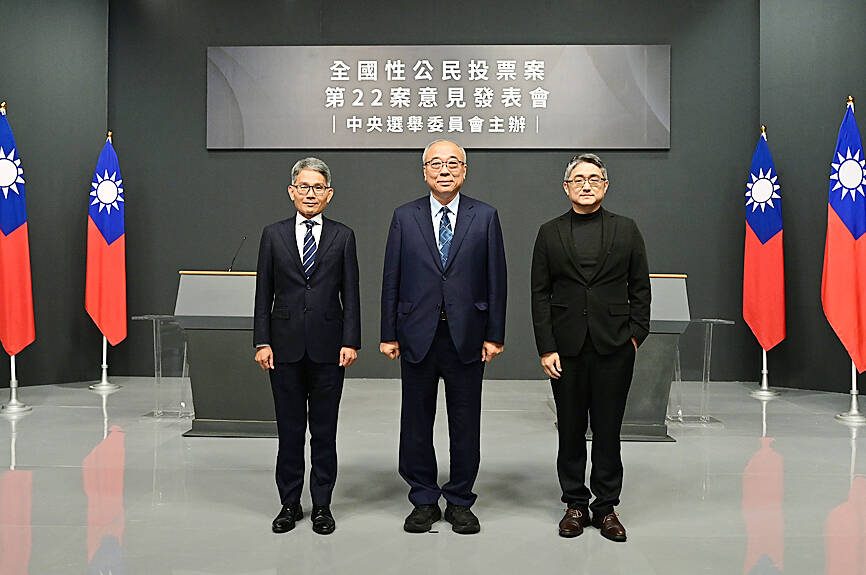
Vice Minister of Economic Affairs Lai Chien-hsin, left, and Chung-Hua Institution for Economic Research associate research fellow Chen Jong-shun, right, pose for a photograph in Taipei yesterday.
Photo courtesy of the Central Election Commission
“What Taiwan lacks most right now is neither goals nor technology, but time,” Chen said.
AI data centers and advanced chip plants can be built faster than major power infrastructure, Chen argued. Citing nuclear industry estimates, he said reactors could be restarted in 18 months to three years, helping meet demand for reliable, affordable and low-carbon electricity while Taiwan expands its renewable capacity.
Chen said he supported continued investment in renewables and saw nuclear power as a way to diversify the electricity mix. Restarting the No. 2 and No. 3 nuclear power plants would also reduce Taiwan’s reliance on shipments of liquefied natural gas, he said.
Vice Minister of Economic Affairs Lai Chien-hsin (賴建信), arguing against the proposal, said that Taiwan’s economy had grown and its exports risen as nuclear power’s share of electricity generation declined.
“Nuclear power is not a cure-all for the economy,” Lai said, pointing to industrial upgrading and the strength of Taiwan’s supply chains.
The government remained open to nuclear power, Lai said, and state-run Taiwan Power Co (Taipower) was already assessing whether existing plants could safely resume operations under the amended law. The checks include looking for deterioration caused by years of exposure to radiation or corrosion.
“A referendum cannot replace the rigorous reviews required by law, nor can it dispense with scientific verification of the structural safety of equipment,” Lai said.
Even if the No. 2 and No. 3 plants were found safe and their restart gained public acceptance, their combined output would be equivalent to only about 10 percent of Taiwan’s current electricity generation, Lai said. He added that any decision would also have to address nuclear waste disposal.
Taiwan shut down its last operating reactor at the Maanshan Nuclear Power Plant on May 17, 2025, fulfilling a longstanding pledge by the ruling Democratic Progressive Party to phase out nuclear power.
On March 21, President William Lai (賴清德) said the Ministry of Economic Affairs had determined that Maanshan and the No. 2 Nuclear Power Plant in New Taipei City’s Wanli District (萬里) met the conditions to begin the restart process and that Taipower was preparing the next steps.
Lai cited rising electricity demand from artificial intelligence, the European Union’s Carbon Border Adjustment Mechanism and growing geopolitical risks, while reaffirming his support for renewable energy.
KioskNews shows a cleaned-up reading view extracted from the publisher’s page — the original always lives on their site, not ours.