Standard Chartered CEO calls for AI guardrails, says human judgment remains key to jobs
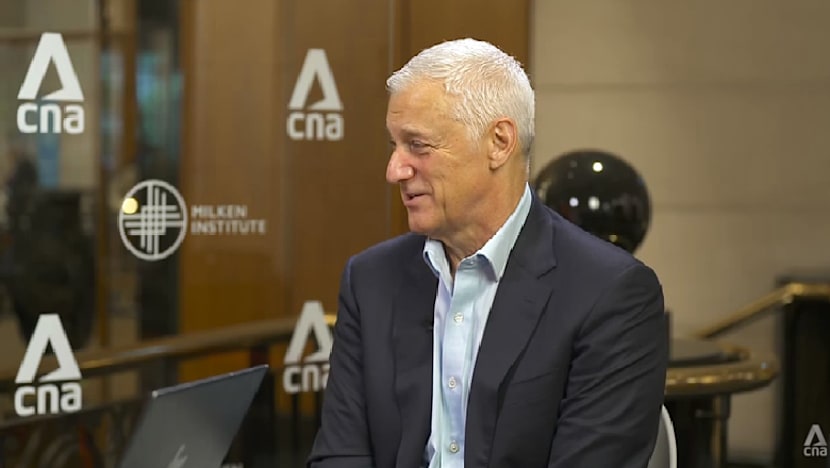
In an exclusive interview with CNA’s Julie Yoo, Mr Bill Winters also discusses the contrasting fortunes across China's economy and the impact of the Middle East conflict on Gulf nations.
New: You can now listen to articles.

This audio is generated by an AI tool.
09 Oct 2026 04:44PM
SINGAPORE: Stronger regulation and greater international cooperation are needed to manage the growing risks of artificial intelligence, Standard Chartered Group CEO Bill Winters said on Friday (Oct 9).
Speaking to CNA on the sidelines of the Milken Institute Asia Summit at the Four Seasons Hotel Singapore, Mr Winters discussed the opportunities AI presents for businesses, alongside concerns over cybersecurity and its impact on jobs.
In the wide-ranging interview, he also shared his outlook for China's economy and his views on how the prolonged Middle East conflict is affecting Gulf nations.
The three-day summit, held from Oct 7 to 9, brought together business and government leaders to discuss economic and geopolitical challenges, with AI a key focus of this year's event.
AI RISKS AND OPPORTUNITIES
Asked whether governments should intervene to address the risks posed by AI, Mr Winters called for greater regulation of the industry.
"I can think of very few industries that have needed regulation more than this one," he said.
"I mean, it takes three years to get a new aspirin formulation through various regulators, but we have not put any guardrails on AI."
Mr Winters acknowledged that technology companies intend to develop AI responsibly, but also highlighted geopolitical competition between the United States and China, with both countries concerned about the other gaining dominance in the technology.
"To me, there's never been a stronger – maybe second only to nuclear weapons – backdrop for cooperation between global players," he said.
Mr Winters said Standard Chartered is already using AI to develop new customer experiences and improve efficiency across its operations.
But he also warned that cybercriminals could use the technology to breach corporate security systems.
"It's also the best defence to have a really good, strong set of AI-based defensive capabilities," he said.
"So we're in an arms race. And I think we're holding our own."
Still, Mr Winters cautioned that the risks are unlikely to disappear.
"I don't think we will reflect a year, two, three years from now on this whole period and say, wow, it's amazing that nothing bad happened. Some bad things will happen,” he said.
AI AND JOBS
Asked about AI's impact on employment, Mr Winters said automation would change the nature of jobs at Standard Chartered, but would not necessarily lead to a smaller workforce.
While the bank has already automated almost 25 per cent of the roles it previously had, its overall headcount has increased, he said.
About 85 per cent of employees whose roles were displaced by automation have been reskilled for other positions, according to Mr Winters.
He added the bank would continue to invest in reskilling employees as AI became more widely used, with the skills required in an AI-driven workplace likely to be significantly different.
"Our job as a bank, as a corporation, is to offer our employees that opportunity to acquire those skills, and we are (doing so)," he said.
Asked which banking jobs would remain relevant over the next decade or two, Mr Winters said roles requiring human judgment or interaction would continue to be important.
In wealth management, for instance, digital tools can already provide investment guidance, but demand for human relationship managers remains strong, he said.
"People still trust people, and it's going to be a long time before we trust the machine over the person, even if we think the machine may have better information or may be smarter."
CHINA'S TWO-TIER ECONOMY
The interview also touched on China, where a prolonged property downturn has weighed on domestic demand even as emerging industries have expanded.
Asked which parts of the economy were attracting greater optimism and where businesses remained cautious, Mr Winters described contrasting fortunes across different sectors.
He highlighted rapid development in green technology, electric vehicles, batteries and advanced electronics, including semiconductor manufacturing.
These industries are helping transform China's industrial base, particularly through robotics.
Mr Winters said the property sector has not recovered, while other manufacturing industries are also under pressure from rising costs and tariffs.
He also noted that China's public finances were under strain as revenue from land sales, an important source of income for local governments, had declined.
Nevertheless, Mr Winters remained confident about China's economic outlook, saying the country still has fiscal and monetary policy tools available to support growth.
GLOBAL ECONOMY AND GULF RESILIENCE
Asked whether rising interest rates signalled trouble for the global economy, Mr Winters said economic growth remained resilient despite higher borrowing costs and persistent inflation.
He identified rising energy and food prices, along with supply-chain disruptions, including those affecting energy supplies from the Gulf amid the Middle East conflict, as factors keeping inflation elevated.
Still, Mr Winters said Gulf economies, including Saudi Arabia, the United Arab Emirates, Qatar and Oman, continue to function relatively well despite the conflict.
However, he acknowledged that the conflict had caused significant damage, particularly in Qatar, where important parts of the gas industry had been temporarily taken out of operation after Iranian strikes.
He also cited Saudi Arabia's escalating conflict with the Houthis in Yemen as another source of disruption.
While acknowledging the conflict's impact, Mr Winters said businesses across the Gulf were carrying on.
"It's impressive how resilient the region has been," he said.
KioskNews shows a cleaned-up reading view extracted from the publisher’s page — the original always lives on their site, not ours.