Taiwan, EU decide their ties, MEP says
BUILDING LINKS: Taipei and Europe should cooperate ‘so that no single supplier and no single government can hold our shared future hostage,’ an official said
By Lee I-chia / Staff reporter


Beijing has no say in Taiwan’s partnerships with European countries, Formosa Club acting chair Rihards Kols, a member of the European Parliament (MEP), told a forum in Taipei yesterday.
The Formosa Club, an interparliamentary group of European lawmakers, and the Ministry of Foreign Affairs cohosted the Trusted Technology Forum for Democracies, focusing on artificial intelligence (AI) and drone technologies.
In his opening speech, Kols said it is crucial that people meet and understand each other’s concerns, and work out how they can help.
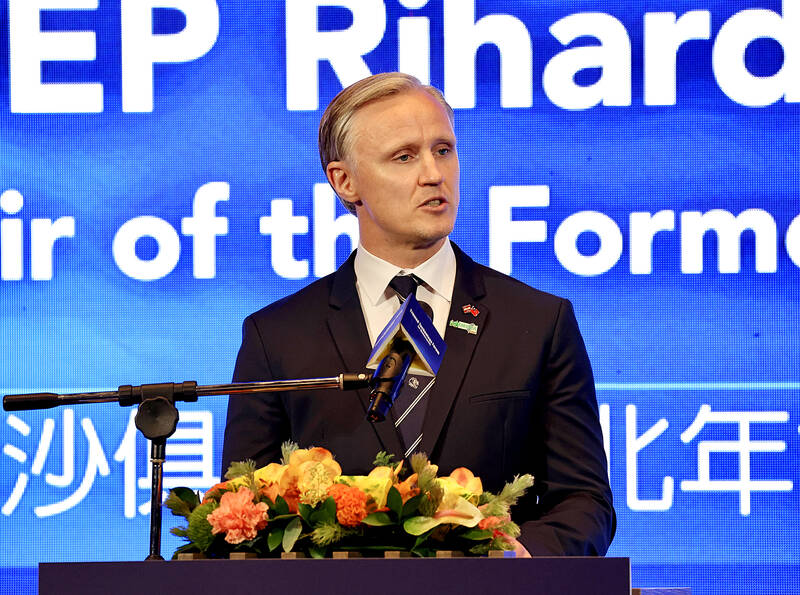
Member of the European Parliament and Formosa Club acting chair Rihards Kols speaks at the Trusted Technology Forum for Democracies in Taipei yesterday.
Photo: CNA
The club has brought European parliamentarians to the second annual forum to understand Taiwan better and seek opportunities for collaboration, he said.
There is a lot of common ground between Taiwan and Europe, he said.
Both want people to live freely and securely, businesses to succeed and to “make our own decisions without someone else threatening to punish us for that,” he said.
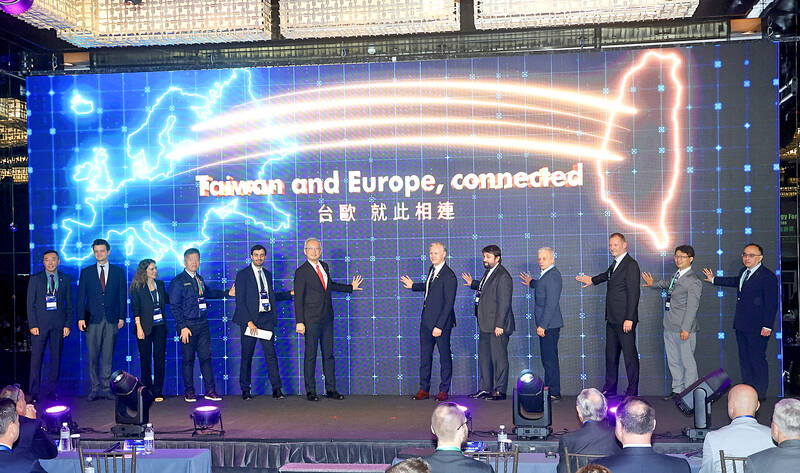
Deputy Minister of Foreign Affairs Francois Wu, center, left, and Formosa Club acting chair Rihards Kols, center, right, pose for a photograph with other event guests at the opening of the Trusted Technology Forum for Democracies in Taipei yesterday.
Photo: CNA
There is also a lot the two sides can offer to each other, such as Taiwan’s strengths in semiconductors, electronics and its growing drone industry, and Europe’s experience in manufacturing and industrial technology, he said.
Europe has learned a costly lesson about dependence from treating Russia’s energy as a commercial matter and dismissing warnings about political leverage, and the same mistake cannot be made with the technologies that factories, communications and defense systems rely on, Kols said.
“Before we buy a system, we should know: Who controls it? Where does the data go? Can we repair it?” he said, adding that these questions become more important when hospitals, electricity network and a country’s defense depend on it.
Russia’s invasion of Ukraine has shown how quickly military designs change and the importance of quickly producing and repairing equipment, he said.
Parliamentarians should work to bring trusted businesses, researchers, investors and policymakers closer together for technology cooperation, he said.
“The European Parliament has called for better market access, greater certainty for investors and closer cooperation with Taiwan on critical technologies. That matters to the company considering an investor, a researcher looking for an industrial partner, or a manufacturer seeking a reliable supplier,” he said.
“Beijing[’s] objections cannot give it a right to decide whom Europeans meet or which partnerships we build,” he said, adding that Taiwan and Europe should be able to pursue opportunities that serve mutual interests.
AI and drones are rapidly becoming fundamental to economies and security, but they carry a heightened vulnerability, Deputy Minister of Foreign Affairs Francois Wu (吳志中) said.
“In an age of geopolitical competition, authoritarian states are treating these technologies as tools of cohesion and related supply chains as instruments of power to challenge the status quo,” Wu said, adding that Taiwan and Europe feel it directly, from Russia and China.
“How do democracies keep the technologies they depend on in trusted hands?” he asked.
Taiwan stands at the heart of many of the world’s high-tech ecosystems, but its greatest contribution to the free world is not just what it makes, but that the nation’s partners can trust how Taiwan makes it and with whom, he said.
“Taiwan is committed to creating non-red supply chains that are secure, transparent and free of coercive control,” he said. “A stronger, more autonomous Europe and a trusted Taiwan are complementary, not competing.”
Europe leads industrial-based world-class research and a drive toward re-industrialization, while Taiwan leads in semiconductors, AI servers, and the coming wave of physical and embodied AI, he said.
“That combination makes us indispensable to each other,” Wu said. “Together Europe and Taiwan can widen the options available to democracies so that no single supplier and no single government can hold our shared future hostage.”
KioskNews shows a cleaned-up reading view extracted from the publisher’s page — the original always lives on their site, not ours.