UK military wants lasers to stop drone swarms without running out of ammo
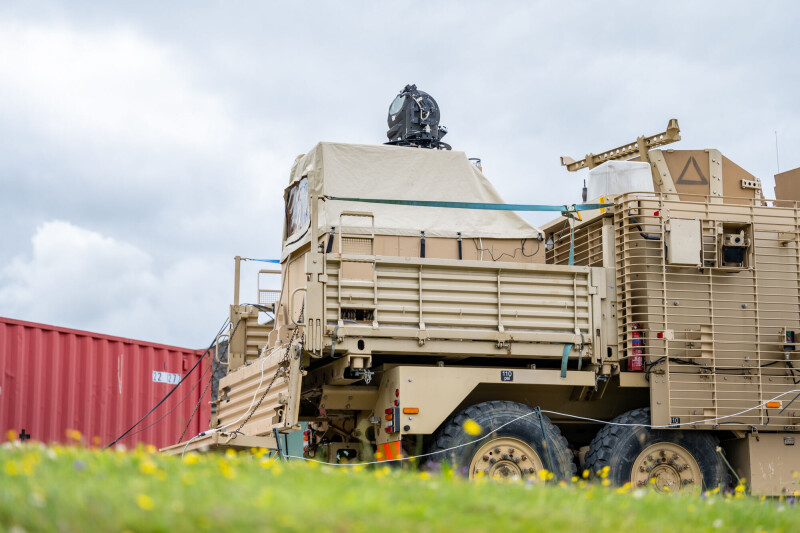
Project PANOPTES puts £5M on the table for an autonomous, vehicle-mounted defense
Britain's Ministry of Defence (MoD) is seeking anti-drone technology capable of protecting troops from saturation attacks designed to overwhelm defenses or exhaust their ammunition.
The tender, dubbed Project PANOPTES, is being run by UK Defence Innovation (UKDI) on behalf of the MoD, with an initial £5 million ($6.8 million) available to successful bidders.
First-stage submissions close at midday on September 23, suggesting that the MoD is in something of a hurry.
REG AD
According to the competition document, PANOPTES aims to deliver "an integrated Counter-Uncrewed Aerial System (C-UAS) force-protection capability, capable of autonomous operation."
REG AD
The MoD wants a system that complements its existing defenses by detecting, tracking, and defeating low-cost threats without being overwhelmed or rapidly exhausting its ammunition. It must operate autonomously and be mountable on an Army vehicle.
UKDI is "particularly interested in capabilities centred on Laser Directed Energy Weapon (LDEW) effectors," although it will consider credible alternatives.
The initial focus is on NATO Class 1 uncrewed aerial systems, a category covering military drones weighing up to 150 kg. These include the small battlefield craft used extensively in Ukraine against targets ranging from armored vehicles to individual soldiers, rather than larger drones intended to strike fixed installations.
The requirement covers "single, repeated, sequential and simultaneous threat profiles" – including potential swarm attacks – as well as drones used for disruption or surveillance.
Reg readers may recall that the British Army tested anti-drone laser systems a couple of years ago. Soldiers from 16 Royal Artillery fired a 15 kW infrared laser mounted on a Wolfhound armored truck against airborne targets, "neutralizing" them at distances beyond 1 km.
The MoD told us at the time that those trials were merely a capability demonstration intended to improve its understanding of laser technology. PANOPTES appears to move closer to procuring an operational system, although it wouldn't be the first defense competition to lead nowhere.
We asked the MoD for further details, including when it anticipates any successful solutions might make it into service with the British Army.
PANOPTES has two stages: applicants first outline their ideas, after which those behind the most promising submissions will be invited to submit detailed proposals.
REG AD
Vulnerability to drones is a major concern for armed forces around the world. US defense startup Mara recently unveiled a counter-drone system that launches small interceptors from a vehicle roof, but these would eventually be used up in a battlefield situation.
Britain's Royal Navy also put out a request for ship-based counter-drone systems earlier this year. Project TALON envisages combining kinetic projectiles with non-kinetic defenses such as lasers, microwaves, and electronic jamming.
Royal Navy ships are already due to receive the DragonFire laser weapon, with the first system expected to be fitted to a Type 45 destroyer next year. Whether that technology can be shrunk or adapted for an Army vehicle is another matter. ®
KioskNews shows a cleaned-up reading view extracted from the publisher’s page — the original always lives on their site, not ours.