‘My father loved Duncan more than he loved us’: the 30-year passion at the heart of the Bloomsbury set – and the family raised in its image
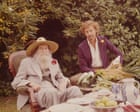
After Duncan Grant died in our house, in Aldermaston in Berkshire, at the age of 93, I remember my father’s knees buckling and him falling to the ground. It was 1978, the end of their 32-year relationship, and the end of an era.
My father Paul Roche, a poet, writer and translator of Greek plays, seemed to crumble before my eyes. He was 61, a father of five, and I was the youngest. Duncan, the painter, designer and a key figure of the Bloomsbury group, had been his beloved friend for more than half his life.
Everyone in our family accepted the fact that my father loved Duncan more than he loved us. Not one of us was jealous, least of all my mother, Clarissa. We knew the depth of their devotion to each other and we did not try to compete. Our only way in was to share our father, and we did so willingly.
None of us questioned what kind of love it was. It was only years later, when I read the words “boyfriend” and “lover” describing my father in an article about Duncan, that it struck me how people had misconstrued their relationship.
They met on a summer’s evening in London in 1946, not even a year after the war had ended. They were both trying to cross the road at Piccadilly Circus. Don (his full name was Donald Robert Paul Roche) was on his bicycle. At the time, he was a Roman Catholic priest. His job gave him joy but he was living a double life, tormented by the restrictions of a sexless vocation. He would slip off his dog collar and dress as a civilian or a sailor in his spare time. He met women at dances and told them he was in the navy, wearing his sailor’s outfit that he had sent off for from a catalogue. As a seminarist during the war, he was ashamed not to be fighting for his country.
On this evening in July – dressed in a sleeveless shirt and trousers – he and an elderly gentleman in a dishevelled, tailored suit were bemoaning to each other how difficult it was to cross the sea of traffic. Duncan asked Don if he would like to see some pictures. My father assumed he meant films. He said: “Why not?” Duncan was talking about paintings, of course.
They set off in a taxi, bundling the bicycle in, and bought a bottle of rum along the way. Duncan took him to the artist Edward Le Bas’s flat in Bedford Square, which he was borrowing at the time, and which housed an impressive collection of contemporary British art: Augustus and Gwen John, Walter Sickert, Paul Nash, Matthew Smith, Vanessa Bell, and Duncan’s own work. This was the beginning of three decades of friendship and my father’s introduction to the arts. He was an educated man, speaking fluent Latin, and with a degree in theology and philosophy. He wrote and even spoke ancient Greek, but he knew nothing about paintings, and little about ballet or opera.
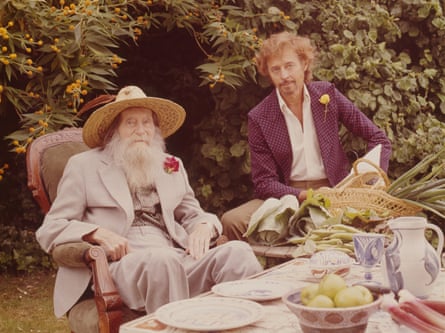
Despite Don’s classical education, Duncan became his educator and his inspiration. A few years later my father left the priesthood and became a writer, a poet and a translator of Greek plays. As erudite and brilliant as Duncan’s literary and artistic friends were, Don was fascinating to him. Different. Yet also familiar. They had both spent their childhoods in India, both had fathers who were officers in the British army, both had a passion for gardening. Don’s father, Robert Roche, worked as an engineer for the Great Indian Peninsula Railway. His mother, Roberta Arathoon, tragically died of smallpox when he was nine, prompting the family to leave India for England.
Don started modelling for Duncan the day after they met. He also briefly modelled for Vanessa Bell, Duncan’s artistic partner and former lover, the sister of Virginia Woolf and wife of Clive Bell. My father later regretted that he had not made more effort with her.
Before long, Duncan had fallen in love with Don, and Vanessa’s disapproval of him only grew. He was not invited to stay at Charleston, the Bloomsbury group’s famed farmhouse retreat. Once, he set up a tent in a field on the Downs behind the house and Duncan brought him food and drink. After Vanessa found out, they could only meet in London. He told me: “Duncan cared a great deal about Vanessa’s feelings.”
Duncan’s relationship with Vanessa became problematic soon after their daughter Angelica was born in 1918. My father told me: “It had become a huge ordeal for him. He was torn in different directions. He couldn’t give her what she needed.”
In a strange way, my father’s relationship with Duncan mirrored the one that Duncan had with Vanessa: unrequited love – or at least, unrequited sexual love – paired with an unbreakable bond. Over the years, there has been so much speculation about my father and Duncan. He told me clearly: “As much as I loved him, I did not have any sexual feelings for him and we certainly never did the deed.” In one of his letters, Duncan writes: “Why oh why is it worthwhile to go on loving you? I should like to know. But you won’t be able to tell me.” He ends another with: “Even if not loved your loving D.”
My father has been described as Duncan’s “muse”, but Duncan was Don’s muse in equal measure. He was his mentor, his educator, the inspiration for his creativity. It was Duncan who told him he was a writer. My father had not imagined he could be a poet or an author. Only because of Duncan did he have the courage to leave the priesthood, telling the cardinal he had a dentist appointment then disappearing. He kept his past vocation a secret from his family. It wasn’t until I was in my 30s that I found out he was ordained.
If all my father had desired was to be with Duncan, his life would have been so much simpler, but in 1953 he met Mary Blundell, the mother of my eldest brother, Toby. She got pregnant after they met on the Côte d’Azur in France. But my mother, Clarissa Tanner, a 22-year-old American, was already in the picture. They had met in Paris a year earlier – now she had returned. My mother also became pregnant. She and my father left for the US and married. My older siblings, Pandora and then Martin (Potie), were born.
Don (now going by his third name, Paul) found to his relief that his academic career blossomed in the US. After a book of fables, The Rat and the Convent Dove and Other Tales & Fables, and a novel, O Pale Galilean – for which Duncan designed the book jacket – were published, Paul was offered a position in the English department at Smith College in Massachusetts.
He was one of the most popular professors, alongside Sylvia Plath who was also teaching there, but when he received a grant from the Bollingen Foundation to translate Greek tragedy, he was no longer allowed to teach, so he left Smith College and he and Clarissa moved to Mexico, where my sister Vanessa was born. Although his agent warned him that there was no money in the classics, Paul pursued it anyway, keeping the poetic incantation of Euripides, Sophocles and Aeschylus alive with his translations. These books have sold in the hundreds of thousands and are still in print.
It was the death of Vanessa Bell in 1961 that brought my father back to England. During his time away, letters to and from Duncan continued: Duncan wanting him to come home; my father resisting. But with Vanessa’s death, Duncan’s grief was so acute that my father returned. Eight years had passed since they had last seen each other, and Paul was now the father of four children. A year later, I was born.
Duncan was like a grandfather to me. He spent every Christmas with us and was a kingpin of our dysfunctional family. When Duncan was around, fights ceased, tempers were muted; we would all behave civilly. He brought us such happiness. Clarissa was elated when Duncan was staying. She was her best self: charming, vivacious and happy, brimming with interesting conversation. My mother and Duncan developed a singular relationship, exchanging postcards and phone calls, independent of my father. Sometimes she would show him off to her friends – the clever ones who would appreciate him. Christmas was extra special with Duncan there. I have a watercolour of a donkey he gave me one year. Another present was a piece of embroidery. We also each received a five-pound note inside a card, a fortune in those days.
Then one Christmas, he didn’t come. We missed Duncan desperately. Forlorn, we children wondered why he had abandoned us. “He’s spending time with his other family,” my mother explained. It seemed extraordinary that he had another family. Did they love him as much as we did? Did he love them as much as he loved us?
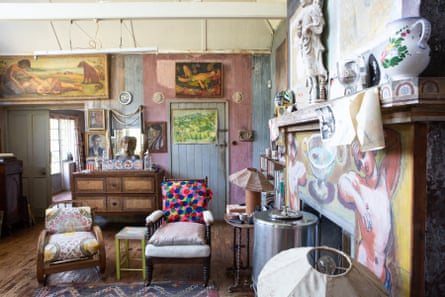
Our family learned so much from Duncan. I never tired of observing him. He worked every single day at his easel, painting or drawing. I believed from a young age that being a painter was natural, accessible. Not surprisingly, my sister Pandora, my brother Toby and I all went to art school. We learned by watching him. And no place in the world was more inspirational than Charleston. It was a magical universe of invention. No door, stool, box or cupboard, screen, tray or fireplace had escaped his or Vanessa Bell’s paintbrushes. To a young eye, it set in my imagination the notion that design and colour could be anywhere and everywhere. Observing him, I learned to look.
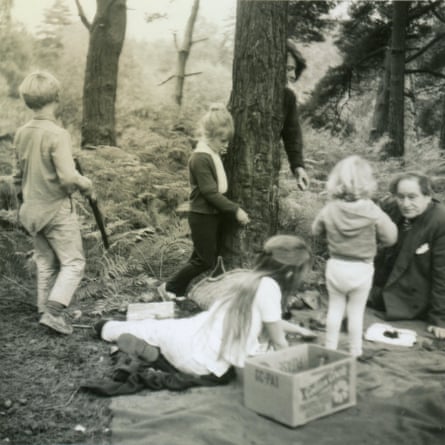
Duncan and my father adhered to a clockwork schedule revolving round work and meals. My father was at his desk by 5am. Duncan would paint in his studio, listening to classical music. Mozart was his favourite.
after newsletter promotion
Towards the end of his life, Duncan was in a wheelchair. We all loved pushing him around and he was quite jolly and never complained. He was capable of standing, but getting on with painting was far more important to him than battling with the walking problem.
My father had stopped teaching at various American universities and came back to care for Duncan full-time. Sometimes he would refer to himself as “nanny” and there was a lot of teasing between the two of them. My mother hated the nanny thing, yet Duncan took it all in jest.
I learned from him the power of words, especially when I was tasked by my parents with reading to him, something I took great pains to do well. I particularly remember Anna Karenina – which he pronounced Kare-neena. He would ask me to reread passages, and on occasion his eyes shone wet. It is a novel about love, but it is so much more than just a love story.
We live in an age where people want to pigeonhole love. Familial love, romantic love, sexual love. But what happens when what two people share is the wrong shape for any box? I often wonder what made their combination so devoutly special.
Lover? Boyfriend? Muse? Companion? Friend? None of these words describe the essence of their partnership. Beloved is the only word that seems to fit. Don was Duncan’s beloved, as Duncan was Don’s.
After Duncan died and my parents divorced, my father bought a house in Mallorca. He continued to write as usual, poised at his desk before dawn every day, on an erect wicker chair as if depriving himself of comfort. He also went back to teaching in the US, notably at the Catholic University of Notre Dame. In 1982, With Duncan Grant in Southern Turkey was published, a journal about a holiday together in 1973.
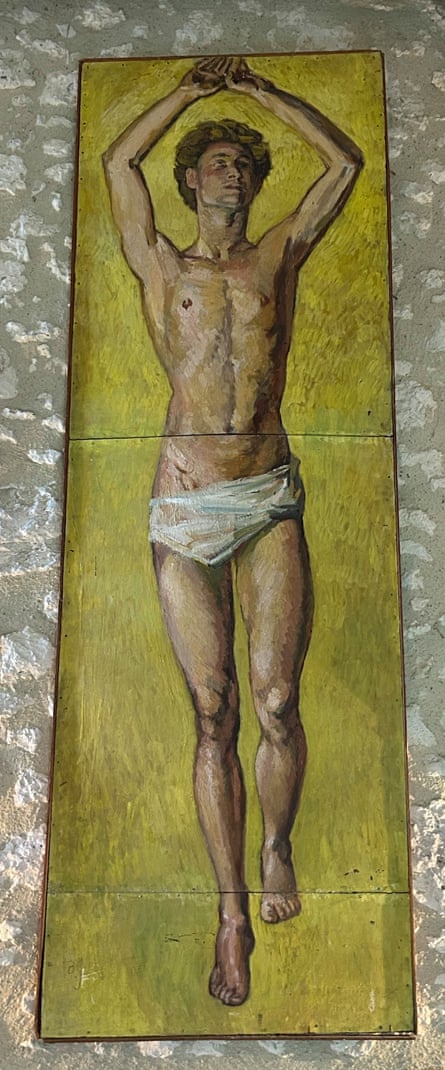
With Duncan no longer in my father’s life, it was his paintings that gave him solace and pleasure. His walls were adorned with them: Don, nude, washing his feet, or in a pose with his back to the viewer. Don typing, reading or writing. Don as Christ ascending, larger than life, a companion piece to the mural in the Russell Chantry of Lincoln Cathedral. Don as Christ the shepherd, where Duncan’s depictions of Christ had been considered too racy. These works in Mallorca lived amid landscapes and still lifes, and paintings and murals by his children and friends, all of us inspired by Duncan.
There was one painting I particularly liked at my father’s house and I put it on my bedroom wall. It was Duncan’s first painting of Don, in Edward Le Bas’s flat in Bedford Square, right after they met. Don is lying naked on the ground, half on his side, his cheek pressed to the floor, an arm crooked, his hand covering his mouth so the bottom half of his face is obscured. It almost looks as if he is sucking his thumb. A rich red rug is spread beneath him, his mop of blond hair falling to one side. The colours are vibrant – complementary greens and reds; the background, so typical of Duncan’s work, as eye-catching as his subject.
Certain people commented that it was weird that I had a painting of my nude father in my bedroom. I simply saw this painting objectively, as a beautiful piece of art. To me it was not sexual or erotic but soulful. It was only later that I understood why: it tells the story of a young man in the throes of a new friendship with an older man who was to become the most important person in his life.
What must it have been like for Don to be introduced to a new way of thinking, to a visionary world? Nude and vulnerable, an artist’s gaze scrutinising him? Don was being truly seen. Perhaps he saw himself for the first time through Duncan’s eyes, allowing himself to accept the person he was. Even love the person he was.
Duncan’s art runs through my veins. His blue eyes, alight with curiosity, still live with me. Some faces fade, but Duncan’s never has. His discipline taught me that the act of making art was serious, even though the result could be light. Nothing escaped his gaze, myself included. At the age of eight, sitting still seemed physically impossible. Posing for a painter is hard work. “You’ll be glad you did this one day,” my mother told me. She was right. I am grateful to have been Duncan’s subject, his eyes on me and my skittish, childish form.
He continued to paint until a few days before he died of pneumonia at our house. I was away at boarding school but came home immediately. My father had kissed him on the forehead and bid him good night, telling him that God loved him. Duncan sighed, apparently, as if relieved, though he was not religious. When my father came back into the room to stay by his side, Duncan had stopped breathing. It seemed inconceivable that he was no longer with us.
Picking my father up, his trembling legs unable to hold him, eyes blurred with tears, I knew we would never be the same. Duncan made us a family, and now we were on our own.
KioskNews shows a cleaned-up reading view extracted from the publisher’s page — the original always lives on their site, not ours.