Four IIT freshers, a suitcase of chemicals, and a Taiwan trip ending in an international award
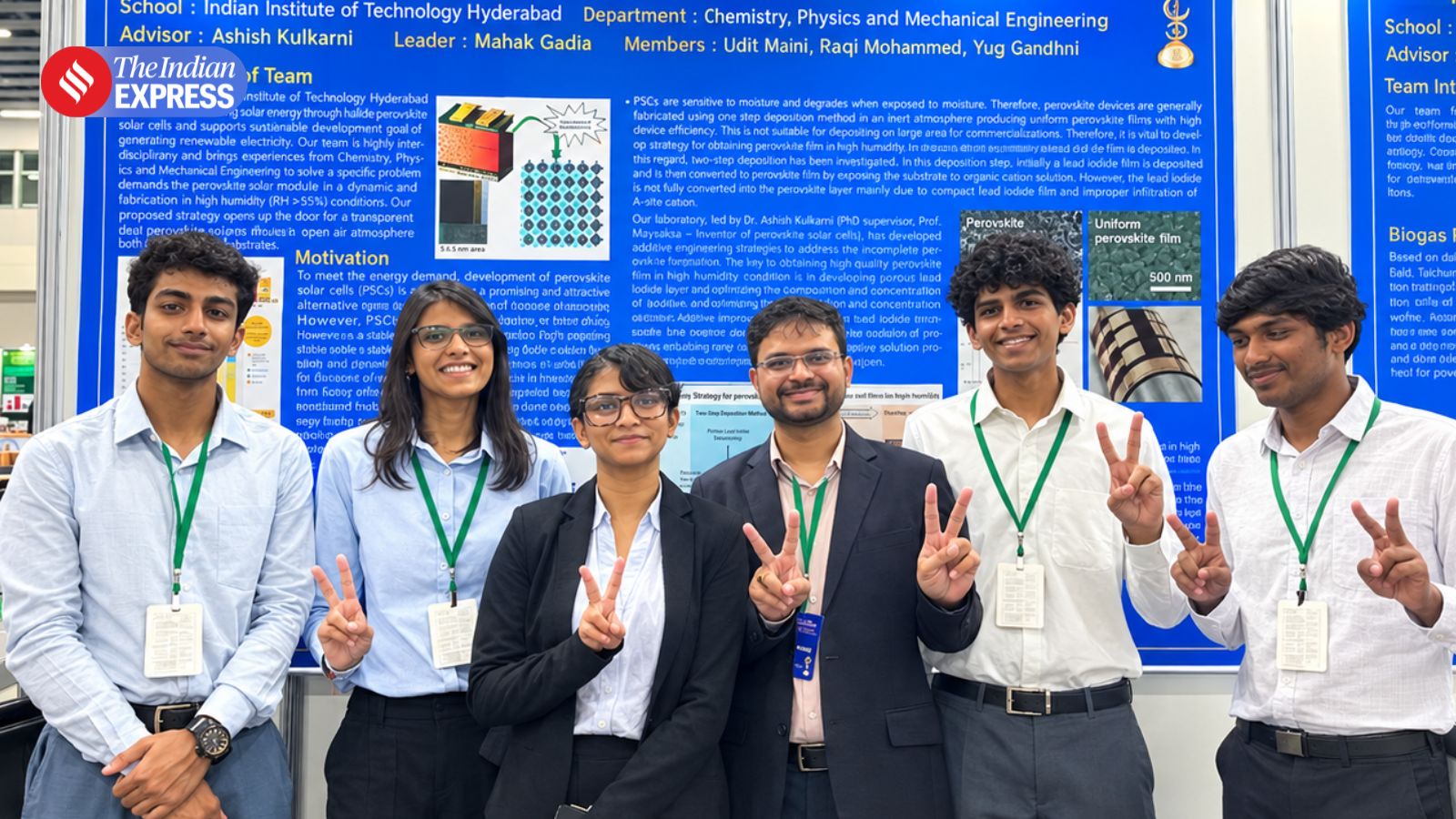
IIT Hyderabad team L-R: Udit Maini, Mahak Gadia, Gayathri Nambiar, Dr Ashish Kulkarni, Yug Nikesh Gandhi, Raqi Mohammad (Image via special arrangement)
It was close to midnight in the student canteen at IIT Hyderabad when Mahak Gadia spotted her chemistry professor eating dinner and decided this was as good a moment as any. “She came running towards me and said, ‘ Sir, we want to participate,” recalls Dr Ashish Kulkarni, who had joined the institute barely six months earlier. His first reaction was honest confusion. “Why me? Because I don’t have a lab. I just started my tenure.” Gadia wasn’t deterred. “No, sir, you are very much approachable,” she told him.
That late-night conversation is how four first-year BTech students, Gadia, Raqi Mohammad, Udit Maini and Yug Nikesh Gandhi, ended up representing India at the TECO International Contest 2026 in Taiwan, walking away with the excellence award among 267 applications from around the world, and doing it without a single postgraduate degree between them.
The team had come across a competition email calling for sustainability innovations and, as Gadia puts it, the reaction was instant: “Let’s make this happen.” What they didn’t yet have was a project. That’s where Kulkarni came in. A new faculty member, he had spent his PhD working under Prof Tsutomu Miyasaka, the inventor of perovskite solar cells, at institutions in Japan and Germany, and had arrived at IIT Hyderabad hoping to eventually build a dedicated solar energy lab. He saw an opening. “I don’t have a lab right now,” he told the students, “but we can work something out.”
Read | ‘The real skill IIT teaches you is not to study more, but how to focus, be fully present’
Within days, Kulkarni had mapped out a plan: four students, four roles, making the device, working with its materials, testing its flexibility, and understanding how it performed. Mohammad remembers the freedom that came with it. “We don’t necessarily divide ourselves by our branch,” he says of life at IIT Hyderabad.
With Kulkarni’s planned solar-energy lab still being set up, he turned to Pavakah Energy, an IIT Hyderabad-incubated startup working on thin-film solar technology. Its CEO, Vikram Bakaraju, and Kapardhi Bharadwaj agreed to open up the company’s lab and inventory to the students, with Gayathri Nambiar, a research scientist associated with the lab, taking charge of training them.
“I was leading the team because I had been working here for two years and knew how to make the thin solar films,” she says. What followed was two months of work that didn’t respect a clock. “We all were working together,” Kulkarni says, “even late at night, because it’s the first time for them working with the chemicals and all.”
Story continues below this ad
“We had to work till 1 am and 2 am in the lab,” he says. “Nothing was going our way, and we were all feeling demotivated. But then somehow we came up with a solution at the end of the day.” The team submitted its first-round entry on June 25, demonstrating that perovskite solar films could be made in hot and humid conditions, and then waited nearly a month to hear back. When the result came, it placed them among the top 20 finalists worldwide, and the only Indian team selected.
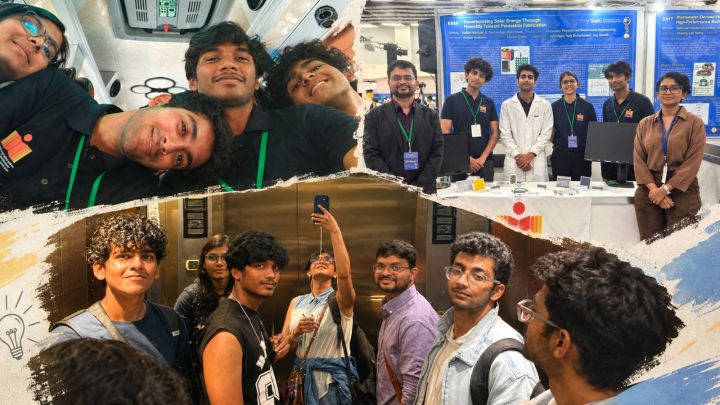 IIT-H team during their presentation in Taiwan (Images via special arrangement/Enhanced with AI)
Getting to Taiwan brought its own kind of chaos, most of it involving a suitcase of chemicals. The team needed to carry their own materials for the final demonstration. “We carried them in glass bottles that we have in the lab,” Nambiar says. “We tightly sealed them with parafilm and put them inside silica gel. We had taped them multiple times. We had a separate suitcase for carrying these chemicals.” Among the cargo were two 100ml bottles of 99.9% isopropyl alcohol, critical to their experiment and not exactly the kind of thing you casually carry through an airport.
“We were a bit scared,” Nambiar admits, though Kulkarni, who had carried chemicals for international conferences before, wasn’t. “He said, ‘I have done this; don’t worry.” They cleared customs without issue, only to discover the night before the competition that the alcohol had been contaminated in transit. What followed was a scramble to track down anyone doing a PhD at National Taiwan University who might help, before the organising committee itself stepped in with a replacement, just in time.
Arriving to find rival teams, many from Taiwan and with far easier logistics, armed with polished posters and full physical set-ups, the IIT Hyderabad team realised they’d shown up with chemicals but no display materials. “Everybody is equally competitive,” Nambiar laughs. “We realised we have to get something.” The team spent the night before the presentation hunting down printouts, building models out of cardboard, and assembling a booth from scratch. “That showed that everybody will stick together,” she says.
Story continues below this ad
Presenting before judges at National Taiwan University, with Taiwan’s President Lai Ching-te later in attendance, the team’s demonstration stood out enough that, as Kulkarni recalls, “The judges said whatever we showed in the presentation, it was not the same that we showed on the board.” That evening, they were awarded the excellence award and a generous cash prize, alongside finalist teams largely made up of master’s and PhD researchers.
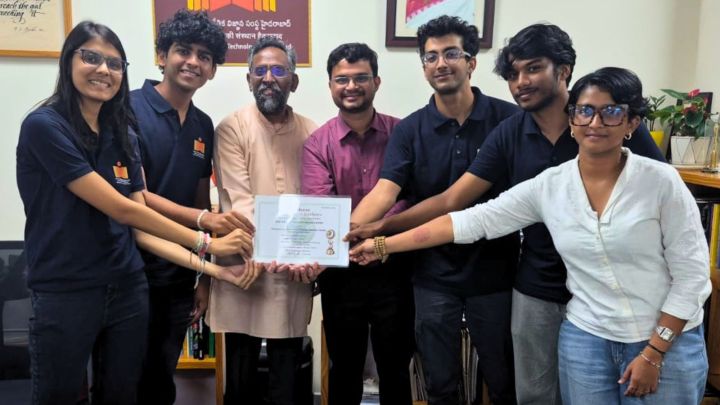 The IIT team with Prof BS Murty, Director, IIT Hyderabad (Image via special arrangement)
“First time, at least to my knowledge, students got recognition with science and technology,” Kulkarni says, calling it a marker of what young researchers can do “when provided with opportunities, mentorship and an environment.”
Between the lab nights and the last-minute scrambles, there was also, simply, a trip, four teenagers navigating a new country for the first time. Gandhi carried a diary through the competition and collected notes from “13 or 14” people in their own languages. Maini remembers evenings with no fixed plan beyond “we’ll figure it out after we leave the hotel.” Gadia recalls one night stranded with dead phones, walking kilometres back to their hotel after the buses stopped running, “pretty an exhilarating moment,” as she calls it now.
For a team that did not set out with a trophy in mind, the journey brought an unexpected lesson. “We didn’t actually believe that it would go forward,” Maini admits. However, the biggest takeaway was simple: “We can only stop ourselves from not reaching out and not giving it a shot. After we gave it a shot, we ended up getting there,” he says.
© IE Online Media Services Pvt Ltd

Deepto Banerjee is a Senior Sub Editor at The Indian Express (Digital), specialising in education policy, career guidance, and student affairs. He is an IIMC New Delhi alumnus. ... Read More
KioskNews shows a cleaned-up reading view extracted from the publisher’s page — the original always lives on their site, not ours.