Trump eases duty threat; penalising India hard to defend for US now
In September, India imported 1.9 million barrels per day (bpd) of Russian crude and it accounted for over 35% of the country’s total oil imports for the month, according to tanker data from commodity market analytics firm Kpler. In the preceding months, import volumes from Russia were even higher, with an all-time-high of 2.8 million bpd in July.
Trump had earlier threatened to curb the US diesel exports, effectively strong-arming G7 countries into releasing 100 million barrels of their emergency petroleum product reserves and, in a shock move, Trump last week announced a diesel deal with Russian President Vladimir Putin.
India’s oil imports from Russia really took off after the Ukraine war broke out. With much of the West shunning Russian crude following Russia’s February 2022 invasion of Ukraine, Moscow started offering discounts on its oil to willing buyers. Indian refiners were quick to avail the opportunity, leading to Russia—earlier a peripheral supplier of oil to India—emerging as India’s biggest source of crude, displacing the traditional West Asian suppliers.
Ajay Srivastava, founder of think-tank Global Trade Research Initiative, said the waiver exposes the uncertainty at the heart of US trade policy: Washington threatens penalties, then retreats when enforcing them becomes inconvenient. The Graham Act became law on September 18, but the US-Russia diesel agreement of October 9 made penalising other buyers hard to defend, he said.
“China already had protection against US tariff increases until January 10. The message is clear: U.S. interests determine when penalties apply, while the ability to retaliate helps secure protection. China can push back. India risks repeated pressure unless it demonstrates that coercion carries a cost,” Srivastava said.
Arpita Mukherjee, Professor at the Indian Council for Research on International Economic Relations, said that the bigger threat over Russian oil purchases is from the European Union. “The European bloc is naming companies in countries like India, Turkey and China and then prohibiting them from working with them [EU],” she said.
Story continues below this ad
“While US companies also work with some of these Indian companies in the EU’s ban list, the US is softening its position as a bilateral diesel supply agreement with Russia has been reached to calm down domestic and global fuel prices ahead of the US midterm elections,” Mukherjee said.
Trade deal prospect rises
As the threat of 100% US tariffs has eased, India may now find itself in a somewhat better position to actually get a deal done. Both countries broadly agree on the US’s investigation under Section 301 of the Trade Act of 1974 into “overcapacity” — a situation when a sector or a country’s production capacity exceeds the demand in the market. Increased supply can push down prices and affect manufacturers in other countries.
India had already banned imports of goods using forced labour following an earlier US investigation under Section 301. And, this month, India and other G20 countries committed to act against structural overcapacity in certain geographies, particularly in sectors such as automobile, electric vehicle, batteries, chemicals, foundational semiconductors and solar panels. China is often accused of having overcapacity in most of these sectors.
So with India potentially falling outside the Section 301 tariff net, its purchases of Russian oil were left as the remaining major point of difference. Russian crude accounts for the biggest share of India’s oil imports (see the chart above). It has proven crucial after supplies from West Asia through the Strait of Hormuz dried up — thanks to a war Trump himself started.
Story continues below this ad
It was unsurprising, therefore, that India had been hesitant to completely stop Russian crude imports. In fact, when Trump had first signed the Graham Bill into law, India’s Ministry of External Affairs (MEA) had stressed that the government remains committed to ensuring the nation’s energy security “through diversified sourcing and based on evolving market dynamics”. It said the proposed legislation’s implications for the India-US relationship as well as the global energy market have been flagged in discussions with US representatives.
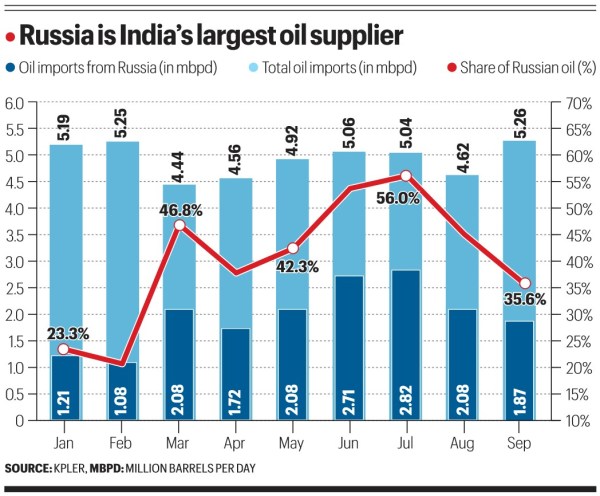 Russia’s oil supplies to India.
Inflation jumps globally and in India
According to the Council on Foreign Relations, diesel prices in the US averaged $6.18 a gallon as of October 12, up from $3.48 at the start of this year. The higher fuel costs have passed on to US consumers.
The latest Consumer Price Index showed that prices rose 0.6% in September, which is more than economists expected, bringing the annual inflation rate to 3.7%. Polls indicate that this could affect Republican candidates in the upcoming midterm elections, which have increasingly centred on cost-of-living concerns, as per the Council on Foreign Relations.
Higher fuel prices have also become a challenge for Indian policymakers as retail inflation continues to inch upwards, rising to 5.54% in September, up from 4.83% in August, according to data from the National Statistics Office.
Story continues below this ad
Food inflation has surged to 7.74 per cent in September, up from 6 per cent in August, driven by items such as onions, ginger, garlic and lemon. The FAO food price index jumped 5.8 per cent, pointing towards an uptick in international prices.
KioskNews shows a cleaned-up reading view extracted from the publisher’s page — the original always lives on their site, not ours.