Any shake-up of the P1 registration system would entail bold and difficult changes. Would parents be ready for it?

When his eldest son enters Primary 1 in a few years' time, Mr S Sharif could have an advantage that other parents do not.
The 36-year-old is an alumnus of Tanjong Katong Primary School, one of the schools he and his wife are considering for their four-year-old. Under the current Primary 1 registration framework, that connection would allow his son to apply in Phase 2A, ahead of children without prior links to the school.
Although he could benefit from it, Mr Sharif does not think getting a child into a school based on parents' connections is fair.
"I've always had the impression that we're a very meritocratic society. But how do you apply meritocracy to five- or six-year-old children?" asked the compliance manager.
"Getting your child into a school then depends on whether the parent has better connections or attended that school, and I don't think that's fair."
But when registration time comes, Mr Sharif acknowledged that he would still seriously consider using the alumni route available to him.
"Since this is the system we have, I'll take advantage of it."
Another parent, Mr Adrian Wong, 36, finds himself grappling with a similar contradiction.
By the time the technical program manager registered his son for St Andrew's School (Junior) this year, he and his wife had already completed about 40 to 45 hours of parent volunteering at the school over three months. He said it was possible only because their managers gave them the flexibility to be away from work on weekday mornings.
Their efforts paid off, as their son secured a place through Phase 2B after balloting. The school appealed to them because it offered what Mr Wong saw as a good balance of reputation, housing options within their reach and a relatively realistic chance of admission, including through the parent-volunteer route.
Yet Mr Wong believes parent volunteering should not give a child priority for admission.
Volunteering itself was worthwhile, he said, because it gave him a closer look at the school and what a student's day was like. But he thinks that the act itself should not be tied to his son's chances of admission.
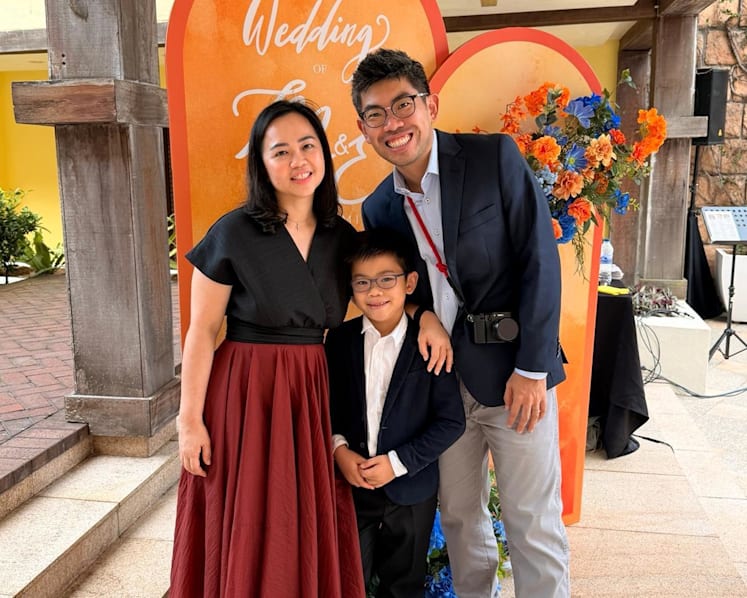
"The idea of volunteering is great, but I think when volunteering is tied to admission priority, it can become more about securing a place for your child than contributing to the school community."
The two fathers' experiences capture a paradox inherent in Singapore's Primary 1 registration system.
While parents may acknowledge that giving children priority based on where their parents studied, volunteer hours, or other ties can tilt the playing field, the presence of these advantages creates a strong incentive to use them for their own children's benefit.
The perennial tension between doing the best for "my child" and creating a fairer system for "our children" has taken on renewed significance as Singapore talks about becoming a more "We First" society – where citizens would strengthen bonds with each other instead of just looking out for their own self-interest.
This debate has also returned to the fore following the Ministry of Education's (MOE) latest changes to Primary 1 registration, which will take effect from the 2027 registration exercise.
Among the changes, most primary schools will have to reserve 60 places for Phase 2C – up from 40 – giving children with no prior connection to a school more opportunities to enter. Those with fewer than 180 Primary 1 places will continue to reserve 40.
At 12 schools where public housing makes up less than 40 per cent of homes within 2km, Phase 2C will also operate under a new two-track system. Half the available places will go to children living within 2km, while the other half will be open to those living farther away, with no home-school distance priority within either track.

The changes are intended to widen access and encourage greater social mixing, while still recognising the practical importance of children attending schools near their homes.
"Ultimately, we want our schools to remain open and inclusive, where our children learn and form friendships beyond their immediate social circles," Education Minister Desmond Lee said when announcing the changes on Sep 10.
"They will encounter different perspectives, they will learn to bridge differences, and they will build mutual understanding."
But education researchers and advocates who spoke to CNA said that if the objective is to build a substantially fairer system – one in which a child's chances depend less on the connections, time and resources of their parents – Singapore would need to go much further. The proposals they put forward ranged from paring back or abolishing alumni and volunteering priority to fundamentally changing how pupils are allocated to schools.
In order to achieve an "ideal" or "fair" framework, the experts also noted that Singapore would need to confront a more fundamental question: What should P1 registration be designed to achieve in the first place?
And if the goal is to build a "We First" society through education, what should parents and society be prepared to give up to get there?
HOW P1 REGISTRATION BECAME SO COMPLEX
Today's Primary 1 registration framework is one that has accumulated layers of priorities and rules over decades, as the system was adapted to recognise different groups and pursue different policy objectives.
Associate Professor Jason Tan, who specialises in policy, curriculum and leadership at the National Institute of Education (NIE), said some might even call the complex system "unwieldy" because it is being used to serve "too many different policy objectives" at the same time.
The use of Primary 1 registration to pursue wider policy goals goes back decades.
For example, in the years following the system's introduction in 1972, children with a parent who had been sterilised were given priority in line with Singapore's "Stop at Two" population policy. The government later reversed this in 1987 as it shifted to encouraging larger families.
In 1984, the Graduate Mothers' Scheme gave graduate mothers with at least three children top priority in Primary 1 admission to the schools of their choice. It was scrapped the following year after generating considerable public unhappiness.
The framework continued to evolve in the decades that followed.
Today, the earliest registration phase is also the only one that guarantees admission. Under Phase 1, children with a sibling currently studying at the school are assured of a place.
Assoc Prof Tan said there was a practical reason for this: Primary 1 pupils are young, and having siblings in the same school can help the children while making things easier for families.
Exactly when children of former students first began receiving priority is less clear from publicly available records.
What is documented is that Phase 2A1 was introduced in the 1999 Primary 1 registration exercise to encourage stronger alumni and community support for schools. It gave earlier priority to children whose parents were former students and members of the school's alumni association, among other eligible groups.
Children whose parents were former students but were not alumni association members, as well as those whose siblings had previously studied at the school, fell under Phase 2A2, alongside several other groups.
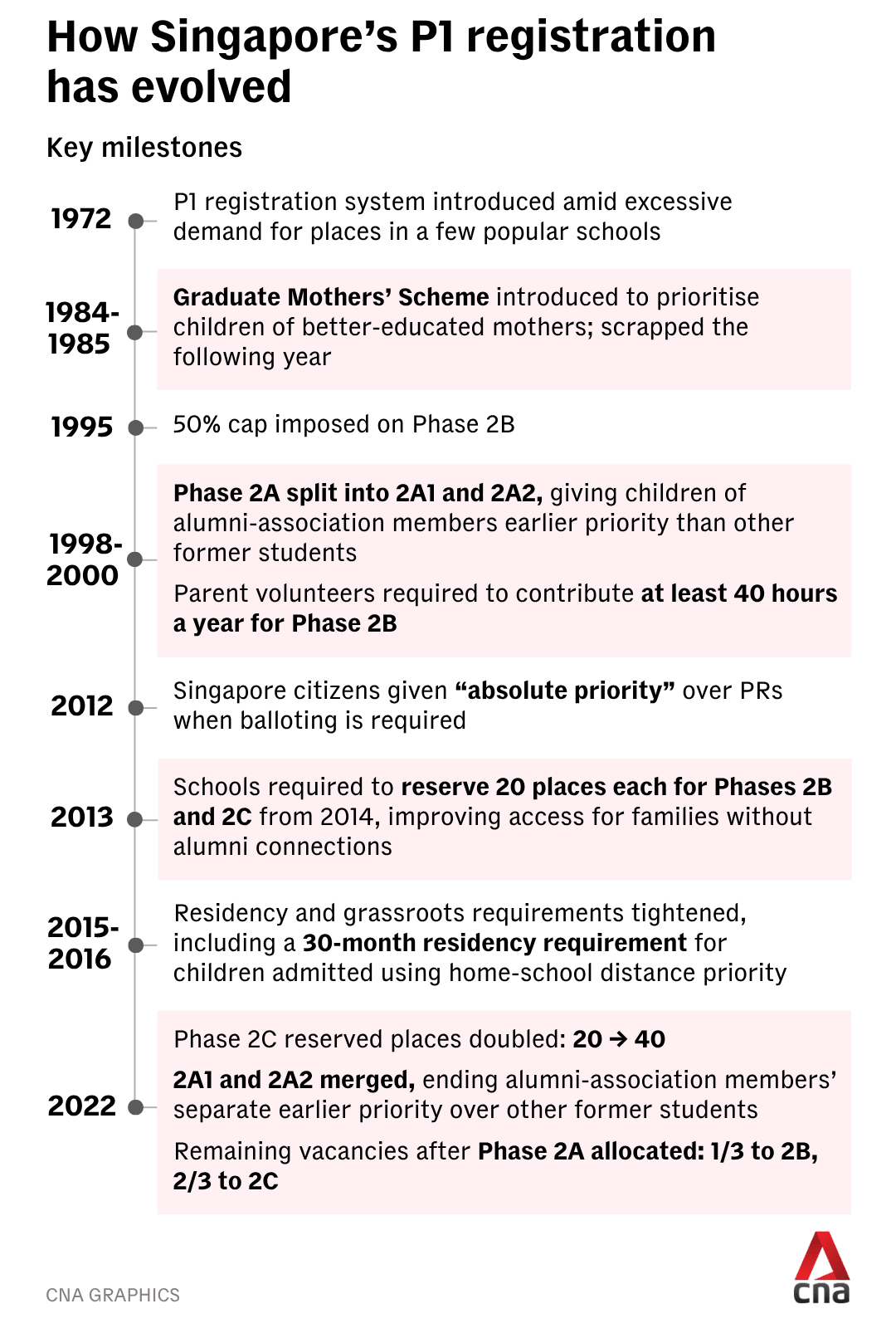
From the 2022 registration exercise, Phases 2A1 and 2A2 were merged into a single Phase 2A, with MOE saying it was timely to review the difference in priority between stakeholders in the two phases.
Assistant Professor Jacqueline Ho, a sociologist at the Singapore Management University (SMU), questioned whether maintaining strong alumni-school ties or preserving a school's culture truly requires giving children of alumni priority in Primary 1 admissions.
She also questioned whether Phase 2A is serving its purpose. That depends partly on why parents used it: to maintain a connection to the school, to give their child a better chance at success, or simply for easier admission.
If it was the latter, Asst Prof Ho said, Phase 2A could become "simply a means of getting your child into a school without the headache, which has little or nothing to do with preserving school culture".
School culture could also be sustained by current families, teachers and students who developed their own sense of belonging to the school, she said.
St Margaret's Primary is one of the 12 schools adopting the new two-track Phase 2C system from 2027. But its alumnae association does not see wider access and strong alumni ties as being mutually exclusive.
Ms Natasha Zhao, president of the St Margaret's Ex-Students' Association, noted that only 27 of 93 Phase 2A places were taken up in the 2026 registration exercise, and 24 of 91 the year before.
"The alumnae places in that phase have not been filled in recent years, so reducing them is unlikely to affect alumnae families at St Margaret's," she said.
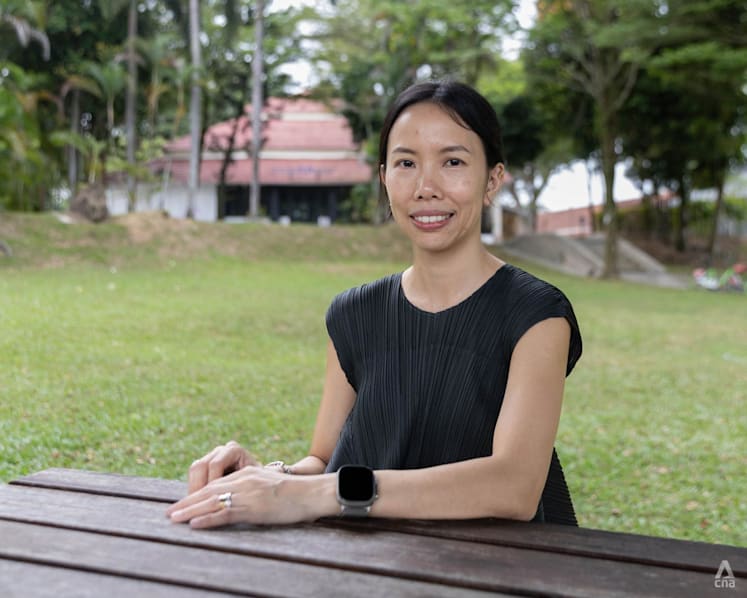
Ms Zhao said nothing significant would be lost if fewer alumnae could send their daughters to the school, as alumnae continue to contribute their time and money even when their children do not attend the school.
Alumni priority can contribute to a strong community, she added, "but it is not and should not be the only avenue".
The alumni association of Tao Nan School – another of the 12 in the two-track scheme – takes a different view.
Its vice-president, Mrs Helen Abidin, 82, believes successive generations attending the school are themselves part of preserving its traditions. Her own ties span generations: She studied there, taught there for 25 years, her father was a teacher and her children were pupils.
She noted that former pupils have expressed unhappiness at the prospect of further reductions in the number of spots for children of alumni, because they wanted their children to share the school experience and community they had helped sustain.
At the same time, Mrs Abidin supports greater social mixing. Her concern is whether changing admissions rules alone will achieve it.
"The rich will always find a way," she said, pointing to families with the means to rent homes near popular schools to improve their children's admission chances.
Phase 2B today brings together several different forms of connection or contribution, including parent volunteers, members endorsed by a church or clan directly connected to the school, and active community leaders.
The parent volunteer scheme was introduced in 1998, when MOE announced that parents who completed at least 40 hours of voluntary service at a school would, from the following year's registration exercise, qualify for priority under Phase 2B.
Assoc Prof Tan said the framework uses Primary 1 admission to incentivise behaviour such as parent volunteering and grassroots involvement, while recognising church and clan affiliations.
Are parents volunteering because they really want to contribute to the school? Or are they volunteering because they want their kids to get into the school?
But Asst Prof Ho similarly questioned whether encouraging such involvement needed to be linked to a child's admission, as parents could instead contribute through parent support groups or volunteer after their children had entered the school.
There was also the issue of whether attaching an admissions advantage to volunteering affected why parents did it in the first place.
"Are parents volunteering because they really want to contribute to the school? Or are they volunteering because they want their kids to get into the school?" Asst Prof Ho said.
HOW FAR COULD REFORMING THE FRAMEWORK GO
If Singapore were to rethink Primary 1 registration more fundamentally, the experts and advocates CNA spoke to offered a spectrum of possibilities.
Centralising admissions
At the most radical end, EveryChild.SG, a non-profit movement to prioritise child well-being, seeks to eventually replace much of the current phase-based system with centralised, automated admissions.
Parents could still indicate their preferred schools and proximity would remain a consideration. But an algorithm would also take into account factors such as socioeconomic background and race.
The eventual aim, its founder Pooja Bhandari said, would be for every primary school to broadly reflect Singapore's national diversity.
Under such a system, Ms Bhandari sees little reason to retain priority based on alumni ties or parent volunteering, although exceptions could remain for practical considerations such as siblings already studying in the school or parents working there.
Her rationale is that primary schools are taxpayer-funded public resources.
"There is no reason one family should have privileged admission compared with everybody else simply because the parents are alumni, or well-off enough to take time off to volunteer with the school or the community before their child is admitted."
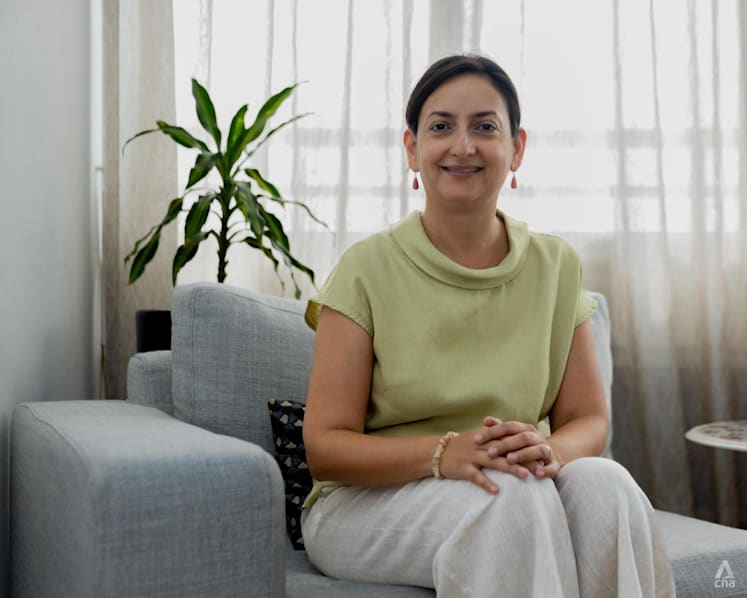
SMU's Asst Prof Ho also sees merit in giving the government a greater role in allocating pupils, while allowing parents to rank their preferred schools.
Such a system, she said, could help prevent children from either very privileged or very disadvantaged backgrounds from becoming concentrated in particular schools.
But she cautioned that diversity on paper did not necessarily guarantee meaningful social mixing. Putting a small number of poorer children into a predominantly affluent school, for example, could leave them feeling isolated or stigmatised.
Tackling 'pedigree' and property
Associate Professor Vincent Chua, a sociologist at the National University of Singapore (NUS), argued that a fairer system would have to address two ways that parental advantage could be passed on – through what he called "family pedigree" and the property market.
"If you curtail alumni priority without touching the distance rules, you simply shift and 'electrify' the competition in Phase 2C," he said, as wealthier parents could redirect their resources towards property.
Assoc Prof Chua suggested eventually going further than the new 50:50 two-track system. Instead of splitting Phase 2C places equally between children living within and beyond 2km, he suggested considering ratios such as 40:60 or 30:70, giving those living farther away a larger share.
He also argued that reform should tackle the "golden pipeline" between affiliated primary and secondary schools, which he said further fuels competition at the Primary 1 level.
For St Andrew's School (Secondary)'s posting group 3 intake, for example, the 2025 cut-off was AL9 for non-affiliated pupils, while an affiliated pupil could be admitted with AL22 – a 13-point difference.
While EveryChild.SG has proposed eventually giving every primary school some form of affiliated secondary school pathway, Assoc Prof Chua disagreed with universalising affiliation.
"The core problem with the golden pipeline isn't just that some schools have it and others don't. Rather, it's the magnitude of the score gap," he said.
Instead, he proposed capping the posting-score advantage for affiliated pupils at two or three AL points.
Tackling demand, not just supply
Mr Kelvin Hong, founder of tuition centres The Economics Tutor and Ace GP, suggested phasing out alumni priority gradually while simultaneously reducing competition for a small number of sought-after schools.
"In economic terms, it's changing how the scarce places are rationed while also reducing the scarcity itself," he said.
He also proposed letting parents rank several schools according to their preferences rather than requiring them to apply to one school in each phase, arguing that the current system rewards families with more "time, information and confidence to strategise".
Associate Professor Eik Leong Swee, an economist at the University of Melbourne in Australia whose research includes education and inequality, similarly argued that policymakers should also ask why parental demand remains so concentrated on a relatively small number of schools.
"There are a lot of good schools that parents are missing out just because they don't know that they are good," he said.
Rather than focusing on fine-tuning the supply of places at popular schools, MOE could also influence demand for places at other schools by giving parents more information about what they offer, he suggested, encouraging them to consider what would actually make a good school for their child.
"If the average parent starts believing that 'the potential set of good schools for my child is 50 schools rather than 10', a lot of things will change."
Assoc Prof Swee added that, if feasible, he would spread the location of sought-after schools more evenly across Singapore. But he acknowledged that doing so would be difficult and financially costly.
Pointing to Anglo-Chinese School (Primary)'s move from Barker Road to Tengah, he noted that relocating an established school requires land, could weaken existing alumni and community ties, and may draw resistance from supporters. Such moves are therefore rare, he said.
Still, if social mixing is a priority, Singapore should consider "reshuffling geographically" where sought-after schools are located, Assoc Prof Swee said.
WHY IS CHANGE SO HARD?
While there is no shortage of ideas for reforming Primary 1 registration, the harder question is why more sweeping changes have not been undertaken.
For all the trade-offs involved, Ms Bhandari of EveryChild.SG does not believe the difficulty is necessarily a technical one.
Unlike other education reforms, such as reducing class sizes, changing admissions would not require substantial additional resources or retraining teachers, she said.
One way forward would be to progressively expand Phase 2C over several years before moving towards a centralised allocation system.
"It is a communications issue, but I don't think it's insurmountable," she said.
By this, Ms Bhandari meant the government should clearly signal where the system was heading and give families several years to adjust, particularly when some had made decisions about where to live and other arrangements based on the existing rules.
The history of Primary 1 registration, however, has largely been one of incremental change.
Assoc Prof Tan of NIE pointed to the gradual increase in places reserved for Phase 2C – from 20 to 40, and now 60 at most schools – as well as changes such as merging Phases 2A1 and 2A2 and introducing the new two-track scheme at 12 schools.
In the short term, he expects this approach to continue.
The framework is trying to balance too many competing claims, he said, while removing established advantages is socially and politically sensitive.
"Once you have put in place certain privileges, it's not always easy to take them away," he said, especially when families have planned years ahead around the rules.
MOE was, in his view, "trying to make compromises" and "treading carefully instead of opting for more sweeping reforms".
Even scaling back an existing priority could draw opposition from those affected, Assoc Prof Tan said. "So what more (would be the reaction) if you propose the complete removal of some of these existing criteria?"
The framework itself also "lends itself well to parental strategising" because families can study the different phases and rules to try to gain "the maximum competitive advantage for their children", he added.
Take the case of a mother in her 40s, who wanted to be known only as Mrs Tan, for instance.
She and her husband sold their previous home and bought a new private property in Newton, within 1km of both ACS (Primary) and St Joseph's Institution Junior, ahead of their son's Primary 1 registration next year.
But ACS (Primary) is one of the 12 schools that will adopt the new two-track system in 2027. Within the Phase 2C track for children living within 2km, her son will no longer receive priority simply because he lives within 1km.
The advertising executive said she understood the government's intention to widen access, but wished the change had been scheduled to start one cohort later.
"For us, it's basically a curveball," she said.
There is another reason Primary 1 registration can become such an emotive issue: Many parents see choosing a school as part of their responsibility towards their child, SMU's Asst Prof Ho said.
In her doctoral research on school choice, some parents described preparing for Primary 1 registration as doing their "homework", while others felt guilty about not having done more.
"Primary 1 registration gives parents a feeling of control, like there is something they can do to influence their children's outcomes," she said.
Primary 1 registration gives parents a feeling of control, like there is something they can do to influence their children's outcomes.
This could explain why parents may recognise inequalities in the system yet still use the advantages available to them. In her research, Asst Prof Ho encountered parents who volunteered or moved closer to a school, despite feeling uncomfortable that not every family had the resources to do the same.
For some, opting out could feel like "they are stepping away from an opportunity to give their children an advantage", she added.
Asst Prof Ho also noted that MOE is not necessarily asking parents to put "We First" ahead of their own child's interests. The ministry still encourages parents to choose the school they think is right for their child, she said, while trying to broaden their idea of what that "right school" can be.
Even so, some parents also do not necessarily agree that the advantages built into the existing framework are unfair.
Public relations consultant Annabel Lim, 38, whose six-year-old son secured a place at ACS (Primary) through her husband's alumni connection this year, believes the current system is broadly fair. Her son will start Primary 1 next year.
To her, the rules are clear, while parents who qualify through routes such as volunteering or proximity have made an effort to improve their child's chances.
"You need the effort to move house. You need the effort to volunteer. You make the effort to do these things. I think that's as fair as it gets. I don't know how else it can be," she said.
The education experts interviewed by CNA said that the disparate views ultimately bring the debate back to one fundamental question: What policy goals should the Primary 1 registration framework actually be designed to accomplish?
Assoc Prof Tan said policymakers have to decide how much weight to give competing considerations, from parental choice and proximity to alumni ties, to greater access and social mixing.
"You have to assign relative weightages to all of these," he said. "In other words, the Ministry of Education has to decide ... who gets priority over whom?"
Whatever framework is chosen, he added, will run into ethical and practical considerations and will not satisfy every family's needs.
A Methodist Girls' School alumna who wanted to be known only as Ms Sharon supports reducing alumni advantage and giving children without prior connections a better chance. Still, the 42-year-old business owner, whose five-year-old daughter will be affected by the latest changes, wishes that families like hers had been given more time to adjust.
Her family had long planned on using her alumna connection and had factored schooling into their housing decisions.
Asked whether alumni families should nevertheless be prepared to give up some of their existing advantage if doing so ultimately created a fairer and more socially mixed system, Ms Sharon acknowledged that they should.
"Because it's for the greater good of Singapore," she said. "Sometimes we have to make sacrifices, right? And this is one of them."
KioskNews shows a cleaned-up reading view extracted from the publisher’s page — the original always lives on their site, not ours.