International student population growth set to fuel Hong Kong property demand
Hong Kong's growing student population is emerging as a new driver of property investment, with commercial real estate transactions surging in the third quarter as investors maintained strong interest in student accommodation.
Commercial real estate investment in the city rose 83% quarter on quarter to HK$18.5 billion (US$2.4 billion) in the third quarter of 2026. Investment in the first nine months reached HK$43.6 billion, up 80% from a year earlier and equivalent to 95% of the full-year 2025 total, according to a recent report by property consultancy CBRE.
Investors continued to show strong interest in student accommodation, supported by structural growth in the number of non-local students studying in Hong Kong, CBRE stated in its "Hong Kong Figures – Investment Q3 2026" report released last week.
 |
|
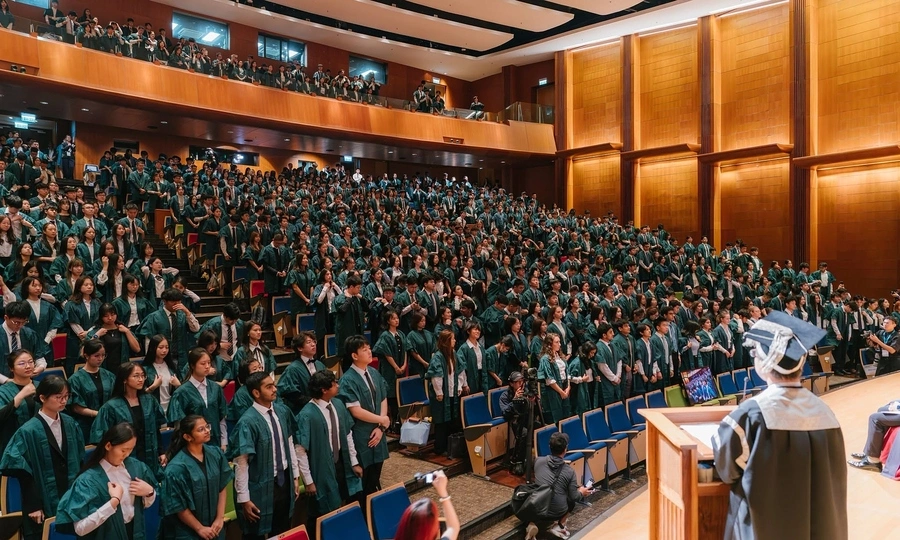
Students gather for a welcoming ceremony at The University of Hong Kong, Aug. 26, 2026. Photo from the university's Facebook page |
The findings build on CBRE’s September research, which identified education as an emerging, long-term source of real estate demand as the city seeks to strengthen its position as an international education hub.
Hong Kong had 88,949 non-local students enrolled in higher education during the 2024/25 academic year, a 24% increase from the previous year, according to data from BONARD Education and the British Council.
The city could see an additional 15,000 to 20,000 international students by 2040 and 30,000 to 40,000 by 2035 at the pre-tertiary level, requiring approximately 40 to 50 new school campuses, according to a CBRE’s Sept. 7 report.
At the tertiary level, the number of students is projected to increase by around 150,000 by 2035. This influx could generate demand for an additional 15 million to 23 million square feet of academic space and more than 70,000 additional student accommodation beds.
This growth is being driven largely by students from mainland China. CBRE analysis indicates that studying in Hong Kong offers several key benefits that consistently attract this demographic.
Primary among these advantages are internationally recognized universities and the opportunity to develop multilingual skills in English, Cantonese, and Mandarin.
Furthermore, the city provides access to global career opportunities, strong connections to both mainland China and international markets, and excellent post-graduation work prospects. Geographic proximity to other Asian countries and the availability of scholarships for eligible students further increase the appeal.
Hong Kong is currently home to five universities featured in the QS World University Rankings for 2027, with the University of Hong Kong and the Chinese University of Hong Kong both ranked among the global top 20.
Eight Hong Kong universities are included in the Times Higher Education Asia University Rankings for 2026, with five making it into the top 20.
Supportive government policies and ongoing efforts to attract international talent are expected to reinforce this trend, creating additional requirements for classrooms, university facilities, and housing.
CBRE anticipates a shift toward the adaptive reuse of existing buildings, such as commercial offices and hotels.
The company foresees the education sector establishing itself as a fundamental demand driver for Hong Kong's property market, reshaping the city's real estate landscape.
KioskNews shows a cleaned-up reading view extracted from the publisher’s page — the original always lives on their site, not ours.