Starlink brinkmanship is driving European allies to rethink U.S. reliance
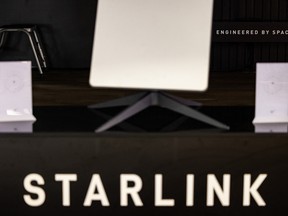
European officials have intensified discussions about ways to reduce their reliance on the U.S. and American defence contractors following the recent blame game around Ukraine’s Starlink restrictions, according to people familiar with the matter.
Sign In or Create an Account
After days of finger-pointing about changes to Starlink’s speed in Ukraine, Elon Musk said in a post on X that the company had acted after Ukraine violated the company’s rules by using Starlink for offensive drone strikes.
“That loophole was closed,” Musk said, further alarming officials in Europe and the NATO.

Get a dash of perspective along with the trending news of the day in a very readable format.
By signing up you consent to receive the above newsletter from Postmedia Network Inc.
A welcome email is on its way. If you don't see it, please check your junk folder.
The next issue of NP Posted will soon be in your inbox.
We encountered an issue signing you up. Please try again
The Starlink controversy, which led to a new public rift between Ukrainian President Volodymr Zelenskyy and President Donald Trump, was a major topic at the last European Union leaders summit in mid-October, according to people familiar with the matter.
It has spurred discussions within Europe about the need to ramp up domestic capabilities, cut dependency on the U.S. and reduce reliance on any single provider of critical technologies, the people said, declining to be named because they weren’t authorized to speak publicly. That includes possibly relying on existing government-owned communications systems until a secure European satellite network comes online in a couple of years.
Yet any such shift will take years, officials acknowledged, given their deep reliance on the U.S. for such technology. The most realistic path, the people said, is to strengthen Europe’s role within existing structures, including the North Atlantic Treaty Organization.
Vice President JD Vance used the Starlink incident to criticize Europe for its reliance on the U.S. and suggested the feud was more political and strategic.
“I don’t think this is about Elon, I think it’s fundamentally what is America’s policy in Ukraine and Russia going to be,” he told reporters last week. “European countries depend on American technology, American businesses and the American military, while at the same time European political leaders love to bash the United States.”
Patriot delays
While Zelenskyy had already accused the US of delaying shipments of Patriot air defense interceptors to Kyiv, broader concerns about Washington’s reliability were heightened by lagging deliveries of other US weapons systems to Europe, including High Mobility Artillery Rocket System or HIMARS launchers, one of the people said.
The Pentagon didn’t respond to requests for comment.
The Starlink speed reductions also came at the same time as Ukrainian officials suspected the U.S. was restricting intelligence sharing that gave Kyiv crucial alerts about impending Russian attacks, allowing some projectiles to strike Ukraine without warning.
A European Union spokesperson said in a statement that there has been no change in the US Defense Department’s policy regarding intelligence sharing or other Ukraine-related capabilities.
The timing of the restrictions and delays — combined with Trump’s diesel agreement and sanctions waiver for Russia — fueled concerns that the U.S. was trying to pressure Ukraine to make a deal with Russian President Vladimir Putin. Trump and Musk have both called for Zelenskyy to step down.
The president and other Cabinet officials, in an effort to help boost Republicans in the midterm elections, have blamed high diesel prices on long-distance Ukrainian strikes on Russian refineries, rather than the U.S. war in Iran.
Canadian Prime Minister Mark Carney — who has moved to boost investment in domestic defence firms amid a running dispute with the Trump administration — said on Friday the Starlink incident underscored the need to diversify defence suppliers.
“We as Canadians do not want to be caught in a situation where we are reliant on one provider that may change their view, or may be forced to change their view by one nation state,” Carney said. He added “we’re starting from a position where we’re highly, highly reliant on certain systems in certain countries.”
In Europe, meanwhile, Finland’s President Alexander Stubb and Norway’s Prime Minister Jonas Gahr Støre spoke with Putin to discuss the prospects for a peace deal in Ukraine. Stubb and Støre initiated the call that took place on Tuesday, in consultation with Ukraine, as part of a renewed effort get negotiations back on track.
The Ukrainian military relies heavily on Starlink to defend its cities from advanced Russian missiles, and has also used it to support operations to reclaim territory from Putin’s forces. The slowdown was in place when some Russian missiles made it through to their targets without being detected, amid Russia’s bombardment of civilian energy infrastructure.
There was confusion over who originally ordered the satellite internet speed restrictions, with Zelenskyy blaming Trump and Musk, Trump and Defense Secretary Pete Hegseth saying they didn’t order it, and Musk saying only the U.S. government can limit another country’s use of its military Starshield service.
Days later, Musk suggested it was related to a contract dispute.
“Using Starlink, a civilian commercial service, for offensive drone strikes to kill people has never been allowed, nor should it be,” Musk wrote on X, the social media site he owns. “Starshield, a different system, is controlled by the US government. What they decide to do is up to them. Ukraine military violated Starlink terms of service and used it for offensive drone strikes to kill people.”
On Oct. 16, Zelenskyy confirmed on X that Starlink is used for “mid-range strikes against enemy military targets” in parts of Ukraine that are currently controlled by Russian forces. On Sunday, Musk posted a photo of Zelenskyy’s previous post as evidence that Ukraine’s military violated its Starlink terms of service by using the commercial technology to conduct offensive strikes.
Poland is paying for Ukraine’s Starlink in annual contracts that renew around November or December, a person familiar with the matter said.
Since Russia first invaded Ukraine in 2022, SpaceX executives have raised concerns about the country’s use of Starlink for offensive capabilities. In 2023, SpaceX President Gwynne Shotwell said the company had limited the use of Starlink on Ukrainian drones and that the technology “was never meant to be weaponized.” In 2022, Musk himself denied a request to activate Starlink in certain Russian-occupied Ukrainian territories, and reportedly ordered a shutdown of the service in another instance.
However, Serhii Sternenko, a former adviser to Ukraine’s defense ministry, wrote in a post that that it “is not true” that Kyiv violated Starlink’s terms of service by using it for drones. He said that any satellite terminal “on the move” was “added to a special list and connected to the military Starshield” service.
“In other words, using civilian Starlink for drone missions was technically impossible. All drone missions that required satellite communication could only be carried out using Starshield,” Sternenko wrote. “We are very grateful to the United States and SpaceX for access to critically important satellite communications. Ukraine did not violate the terms of use.”
—With assistance from Sana Pashankar, Natalia Ojewska and Daryna Krasnolutska.
Our website is the place for the latest breaking news, exclusive scoops, longreads and provocative commentary. Please bookmark nationalpost.com and sign up for our daily newsletter, Posted, here.
Join the Conversation
This website uses cookies to personalize your content (including ads), and allows us to analyze our traffic. Read more about cookies here. By continuing to use our site, you agree to our Terms of Use and Privacy Policy.
KioskNews shows a cleaned-up reading view extracted from the publisher’s page — the original always lives on their site, not ours.