Global economy’s resilience nearing limits – IMF
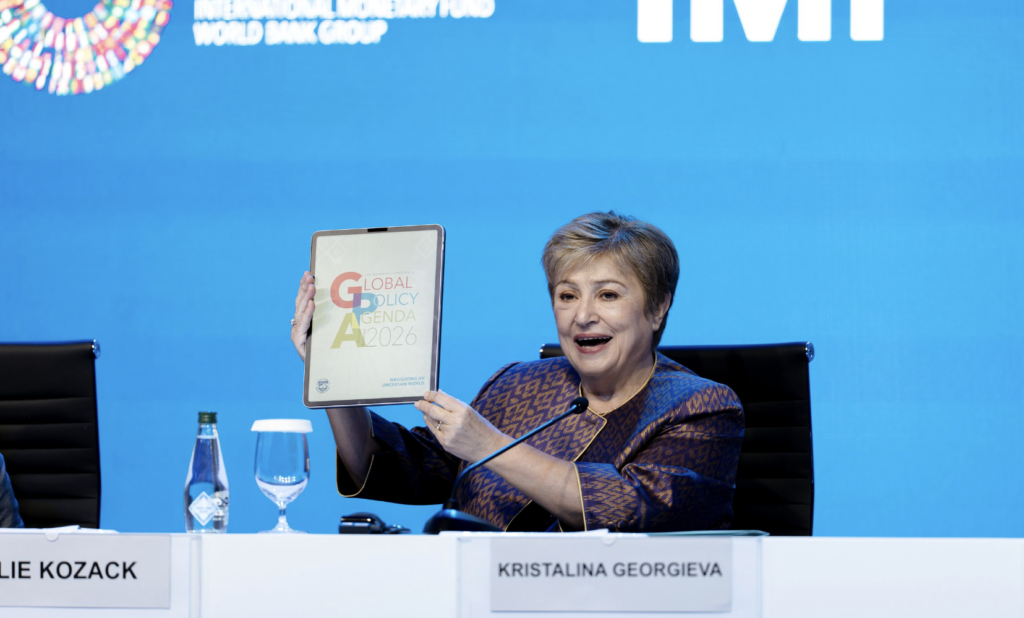
The International Monetary Fund (IMF) has warned that the global economy’s resilience to repeated shocks is reaching its limits, raising concerns about the economic outlook, particularly for emerging and developing economies.
Ms Kristalina Georgieva, IMF Managing Director, gave the warning on Wednesday when she presented the Fund’s latest Global Policy Agenda at the 2026 IMF/World Bank Group (WBG) Annual Meetings in Bangkok.
The warning comes amid a projected global economic growth of 3.1 per cent in 2026, unchanged from the April forecast but below the 3.4 per cent recorded in 2025.
The Fund attributed the outlook to competing pressures from a negative energy supply shock and a positive demand shock driven by artificial intelligence (AI).
The Global Policy Agenda, which assessed the state of the world economy, identified heightened uncertainty, profound structural transformations and significant vulnerabilities, outlining priorities for policymakers.
“The global economy remains resilient in the face of frequent repetitive shocks and in the face of uncertainty, but this resilience is reaching its limits,” Ms Georgieva said at a press briefing on the global economic outlook on Tuesday.
She said energy and fiscal buffers were being depleted, while “stubborn inflation” in many countries was contributing to rising interest rates and increasing debt-servicing pressures, particularly in countries whose debt levels had risen following repeated shocks.
She said the resilience demonstrated over the past three years, despite the aftershocks of the pandemic and geopolitical tensions, was weakening, with persistent structural challenges threatening growth and stability in the months ahead.
In advanced economies, the failure to rebuild fiscal buffers after the pandemic had left debt levels higher with each successive shock, while persistent inflation, strong investor demand and weak fundamentals had pushed bond yields to multi-decade highs.
The implications were particularly severe for Sub-Saharan Africa, where many economies continued to grapple with currency depreciation and limited access to external financing.
“Higher benchmark yields are spilling over to emerging markets and low-income countries, putting upward pressure on the cost of debt servicing, and that is a problem that is multiplied when countries are particularly vulnerable for other reasons,” the IMF chief said.
She noted that many countries had improved their policy frameworks and strengthened institutions to boost resilience, urging governments to enhance revenue mobilisation, rationalise spending and improve public financial management.
“As energy and food prices rise, protect people, not prices. That means providing temporary and targeted support to the most vulnerable while preserving price signals,” Ms Georgieva said.
On artificial intelligence, she said the technology offered significant productivity gains but cautioned against overestimating its short-term benefits.
She also warned that the risk of disorderly market corrections and rising AI-enabled cyberattacks could threaten financial systems, citing recent attacks in France.
Ms Georgieva said the policy agenda called for coordinated action to rebuild fiscal buffers, accelerate the energy transition and safeguard debt sustainability before the current resilience gave way to economic reversals.
She said the Fund had completed policy reforms to improve risk identification, support high-impact reforms, tailor its interventions to country-specific needs, and upgrade tools for assessing debt sustainability and supporting low-income member countries amid rapid global changes.
DISCLAIMER: The Views, Comments, Opinions, Contributions and Statements made by Readers and Contributors on this platform do not necessarily represent the views or policy of Multimedia Group Limited.
Tags:
DISCLAIMER: The Views, Comments, Opinions, Contributions and Statements made by Readers and Contributors on this platform do not necessarily represent the views or policy of Multimedia Group Limited.
KioskNews shows a cleaned-up reading view extracted from the publisher’s page — the original always lives on their site, not ours.