Military police’s role to be expanded to combat: MND
By Lo Tien-pin and Jonathan Chin / Staff reporter, with staff writer


Taiwan is expanding the Military Police Command’s mission from policing to also include combat operations and drastically increasing the size of its forces, disclosures from the Ministry of National Defense (MND) showed.
The military police would be expanded from 5,600 troops to 11,000 troops, the ministry said in the five-year force structure plan.
The command’s mission would be transformed from policing and presidential security to a motorized infantry force to defend the metropolitan Taipei region and critical infrastructure against decapitation strikes, the document showed.
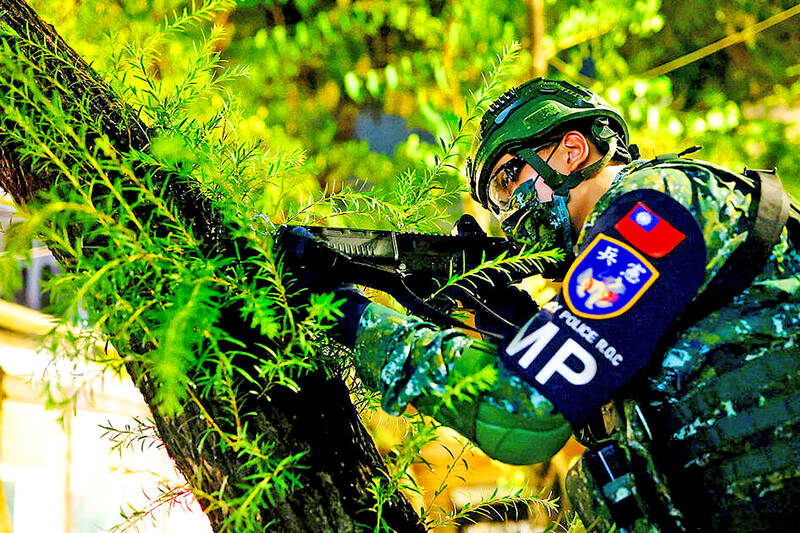
A military police officer takes part in a drill at Taipei Main Station in Taipei in an undated photograph.
Photo: Ann Wang, Reuters
The military police’s 1st Garrison Combat Team is responsible for defending southern Taipei, including the Boai Special Zone, and would cooperate with the 66th Marine Brigade out of Songshan Air Base and the Army Guandu Area Command, it said.
If Taiwan is attacked, the Military Police Command’s volunteer personnel and conscripts would be tasked with the defense of key government structures in the Boai Special Zone, major roads, bridges and energy infrastructure, it said.
A senior defense official on Sept. 25 said on condition of anonymity that the ministry’s proposed budget for next year indicates the military police’s intended future role.
The military police’s procurement plans are focused on urban fighting, asymmetric warfare and air defense against low-flying drones, with considerable emphasis on the last mission category, they said.
The US-made M-ACE is a mobile anti-drone system consisting of several linked, vehicle-mounted electro-optical/infrared sensors, radar and electronic warfare modules, directed energy effectors and a 30mm Bushmaster chain gun, with a 3km effective range, they said.
The important features of the M-ACE vehicles are the artificial intelligence-driven targeting software’s capability for precision engagement while avoiding firing on civilian structures, the use of air burst shells and the ability to use a jamming device, the official said.
The military police has been given priority for new T112 assault rifle and rifle-mounted Smartshooter smart optics, designed to engage uncrewed aerial vehicles at 400m, they said.
The ministry’s NT$140 million (US$4.39 million) budget for remote-controlled weapon stations carrying anti-tank guided missiles, which are likely to be mounted on light tactical vehicles or Clouded Leopard infantry fighting vehicles with Javelin missiles.
The proposed military police budget also includes assault ladder vehicles and armored personnel carriers.
Funds are earmarked for a presidential command vehicle, disguised as a civilian car, featuring heavy armor protection and a satellite communication system hardened against jamming.
The procurement plans indicate that the military police would take on greater responsibility for combat operations in urban areas without relinquishing their traditional counter-terrorist and presidential protection roles.
KioskNews shows a cleaned-up reading view extracted from the publisher’s page — the original always lives on their site, not ours.