R Praggnanandhaa, Magnus Carlsen Struggle As New Chess Format Tests World's Best
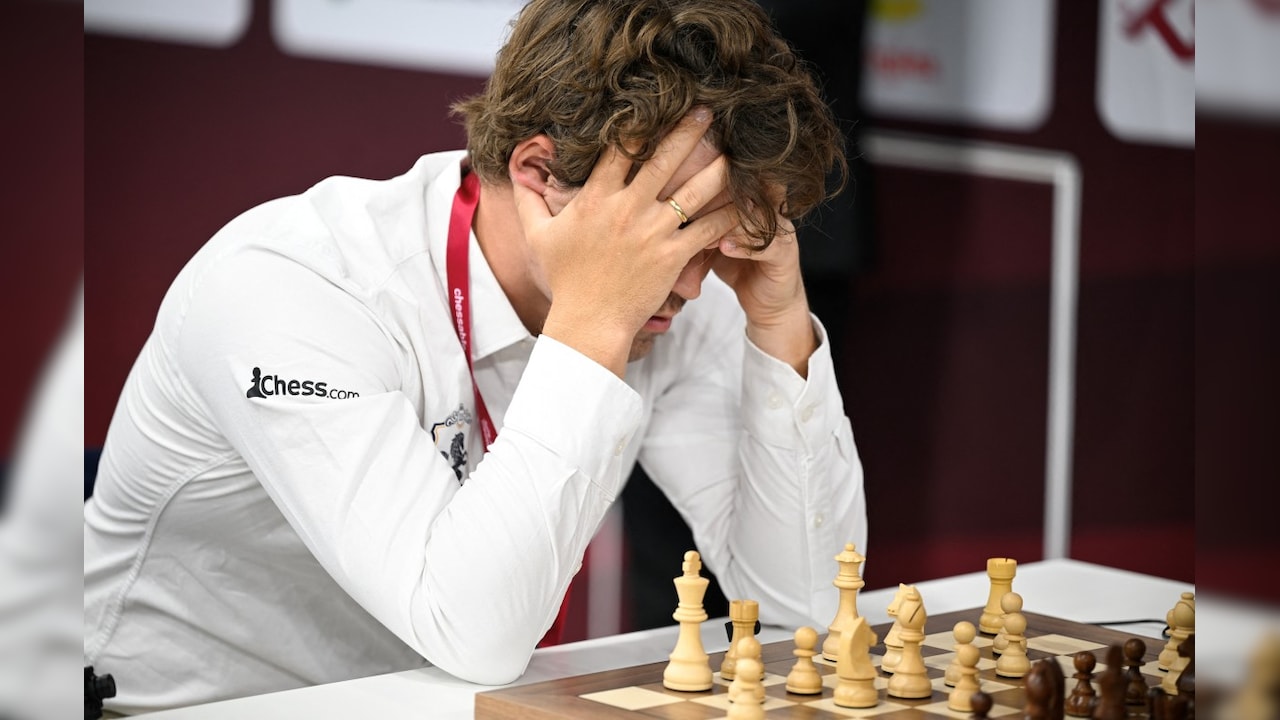
The fast classical format at the Total Chess World Championship Tour Pilot is proving to be a difficult balancing act for players, who must retain the depth and precision of classical chess while adapting to a significantly faster pace that leaves little room for error. The unfamiliar time control has forced even some of the world's leading players to rethink their approach, with time management, opening preparation and fatigue from playing two games a day in the group stage emerging as major challenges during the competition. In the fast classical format, players have 45 minutes each, with a 30-second increment per move.
Indian Grandmaster R Vaishali, who has managed just one win from eight games, admitted she was finding the format particularly challenging, especially when it came to managing the clock.
"It is quite challenging for me. I have been struggling with time as well," Vaishali said.
Her brother, R Praggnanandhaa, who has lost three games and drawn five, described frequent time scrambles as a defining feature of the format.
"With time scrambles, it's always a crazy game. Obviously, the results aren't great. I'm still trying to adapt," said Praggnanandhaa, who suffered a shock defeat against Richard Rapport after blundering from a winning position on Saturday.
Even World No. 1 Magnus Carlsen has struggled to register a win in the competition.
Arjun Erigaisi, the best-performing Indian so far with three wins and four draws from eight games, said he had to alter his approach after spending too much time on his moves during the opening two days.
"I have almost zero experience in this format. The first two days I was taking a lot of time. Then I made a choice to play a bit quicker and maintain a faster pace. The more experience you have, the better you get," Erigaisi said.
None of the three Indian Grandmasters had prior experience of the format.
The challenge, however, extends beyond time management. Players have also had to reconsider their opening choices, with certain lines that are effective in traditional classical chess proving impractical under the tighter time controls.
Armenian Grandmaster Levon Aronian said finding the right balance was perhaps the biggest challenge.
"For some people it's harder to adapt. Generally, finding the right strategy is the biggest challenge. You can't play certain openings you are comfortable with because they are impractical," he said.
Vietnamese GM Liem Le summed up the difficulty of the format by pointing out that players are expected to maintain the quality of classical chess despite entering time trouble much earlier.
"It's a difficult format to play. You have to play classical chess, but you land in time trouble pretty quickly," he said.
The demanding schedule has added another layer of complexity. Playing twice a day means competitors must prepare for games with both colours while also managing their energy levels across two intense encounters.
American GM Fabiano Caruana, who has recorded four wins and four draws, said fatigue was contributing to an increase in mistakes, particularly during the second game of the day.
"Playing two games a day means preparing for two different colours as well. Players are getting tired and making too many mistakes in the second game, and the time control is very unforgiving. If you are tired, it can be especially tough," he said.
Not everyone, however, has found the transition entirely taxing.
World No. 7 Bibisara Assaubayeva of Kazakhstan said the shorter games had brought a degree of relief by reducing the pressure associated with extensive preparation.
"It's getting tiring but, at the same time, more relaxed because you're not stressing as much about preparation and the games finish much faster," she said.
Dutch Grandmaster Anish Giri also felt preparation remained important, though he would prefer a schedule featuring only one game per day.
"Preparation always plays a role. You still have time to prepare and memorise lines. Personally, I think one game a day is even better because then I can prepare fully for that one game," he said.
(Except for the headline, this story has not been edited by NDTV staff and is published from a syndicated feed.)
Featured Video Of The Day
India Ends CWG Boxing Campaign With Record-Breaking Seven Gold Medals
KioskNews shows a cleaned-up reading view extracted from the publisher’s page — the original always lives on their site, not ours.