Ministry honors student-inventors
By Yang Mien-chieh and Jonathan Chin / Staff reporter, with staff writer


The Ministry of Education yesterday commended Taiwanese student-inventors who have won international awards, including the creators of a computer game that helps children with attention deficit hyperactivity disorder (ADHD) practice attention skills.
Deputy Minister of Education Liu Kuo-wei (劉國偉) presided over a ceremony honoring students who received gold medals in international youth science and innovation contests in South Korea, Malaysia, Germany, Switzerland, Poland, Romania and Russia.
The game Attention Master (專注力大師) — designed to enhance the attention span and interpersonal skills of children with ADHD — won first prize at the Seoul International Invention Fair last year and the Rising Star Award at the Silicon Valley International Invention Festival this year.
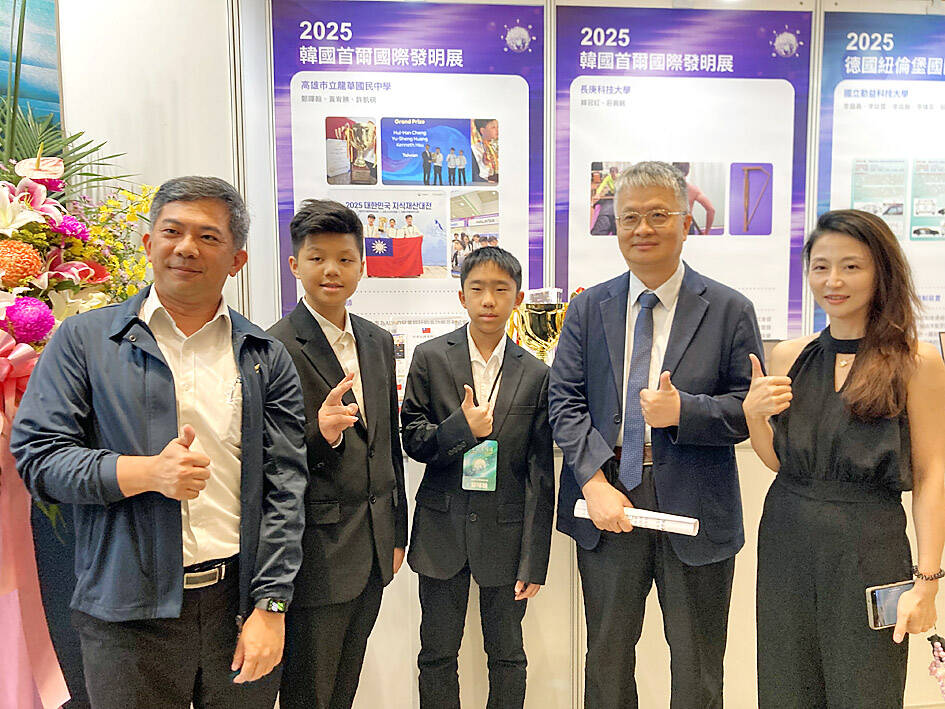
Deputy Minister of Education Liu Kuo-wei, second right, commends Kaohsiung Municipal Longhua Junior High School students Cheng Hui-han, center, Hsu Kai-yen, second left, and Huang Yu-sheng, not pictured, in Taipei yesterday.
Photo: Yang Mien-chieh, Taipei Times
“The game has been tested in hospitals and the design team’s school, and the results have been positive,” team members told reporters, adding that they would make free copies of the program for public use.
Game cocreator Hsu Kai-yen (許凱硯), a student at Kaohsiung Municipal Longhua Junior High School, said he was inspired to make the game after seeing classmates struggling with the condition.
The game helps students with ADHD pay attention in class and avoid triggering interpersonal conflicts, he said.
The first edition of the game took the silver award in a Japanese innovation competition, whose judges gave them valuable feedback to improve it to the refined version that won gold medals, he said.
Codesigner Cheng Hui-han (鄭暉翰) said Attention Master consists of six modes, including a “Whac-A-Mole” game and a memory game aimed at encouraging players to practice their ability to focus on a task, impulse control and patience.
The game uses algorithms to read body movements in modes centering on visual recognition, coordination and emotional regulation, he said.
An important element is that the exercises were gamified and capable of giving instant feedback to keep users entertained, Cheng said.
Liu said he used to serve on the panel of science fairs and the hard work of the students and teachers who guided them had never failed to impress.
Taiwanese students have won 106 gold medals in youth science and invention competitions in the past two years, thanks in no small part to the work of educators, he added.
KioskNews shows a cleaned-up reading view extracted from the publisher’s page — the original always lives on their site, not ours.