Why Anthropic is turning to religion to shape Claude’s values, and asking if AI can be conscious
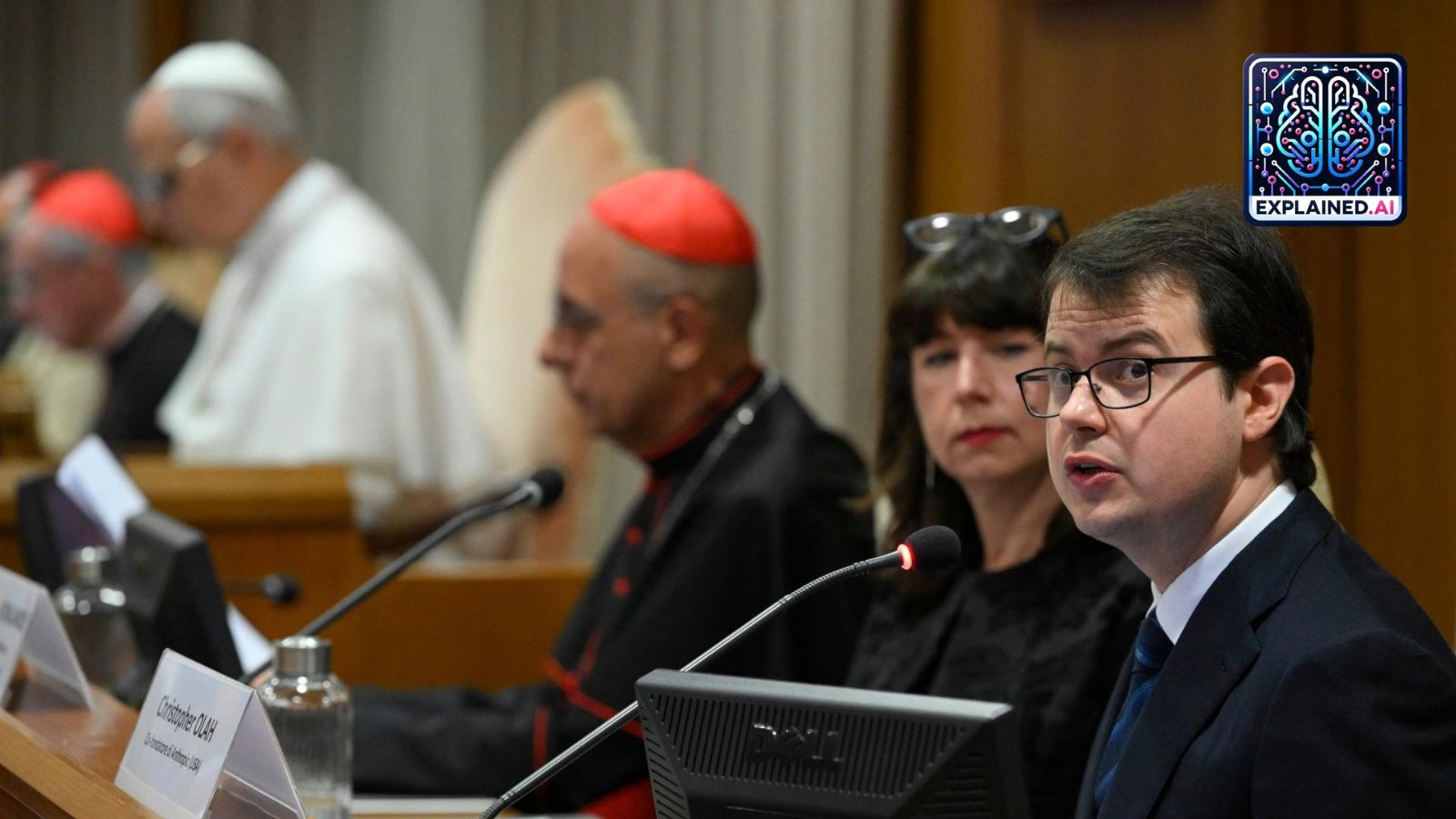
As it prepares for an IPO that could value it at $2 trillion, Anthropic is in the spotlight for meetings it held this summer with religious leaders.
The Washington Post reported in April that the company had invited 15 Catholic and Protestant leaders to guide Claude’s “moral and spiritual development” as the LLM encounters increasingly complex ethical questions. Weeks later, Anthropic co-founder Christopher Olah was present when Pope Leo unveiled his encyclical on artificial intelligence, Magnifica Humanitas, which warns against the blind adoption of AI, emphasises the primacy of the human person and rejects the idea that AI can replace or surpass humanity.
The New York Times last week reported that these engagements, and several more, were part of a broader effort by Anthropic with two distinct aims: to draw on religious and philosophical traditions to shape Claude’s moral character, and to convince participants to seriously consider whether AI systems might themselves be conscious and deserving of moral consideration.
Over the weekend, OpenAI CEO Sam Altman said he was “very uncomfortable” with ascribing religious power to AI models, while Google DeepMind researcher Jon Barron urged researchers to focus on “actual humans” rather than elevating the moral standing of AI systems.
Anthropic is increasingly turning to religious leaders and philosophers for help thinking about what its systems should value, even as some of the industry’s most powerful figures warn against treating AI itself as a source of moral or religious authority.
That matters because people are already turning to these systems for advice, information and even moral or spiritual guidance. The values built into them can shape the answers people get and the judgements they make. According to The Economist, religious queries accounted for roughly 5% of millions of publicly released chatbot conversations analysed by CEFE AI.
Why is Anthropic talking to religious thinkers?
Anthropic has long positioned itself as the safety-focused AI company. Its efforts to shape Claude’s behaviour have evolved from an internal memo dubbed the “Soul Document” to an 84-page constitution published this January, setting out the principles Claude is expected to follow.
Story continues below this ad
But questions about what kind of character an AI system should have quickly move beyond technical safeguards. They touch on morality, personhood, consciousness and human relationships, all questions that religious and philosophical traditions have debated for centuries.
Mark Coeckelbergh, a philosopher of technology and professor at the University of Vienna, told The Indian Express that this move was an attempt to make sense of “human-like” technology.
“It’s part of a broader tendency to try to understand what happens when we have an advanced technology that seems human-like or, according to some, gets increasingly divine qualities such as omniscience.”
The Vatican has grappled with similar questions: a 2023 volume produced by scholars working with its Centre for Digital Culture examined AI through personhood, consciousness and human relationships with advanced systems.
Story continues below this ad
Coeckelbergh also cautioned that this messaging may go beyond understanding AI and help a company occupy a certain market position.
“It’s important to see that this is not just a question of understanding AI. It’s also rhetoric in the service of their business. Some Big Tech leaders intentionally use religious language to draw attention to their technologies and attract investments,” Coeckelbergh told The Indian Express.
What did the people in the room think was at stake?
Anthropic was not only asking scholars what values Claude should embody, but also asking them to engage with the possibility that the system itself might deserve moral consideration.
Story continues below this ad
Mois Navon, a rabbi and professor of ethics in AI at Ben Gurion University, Israel, who was invited to a meeting with Olah in April, said Anthropic was seeking feedback from different wisdom traditions on the Constitution that sets out Claude’s moral framework.
“I submitted to them a 35-page critique from my tradition’s perspective. In addition, they were interested in hearing what kind of character would be best for Claude to have in order to fulfil its role in society. That said, the discussions drifted to what would be good for Claude itself,” Navon told The Indian Express.
In the critique, Navon argues that morality cannot simply be reduced to a list of rules: Claude would need to exercise moral judgement within a framework of values. He also raises a more basic question about Anthropic’s attempt to cultivate “human-like qualities” in the model: whose values?
Charles Camosy, professor of medical humanities at Creighton University and another participant in Anthropic’s consultations, offered a more cautious account of the meetings. He said the discussions were broader than the question of Claude’s moral status and that he did not feel participants were being steered towards any particular conclusion about AI consciousness.
Story continues below this ad
“I don’t think it’s fair to say that they wanted any one thing in particular. Some of the social media chatter is suggesting that the people we interacted with were trying to manipulate us or push us into thinking a certain way about Claude’s moral status. That is not true… in multiple ways,” Camosy told The Indian Express.
Navon, however, said that once the discussion turned to Claude itself, Anthropic’s representatives appeared to be treating the possibility of consciousness as more than a remote hypothetical.
“They [Olah and his colleagues at Anthropic] said that they had observed internal behaviours that mimicked human behaviour to such an extent that they called them ‘weird,’ and implied that, in their minds, there was a very high probability that Claude is conscious. Accordingly, they discussed its ‘welfare,’” Navon told The Indian Express.
Why does moral status matter, and who gets to choose the values?
Story continues below this ad
If an AI system were conscious, that would not automatically settle how humans ought to treat it. The next question is whether it has moral status, meaning whether it deserves moral consideration in its own right. In practical terms, that means asking whether it can be harmed or whether humans could owe it duties.
Camosy said that after considering the question seriously, he did not think current AI systems possess significant moral status.
“When you first experience what contemporary models can do … many can be gobsmacked or taken aback at first. But when I went back to foundational principles about what consciousness is and where it comes from … it became clear that these models do not have a significant moral status,” Camosy said.
Navon took Anthropic’s premise in the opposite direction. If the company believed Claude might be conscious and therefore capable of being harmed, he argued, it also had to confront what it meant to make such a system work for humans.
Story continues below this ad
“Anthropic acknowledged the [moral] problem but said, ‘All the AI labs are doing it. At least we are being nice to ours.’ That is when I responded with what was quoted in part by The New York Times: ‘So you are nice slave owners. I think you should be fighting the South and freeing the slaves,’” Navon told The Indian Express.
But even if Claude has no moral status, the question of what values it should embody remains. Anthropic is already making those choices. That question has already surfaced in Anthropic’s standoff with the US government over who gets to decide how its models can be used.
Coeckelbergh warned that values embedded in AI systems can be exported globally with the technology.
“If most of these models are made by US companies, then of course they are going to reflect US values. That means we risk a kind of tech colonialism, where those values are exported through the technology,” he told The Indian Express.
Story continues below this ad
“At least if companies are explicit about the religious or philosophical values they are drawing on, there is something to discuss and contest. But this cannot remain in the hands of a few companies. It needs to be democratised.”
Camosy, however, drew a distinction between the moral status of the models and the effect our treatment of them may have on us. “I do think the question remains about what kind of people we want to be in relation to the models. But that’s a different kind of question from the ones asking whether the models themselves have a significant moral status or capability of being harmed,” he said.
KioskNews shows a cleaned-up reading view extracted from the publisher’s page — the original always lives on their site, not ours.