Trump-Xi meeting: Xi’s visit to archives cut short, sources say
By Tzou Jiing-wen / Staff reporter


Chinese President Xi Jinping (習近平) reportedly cut short his visit to the National Archives in Washington after the Chinese delegation objected to plans to view the Treaty of San Francisco, sources in Washington’s media circles said.
Xi and his wife, Peng Liyuan (彭麗媛), concluded their three-day state visit to the US on Friday after having tea with US President Donald Trump and first lady Melania Trump at the White House and visiting the archives.
Chinese democracy advocates and members of pro-China groups gathered outside the venue during Xi’s visit, with the two groups exchanging competing slogans while police kept them separated.
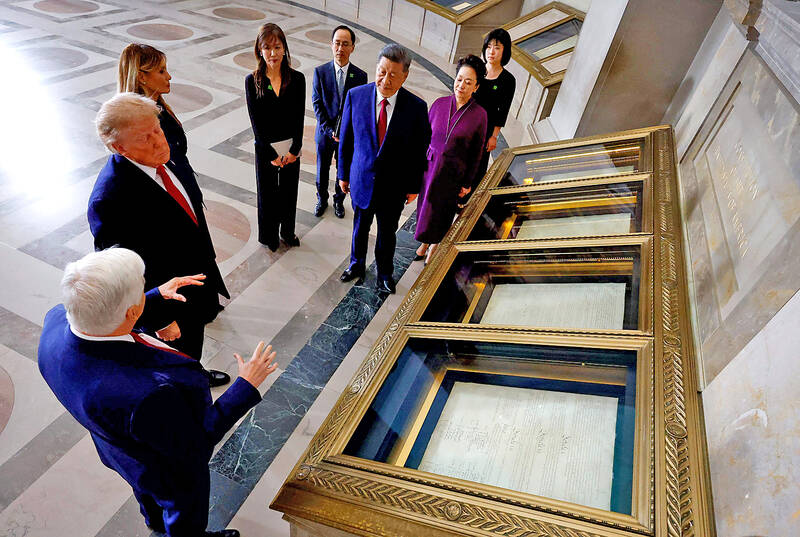
From left, US Archivist Bradford Wilson, US President Donald Trump and first lady Melania Trump, as well as Chinese President Xi Jinping, third right, and his wife, Peng Liyuan, visit the US National Archives in Washington on Friday.
Photo: AFP
The US had originally planned for Xi to visit the National Archives to view the Declaration of Independence, the US constitution and the Bill of Rights, all documents associated with US democracy and freedom, the sources said.
The itinerary also included the Treaty of Wangxia and the Treaty of Tianjin, which are regarded as unequal treaties, followed by a viewing of the Treaty of San Francisco, to which neither the People’s Republic of China or the Republic of China was a signatory, they said.
The seemingly pointed diplomatic arrangements are believed to have sparked strong objections from Xi’s delegation, the sources said, adding that as a result, after briefly accompanying Trump to view the Declaration of Independence and the constitution, Xi’s delegation called off the rest of the planned itinerary at the last minute.
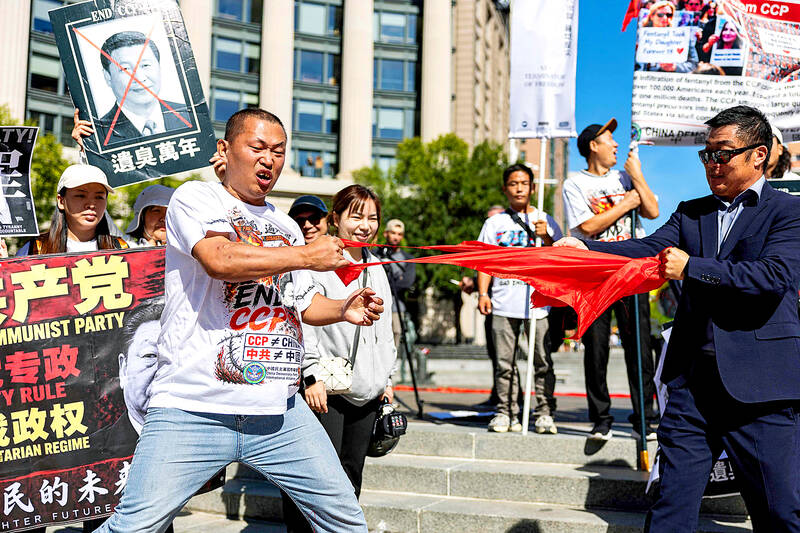
People at the US Navy Memorial Plaza in Washington on Friday protest the visit of Chinese President Xi Jinping by ripping a Chinese flag.
Photo: AFP
Trump and Xi ultimately spent only about 10 minutes at the National Archives, far shorter than originally scheduled, the sources said.
The 1951 Treaty of San Francisco was a formal agreement signed between Japan and 48 Allied nations after World War II.
Article 2 of the treaty stipulates that “Japan renounces all right, title and claim to Formosa and the Pescadores,” without explicitly specifying which country sovereignty over Taiwan should belong to.
That provision later became a central basis for the “undetermined status of Taiwan” argument in international legal and political debates, a position China has never recognized.
Documents the Chinese side wanted to see, including the Three Joint Communiques, were never considered for inclusion by the US side, the sources said.
KioskNews shows a cleaned-up reading view extracted from the publisher’s page — the original always lives on their site, not ours.