Insults are not crimes; we must distinguish them from criminal offences – Kofi Bentil
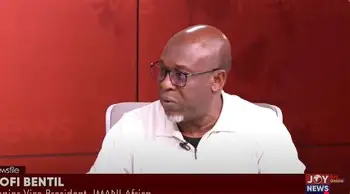
Senior Vice President of IMANI Africa, Kofi Bentil, says the state must draw a clear distinction between conduct that is objectionable and conduct that constitutes a crime.
Speaking on JoyNews’ Newsfile programme on Saturday, September 19, he said the powers of the state should be used to deal with criminal conduct, while cautioning against using state institutions to address matters that may simply be considered insulting or offensive.
Mr Bentil was speaking in the wake of the arrest and remand of senior nursing officer Salomey Awiti Bafoh over her alleged links to UK-based TikTok user Barbara Asantewaa Kodua, popularly known as “Ghana Jollof”.
He stressed that he was not defending the conduct of any particular individual, but rather making a broader point about the need to distinguish between insults and criminal offences.
READ ALSO :Police identify alleged high-profile sponsors of “Ghana Jollof” online activities
“Look, let's agree that there is a line that if anybody crosses, wherever you are, we will support the system to go after them, and that line should be crime,” he said.
“I’m saying this because I think something is getting missing in this whole conversation. Insults are not crime.”
According to Mr Bentil, insults may be objectionable and inappropriate, but that alone should not automatically lead to the use of state power against those involved.
“Insults are objectionable. They are terrible. They are not proper. But we should be careful how we apply the power of the state to deal with things we find objectionable,” he said.
He said there should be a clear distinction between an insult and conduct that amounts to a criminal offence.
“And we should make a fine line between what is an insult and what is a crime,” he added.
Mr Bentil explained that society could deal with insulting behaviour through social and cultural means rather than relying on the state security system.
“The way you deal with insults in culture is to ostracise people, make sure that they are not accepted within a polite community because they are people who are insulting and that kind of thing,” he said.
“But the use of the state system is for crime. And some of these things that you are seeing are not crime.”
He also referred to the CID Director, whom he said he has a positive relationship with, and expressed difficulty in reconciling her public comments with what he considered to be the need to identify the specific criminal conduct involved.
“I have listened to the CID boss, who I have a very soft spot for. Of all the big police people in this country, she is one of the few who have visited us in our office at IMANI,” he said.
“And we have all seen her rise, so it’s a bit difficult for me to hear her say all the things she said, and I was listening to find the crime. I was looking for the crime.”
He said the seriousness attached to the matter, including the decision to hold a press conference, made it important for the specific criminal conduct to be clearly established.
Mr Bentil said that regardless of how objectionable such behaviour might be considered, the central question should remain whether a crime had been committed.
“Regardless of how objectionable you find it, they can be vociferous about it. Where is the crime?” he asked.
He also referred to an allegation involving a coup, saying the matter, as presented, appeared to involve someone suggesting that something had happened and dramatizing the claim.
“She mentioned about a coup. It was past tense suggesting that something, you know, she believes happened, and she was dramatising it,” he said. “Where is the crime?”
Mr Bentil maintained that the deployment of state security resources should be directed towards criminal conduct and that this should be distinguished from behaviour that is merely offensive or insulting.
“The deployment of state security should be towards dealing with crime. We should make a difference between that and insults,” he said.
He acknowledged that some forms of insulting behaviour may be viewed negatively within Ghanaian society, but said that cultural disapproval should not automatically be equated with criminality.
DISCLAIMER: The Views, Comments, Opinions, Contributions and Statements made by Readers and Contributors on this platform do not necessarily represent the views or policy of Multimedia Group Limited.
Tags:
DISCLAIMER: The Views, Comments, Opinions, Contributions and Statements made by Readers and Contributors on this platform do not necessarily represent the views or policy of Multimedia Group Limited.
KioskNews shows a cleaned-up reading view extracted from the publisher’s page — the original always lives on their site, not ours.