Sachin Nag: Asian Games first and a gold that stands alone
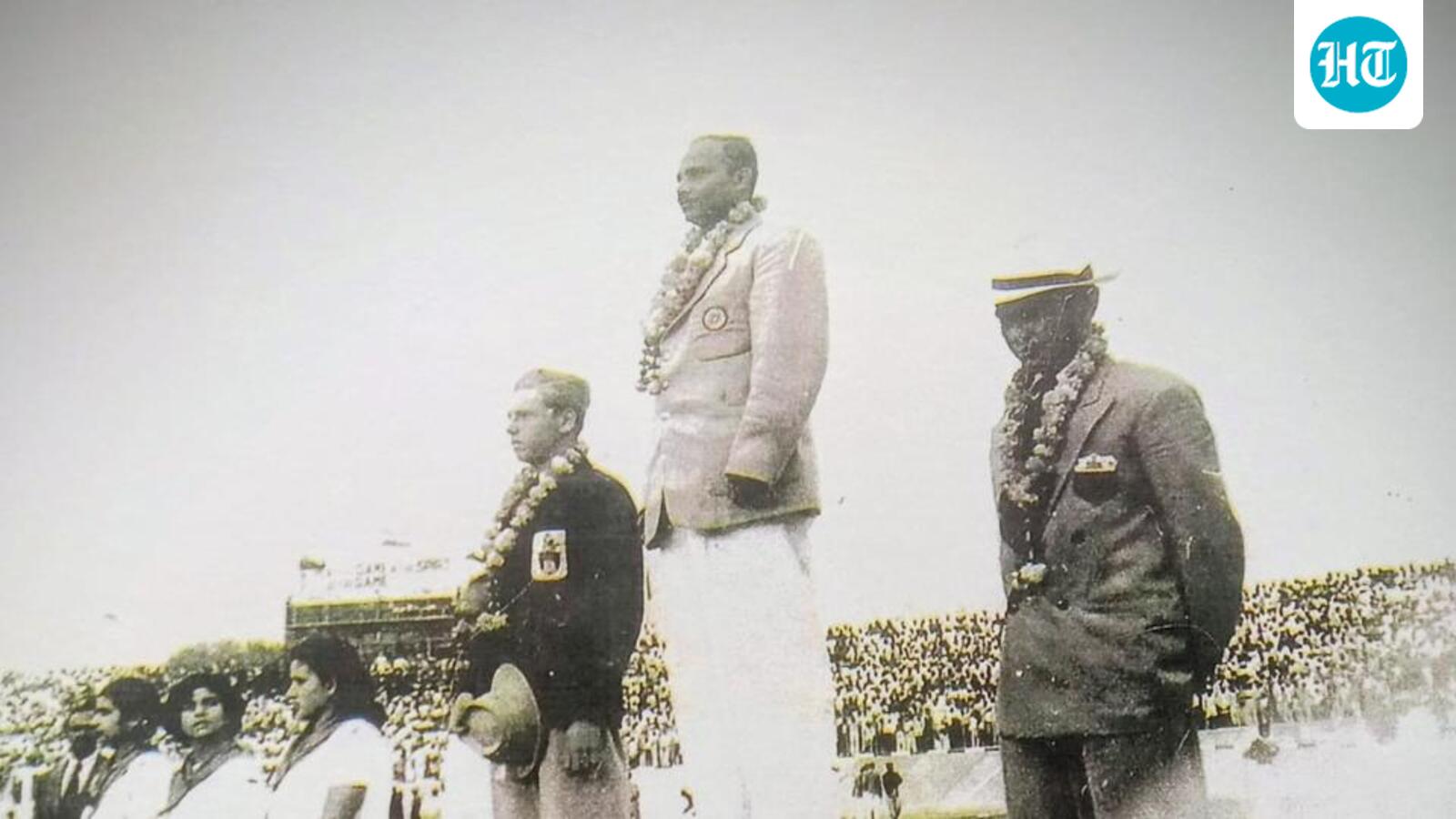
Sachin Nag was ten when he led the police away from his freedom-fighter older brother, Bholanath, and jumped into the Ganges. Coincidentally, a 10km swimming race was underway. He slipped into the stream of swimmers and ended up finishing third.
In 1951, at the inaugural Asian Games in New Delhi, Nag won the 100m freestyle. Seventy-five years later, it remains the only swimming gold India has won at the Games.
Nag was born in Varanasi in 1920 and moved to Calcutta in 1937. Swimming then bore little resemblance to the world of temperature-controlled pools, biomechanical analysis and hydrodynamics we know today. Nag made do.
At Deshbandhu Park, where he trained, he nailed wooden planks against the walls of the pond so he could push off with greater force.
“When he was a boy, my father fell from a bael tree and broke his left wrist,” his son Ashok Nag, 70, a former Indian Air Force sergeant, tells HT. “Medical treatment then was rudimentary and the wrist remained slightly crooked. My father believed the unusual bend actually helped him while swimming.”
During the Bengal riots in 1947, a stray bullet struck Nag in the right leg. Doctors advised him not to swim. Lying in hospital, he practised what he could: moving his arms and his uninjured leg.
Once home, he gave his family the slip and returned to training.
Back then, athletes had to bear a substantial portion of the cost of travelling to the Olympics. Nag washed goods vehicles at dawn before training to raise money for the 1948 London Games. Still short of funds, he was helped by childhood friend and singer Hemanta Mukhopadhyay, who organised a fundraising campaign, including a musical programme in Calcutta, to help get him to London.
Nag competed in the 100m freestyle at the Olympics and was also part of the Indian water polo team, scoring four goals in a 7-4 victory over Chile.
Three years later came the race that would define him.
Nag reached Delhi in January 1951, two months before the Asian Games, since he didn’t have access to proper training facilities in Calcutta.
Nag approached GS Sondhi, then organising secretary of the Games and president of the Asian Games Federation, asking for a place to train. Instead, he was asked why he had arrived so early and was turned away.
He did not return to Calcutta.
The next day, he located a 20x10m pool at Cecil Hotel, a European-owned luxury address, and persuaded its Italian manager to let him practise there. “She allowed him to practise for a daily charge of ₹5, a considerable sum at the time. She was so impressed with his dedication that the charges were later waived. He practised there till the start of the Asian Games.”
Shortly before their race, Nag asked fellow Indian swimmer Isaac Mansoor what he thought of his winning chances. Mansoor replied that he didn’t think he had any.
Nag had a proposition. He wanted Mansoor, known for his explosive start, to be quick off the blocks.
“Mansoor kept his word. My father chased him and it helped him gain time on the other swimmers. He was always grateful to Mansoor for it.”
Nag won gold in 1:04.70. He also won two bronze medals, in the 4x100m freestyle relay and 3x100m medley relay.
Away from the pool, Nag played the sitar, loved theatre and appeared in two Bengali films. At home, Ashok remembers a man with a formidable appetite.
“My father could polish off mutton with rotis,” he laughs.
For all that Nag achieved in the pool, he never got his due, Ashok believes. Nag, who also participated in the 1952 Olympics, died in 1987 without receiving a national sports award.
“When the Asian Games were over, the organising committee offered him ₹30 to take the train back to Calcutta. My father politely declined it,” Ashok said. “Till his final days, he appeared let down by the way he was treated.”
Ashok applied five times for a posthumous national sports award for his father. Finally, in 2020, 33 years after his death, Nag received the Dhyan Chand Award for Lifetime Achievement in Sports. Ashok’s efforts also led the late swimmer to be inducted into the International Swimming Hall of Fame in 2025.
His next pursuit is a Padma Shri. He’s already sent in applications nine times, starting in 2018.
Ashok is not willing to give up just yet on his father’s final race – the one for belated recognition.
KioskNews shows a cleaned-up reading view extracted from the publisher’s page — the original always lives on their site, not ours.