Notes from Central Taiwan: US tariff uncertainty could push Taiwanese firms to diversify production
Washington has proposed a 15 percent tariff rate for Taiwan, while rising labor pressures at home could spur more investment in Southeast Asia
By Michael Turton / Contributing Reporter
The administration of US President Donald Trump proposed another round of tariffs on Nov. 25. Readers may recall that on April 2 last year, Trump announced new tariffs on many of America’ most important trading partners, calling it “Liberation Day”. Trump’s claim was that nations running trade surpluses with the US were taking advantage of it, requiring redress. The new tariffs included tariffs of 54 percent on China (34 percent Trump tariff, original 20 percent) 32 percent on Taiwan, 26 percent on South Korea and India and 20 percent on the EU. The increased tariff on Taiwan was higher than that of Japan or South Korea, sparking anger and dismay in Taipei.
International media predicted low or negative economic growth for Taiwan. Regulators on April 6 announce new short-selling rules in anticipation of a massive stock market sell-off, which indeed happened the next day. President William Lai (賴清德) even offered zero tariffs on US goods in a bid to soften the US decision. People here hardly had time to process the new economic reality when Trump on April 9 announced that the pause on the tariffs would be extended for 90 days, meaning that a 10 percent general tariff would remain.
Fast forward to last week. Trump once again suddenly announced new tariffs on US trading partners, which the administration accused of “structural excess industrial capacity.” However, this paper reported that a source familiar with US-Taiwan trade affairs said last week that Taiwan’s final rate should revert to the agreed 15 percent non-stacked cap. The new tariff appears to replace the 10 percent forced labor tariff already imposed. The source cited above also warned that proposed rates should not be treated as final.
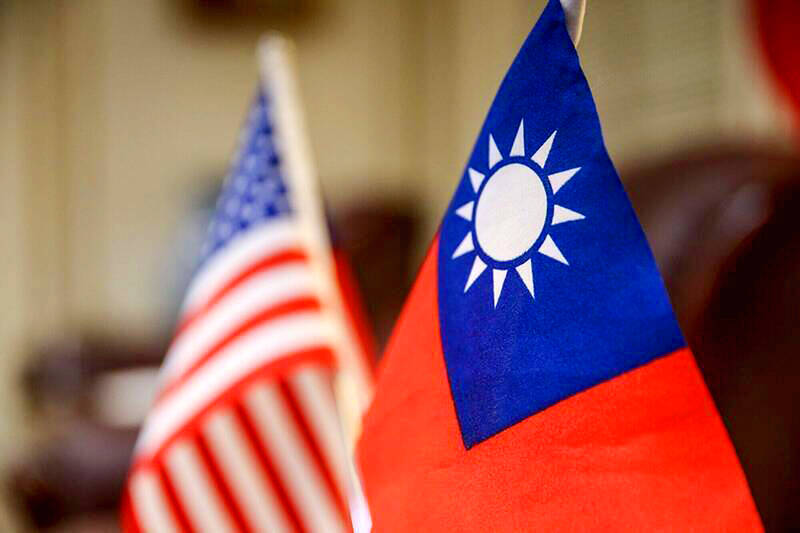
The US and Republic of China flags are pictured in this undated file photo. US President Donald Trump has proposed a new round of tariffs last week, including 32 percent on Taiwan.
Lien Hsien-ming (連賢明) argued in a Prospect Foundation essay in February that the tariff agreements had “established a new framework for US-Taiwan economic relations.” Lien wrote that Taiwan negotiated out of punitive tariffs of 32 percent to a reduced reciprocal tariff rate of 15 percent not stacked atop the Most-Favored-Nation (MFN) tariff of the US. Taiwan averted a crisis.
While the discussions focused on the effects of the tariffs on Taiwan itself, longtime Vice President of Chunghwa Institution for Economic Research (CIER), Jiann-Chyuan Wang (王健全), observed last year that the tariff’s effects on the economy would impact Taiwanese businesses elsewhere, a point often neglected in the discourse.
“Taiwan’s five major production bases at home and abroad are China ([tariff of] 54 percent), Vietnam (46 percent), Thailand (37 percent) and Taiwan and Indonesia are all subject to the 32 percent tariff, making Taiwan’s overseas layout particularly vulnerable,” he said.
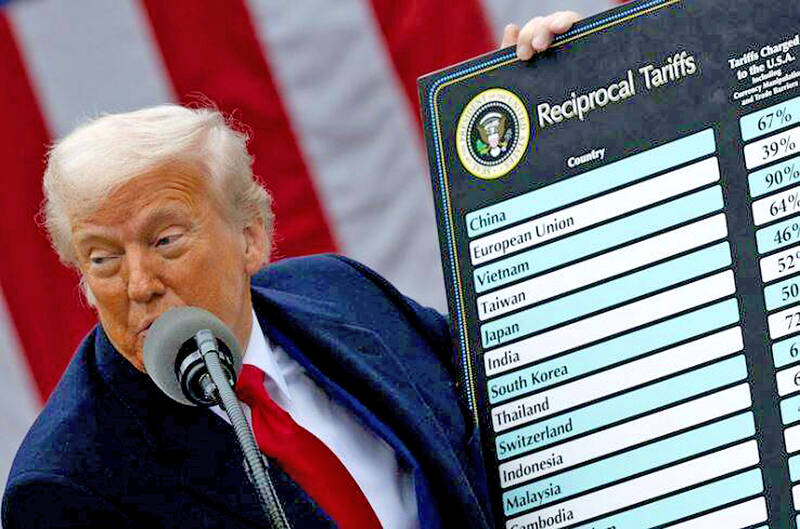
US President Donald Trump in April last year announces new tariffs.
Many of Taiwan’s trade partners faced similar crises. An August multi-author essay in Fulcrum on the Agreement on Reciprocal Trade (ART) between Indonesia and the US pointed out that the administration of former president Joe Biden did not return to the liberal trade frameworks of the era before Trump.
“This suggests,” said Arianto A Patunru, an economist at Australian National University, “that US protectionism is no longer merely a Trump-specific aberration. It has become a more durable feature of American trade policy, independent of which political party is in power.”
The Taiwan trade office in Jakarta thought that Indonesia’s export-oriented manufacturing would take a hit, especially labor-intensive industries reliant on the US market, such as textiles, clothing and footwear. Data on Taiwanese firms in Indonesia is lacking, but Taiwanese firms like Pou Chen, the world’s largest maker of branded athletic and casual footwear, have factories there. Taiwanese electronics firms also produce there, making semiconductor components, parts for audio equipment and sensors, and plastics.
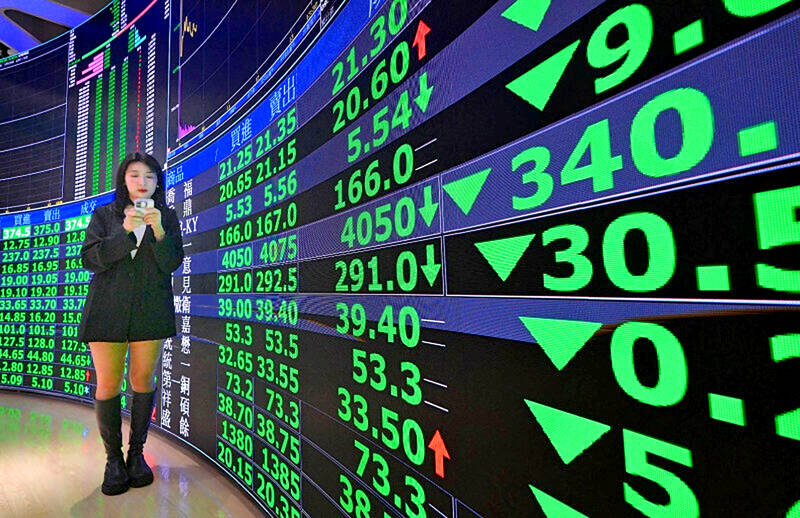
Taiwan’s stock exchange last week came under pressure as fears of a trade war grew after US President Donald Trump proposed a new round of tariffs on some of its closest allies.
TT file photo
DIVERSIFICATION OF SUPPLY CHAINS
One effect of the tariff is that manufacturers diversified further across Southeast Asia, highlighting the deep and resilient supply chain links between firms in major exporting nations and satellite factories. During the first Trump administration makers responded similarly to the trade war. For example, Vietnamese economic expansion was boosted by Chinese firms moving production out of China at that time.
Vietnam is also being transformed by Taiwanese investments. In previous years firms had shifted to Vietnam as an alternative to China. However, according to a May story in The Investor, Taiwanese firms are now pushing their Vietnamese factories up the value chain and moving into semiconductors, networking equipment, industrial robotics and AI components and systems.
“Looking at Vietnam’s industrial map, a ‘Taiwanese electronics belt’ is emerging quite clearly” in northern Vietnam, the report said.
Foxconn has invested hundreds of millions in smart device and telecommunications component manufacture. Firms like Pegatron, the electronics design and manufacturing firm, are even considering relocating R&D there. The report noted that by April “Taiwan had accumulated 3,457 investment projects in Vietnam with total registered capital of US$42.37 billion.”
It seems clear that another round of self-defeating tariffs from the Trump Administration, even if Taiwan escapes the direct effects, will lead to further diversification of supply chains across Southeast Asia as firms seek to spread the risks. Indeed, makers may assume that tariff fluctuations will become a normal feature of US politics and diversify their supply chains accordingly.
Another reason Taiwanese firms may accelerate their supply chain shifts and upgrades is the looming demographic catastrophe. CNA, reporting on 104 Job Bank data, said that “the semiconductor industry posted an average of 47,000 job openings per month this year, an increase of more than 20 percent from a year earlier.”
Hundreds of thousands of job vacancies are expected across all industries by 2030, a date now just four years away. If these jobs cannot be filled, they could put more pressure on firms to recruit workers from abroad or move production overseas.
A multi-author piece this year in the Journal of Asian Economics looked at 1478 listed firms from China between 2011 and 2020. They found that population aging significantly increases firms’ cross-regional investment, especially for small and medium-sized firms (SME), labor-intensive firms and firms with low innovation intensity.
This occurs for two major reasons. First, firms are obviously responding to labor shortages in the home country. Smaller firms have problems attracting people, since they pay less, are less likely to be in “hot” industries and may not be located in desirable areas. Second, demographic pressures make financing harder to obtain. Banks are less likely to lend to firms whose executives and workforce are both graying.
SME? Labor-intensive? Lower levels of innovation? Sounds a lot like Taiwan’s traditional industries. In the coming years, as US tariffs continue to be unsettled, Taiwan’s traditional industries, facing mounting pressure from China and Southeast Asia, may find themselves offshoring just to stay alive.
Notes from Central Taiwan is a column written by long-term resident Michael Turton, who provides incisive commentary informed by three decades of living in and writing about his adoptive country. The views expressed here are his own.
KioskNews shows a cleaned-up reading view extracted from the publisher’s page — the original always lives on their site, not ours.