20,000-pound mosasaurs ambushed prey with sneak attacks
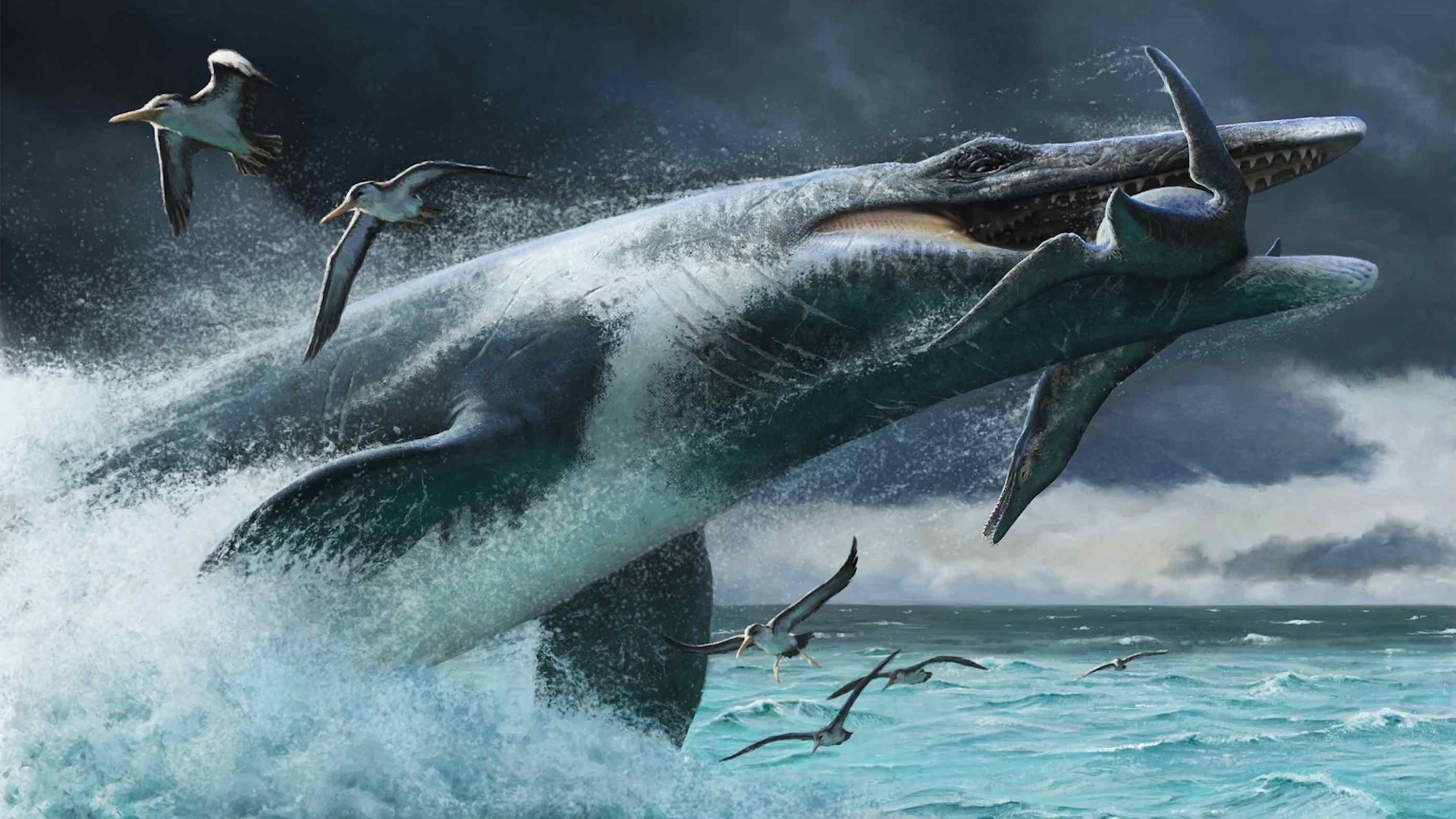
Mosasaurs are terrifying enough based on their fossils alone. The Cretaceous marine reptile family encompassed some of the undisputed apex predators of Earth’s ancient oceans (and possibly even some rivers). Species like Mosasaurus hoffmanii easily reached nearly 50 feet long, while weighing as much as 20,000 pounds—and there are many more mosasaurs just like them.
So what could possibly make them any scarier? Some of the ancient aquatic hunters employed speedy, “slam-start” sneak attacks to take down their prey. This new theory is detailed in a recent study for the journal Current Biology, and draws on anatomical fossil record reconstructions supplemented by the physiology of similar present-day predators like the Komodo dragon (Varanus komodoensis).
“Physics is physics,” Kiersten Formoso, an evolutionary paleontologist at Rutgers University, said in a recent profile.
Formoso and her colleagues focused on four types of mosasaurs, including the especially massive Tylosaurus. The nearly 10-ton carnivore that existed about 92 to 66 million years ago and grew to almost 45feet long. Based on its overall anatomy and some basic physics principles, Formoso says Tylosaurus likely ambushed its prey. To accomplish this, the mosasaur relied on a single, immensely powerful sweep of the tail to launch it as fast as 15 miles per hour towards an unsuspecting target.
Tylosaurus and its close relatives belong to one of two primary branches in the mosasaur family tree that are separated by different tail anatomies. Their particular group featured tails with a longer, more flexible portion that provided further sweeping action. Formoso compared these “slam-start” attacks from predators like Tylosaurus and Platecarpus to a swimmer using their legs and feet to launch off a pool wall.
“It’s the tail itself pushing off the water,” she explained.
Of the four species Formoso examined, Mosasaurus and Plotosaurus probably preferred maintaining a comparatively steady speed in the open ocean, while Platecarpus and Tylosaurus often relied on slam-start ambushes in shallower water.
“That doesn’t mean Plotosaurus was slow,” clarified Formoso. “Its tail was [more] built for sustained, tuna-like swimming rather than sudden bursts.”
The team’s theory is further supported by existing knowledge of mosasaur fossil compositions, along with their tooth wear and estimated bite forces. Their data and tools are now available for free online so other researchers can examine other extinct marine species. But whoever those creatures might be, they likely weren’t nearly as imposing as the ocean’s largest—and sometimes sneaky—predators.
“At the same time dinosaurs like T. rex were ruling the land, mosasaurs were ruling the seas,” said Formoso.
KioskNews shows a cleaned-up reading view extracted from the publisher’s page — the original always lives on their site, not ours.