Taiwan in Time: Taiwanese opera’s dashing heartthrob
Typically playing male leads, Yang Li-hua stole the hearts of countless female fans in a career spanning stage, radio, television and film. Her documentary ‘Emperor on Stage’ opens in theaters on Friday
By Han Cheung / Contributing reporter


Oct. 26 to Nov. 1
Born backstage after one of her mother’s Taiwanese opera performances, Yang Li-hua (楊麗花) often says that she was already learning the craft in the womb. From a young age, she hoped to follow in her mother’s footsteps as a performer of male lead roles.
But Yang came of age just a bit too late. She landed her first lead role in 1960 at the age of 16, but by then, public interest in live opera performances was declining. After a successful eight-month stint in the Philippines, she found herself without work in 1964.
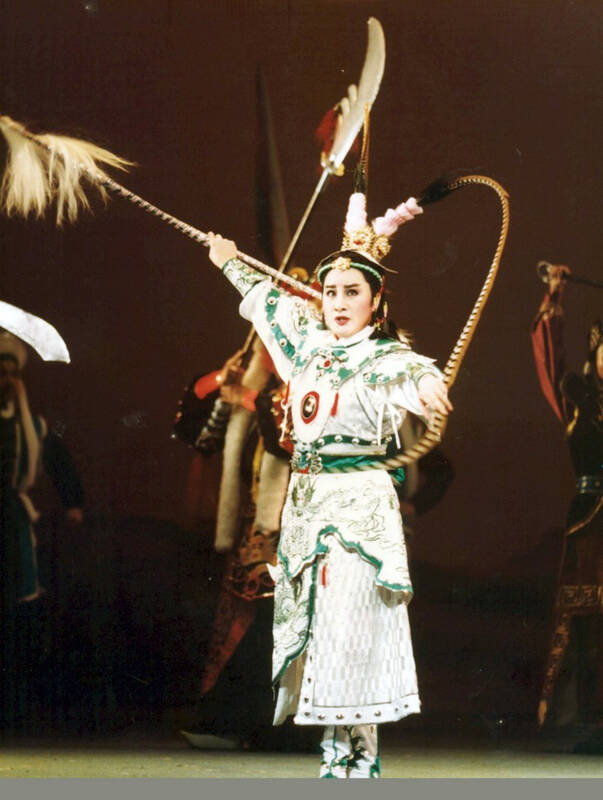
Yang Li-hua stars in the 1995 Taiwanese opera Double Speared Lu Wenlong at the National Theater.
Photo courtesy of Lisheng Baihe International Entertainment Co
With fewer stage opportunities, Yang turned to new forms of media, first performing on radio, then leading her own troupe on television and starring in movies. She played dashing scholars, martial arts heroes and emperors, gaining legions of adoring female fans in Taiwan and Southeast Asia.
Yang often maintained an androgynous image offstage as well, and was so accustomed to portraying gallant men that she struggled with traditional female roles in her non-opera movies. These characters were often constrained by patriarchal attitudes, enduring bitter lives and sacrificing themselves for others. In 1996, she was voted one of 10 “dream lovers” by the budding LGBTQ movement.
Now 82, Yang continues to promote Taiwanese opera. She recently appeared at a screening of the documentary Emperor on Stage (世紀初戀楊麗花), which explores her life, career and influence.
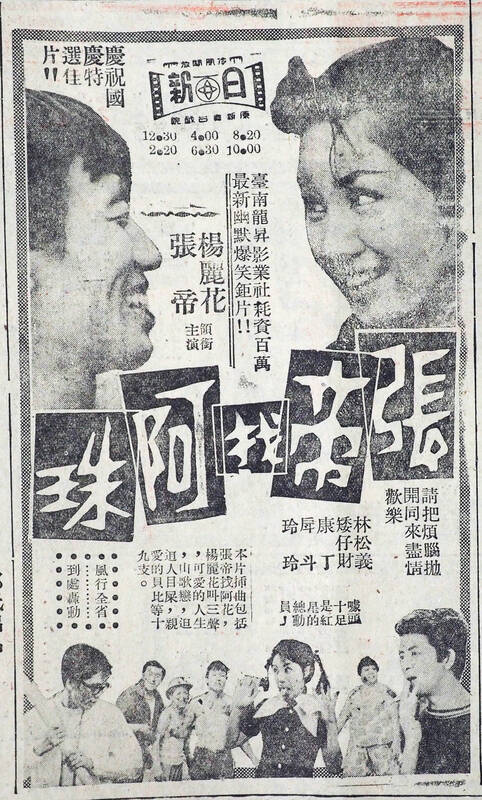
Yang Li-hua stars in the 1989 Taiwanese musical film Zhang Di Seeks A-Zu.
Photo courtesy of Taiwan Film and Audiovisual Institute
“After watching this film, have you fallen in love with me yet?” she asks the audience in a post-screening video message.
The film opens in theaters on Friday.
TRAVELING CHILDHOOD
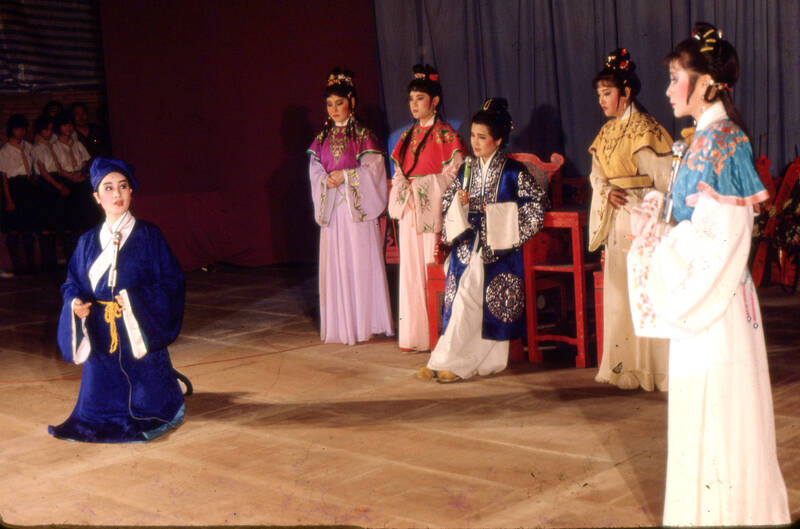
Yang Li-hua, left, performs during a religious celebration in 1982 at Sihu Cantian Temple in Yunlin County.
Photo courtesy of Yunlin County Department of Culture and Tourism
Yang’s opera roots trace back to her maternal grandfather, who ran a troupe in Yilan’s Yuanshan Township. His daughter, Yang Hao (楊好), fell in love with his disciple, Lin Huo-yan (林火燄), and the two eloped, joining various traveling opera troupes to make a living.
On Oct. 26, 1944, Yang Hao was experiencing contractions before a performance but still managed to finish the three-hour show. There was no time to call a midwife. As her parents were not officially married, Yang Li-hua took her mother’s surname, writes Shih Ju-fang (施如芳) in Yang Li-hua: The Legendary Opera Star and Her Times (如有神在:楊麗花與他的時代).
The end of Japanese rule the following year brought an explosion in Taiwanese opera. Yang’s family continued to travel and grow, partitioning off a room with mosquito nets behind the stage at each stop so they could sleep.
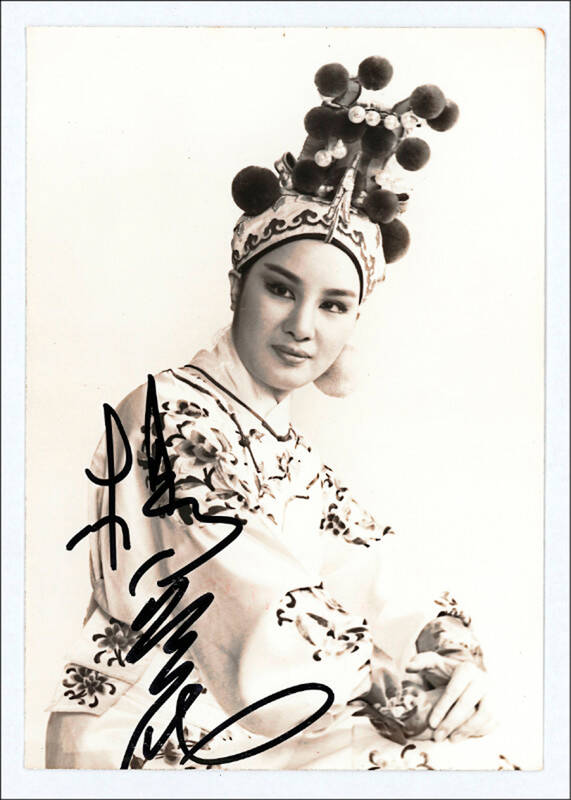
Yang Li-hua poses as Zhan Zhao for the 1972 Taiwan Television opera program The Seven Heroes and Five Gallants.
Photo courtesy of Yang Li-hua
Yang learned her first “seven-word tune” at the age of six. From then on, she tried turning everything she saw into seven-word lines, honing her rhyming, intonation and improvisation. She quickly figured out how to make audiences laugh and cry, and at seven, she played her first role, moving the audience to tears with a song about missing her mother.
Yang’s parents sent her to stay with relatives in Yilan so she could attend school, but she often ran away to rejoin the troupe. One day, after visiting her parents, she jumped off the train and sneaked back to the troupe. After a performance, they found her watching from the audience and finally agreed to let her stay. She helped with chores, cared for her siblings, filled in for performers when needed and earned extra food by taking on tasks such as dragnet fishing.
Yang’s parents hoped she would play scholarly characters, but she preferred fighting roles. She trained hard on her own, and once sustained a 6cm gash on her forehead during a swordfight.
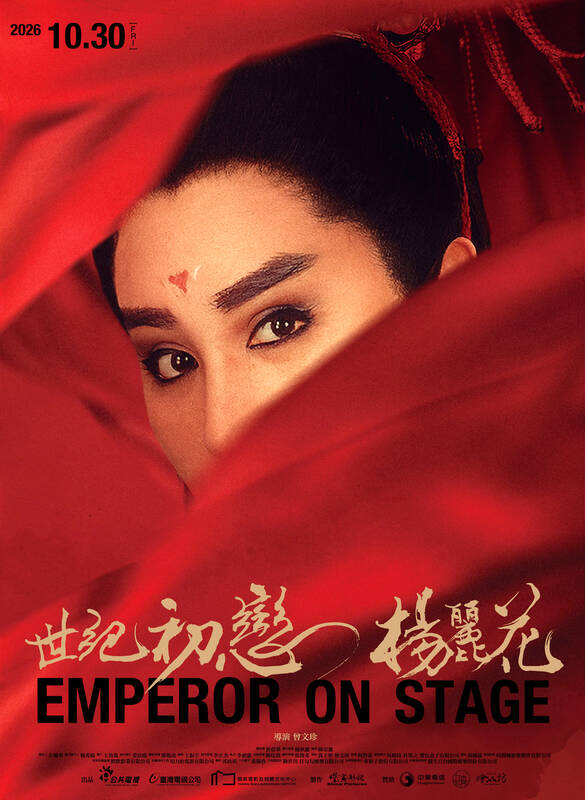
Movie poster for the film Emperor on Stage.
Photo courtesy of Public Television Service
Her first leading role was Double Speared Lu Wen-lung (雙槍陸文龍), a character she would reprise 36 years later at the National Theater.
NATIONAL HEARTTHROB
However, the growing popularity of Taiwanese opera movies was drawing audiences away from live performances, forcing many troupes to disband. The overseas Chinese market remained strong, and in 1963, Yang traveled to the Philippines with the Sai Chin Pao Opera Troupe (賽金寶歌劇團). It was her first large-scale production, with a team of more than 50 people. The show was immensely popular over its eight-month stay.
Upon return, Yang had earned enough money to buy her family a two-story apartment in Dadaocheng. However, no more work came in. A neighbor suggested she try radio, and in 1965 she joined Cheng Sheng (正聲) radio station’s Tian Ma Opera Troupe (天馬歌劇團). It was her first regular job with a monthly salary.
Yang insisted on maintaining her hand gestures and eye movements while recording, saying that “without getting into character, I couldn’t convey genuine emotion.” Her stylish, dashing image made her hugely popular, and she received stacks of fan mail every day, many from housewives who listened to her while doing chores.
The troupe put on live shows a few times a year, drawing screaming, tearful fans eager to see the performer they had come to know through the radio.
By the late 1960s, television was overtaking radio. In 1966, Taiwan Television held a contest between opera troupes for its Thursday noontime slot. Tian Ma entered with the politically correct Loyalty to the Country (盡忠報國) and won.
Television brought new challenges. Multiple cameras and limited space in the frame required Yang to adjust her movements, while commercial breaks interrupted the flow. But she soon mastered the medium, and the nation would come to a standstill when her show came on. Crowds waited outside the station to catch a glimpse of her, and she appeared on magazine covers.
MOVIE STAR
In 1967, Yang made her film debut in The Jade Hairpin (碧玉簪), helping revive a fading Taiwanese opera film industry. She would star in 24 films, taking on Mandarin-language productions and modern, non-opera roles for the first time. She practiced in front of a mirror to learn how to act more feminine for these roles, and joked that she was usually the one marrying the woman, but this time, their roles were reversed.
Yang was often paired on set with Hsu Shiu-hian (許秀年), whom audiences called Yang’s “forever bride” — even after Yang married physician Hung Wen-tung (洪文棟) in 1983.
Yang got to play a hero again in Vengeance of the Phoenix Sisters (三鳳震武林), portraying one of the sisters masquerading as a man. At one point, both sisters even fall for Yang’s character, unaware of her identity.
In 1970, Yang was hired as leader and producer of Taiwan Television’s in-house troupe. After a three-year hiatus, she returned to Taiwan Television in 1979, with the troupe named after her. The show soon moved to the evening, and watching Taiwanese opera over dinner remains a fond memory for many Taiwanese.
Yang continued producing television shows and touring. In 1981, she performed on a modern stage for the first time at Sun Yat-sen Memorial Hall. She later performed at the National Theater and Taipei Arena, as well as countless large venues overseas.
Her last production was The Timeless Virtues (忠孝節義), which aired in 2019. At the age of 75, she still rode a horse in a battle scene and continued filming despite falling off once.
After two years of preparation, filming on her documentary began in 2023. The documentary follows Yang as she revisits people and places from her past, sometimes marveling that old props and artifacts have survived.
Taiwan in Time, a column about Taiwan’s history that is published every Sunday, spotlights important or interesting events around the nation that either have anniversaries this week or are tied to current events.
For your information
Film Notes
Directed By: Tseng Wen-chen (曾文珍) Languages: Taiwanese and Mandarin with English and Chinese subtitles Running Time: 108 Minutes Taiwan Release: Friday
KioskNews shows a cleaned-up reading view extracted from the publisher’s page — the original always lives on their site, not ours.