Robo-soldier startup backed by Eric Trump misses payroll, may collapse
But Craig Smith, an independent journalist and host of the podcast Eye on AI, described tagging along during the delivery of the Phantom robots to Ukraine. He said that the robots never made it to Ukraine because they were stopped at the border with Poland.
When questioned by Smith, LeBlanc only said that Foundation had conducted a pilot demonstration at an undisclosed location, without clarifying whether the robots ever reached Ukraine. LeBlanc also walked back a claim that Foundation had demonstrated its humanoid robots to the Ukrainian government organization Brave1.
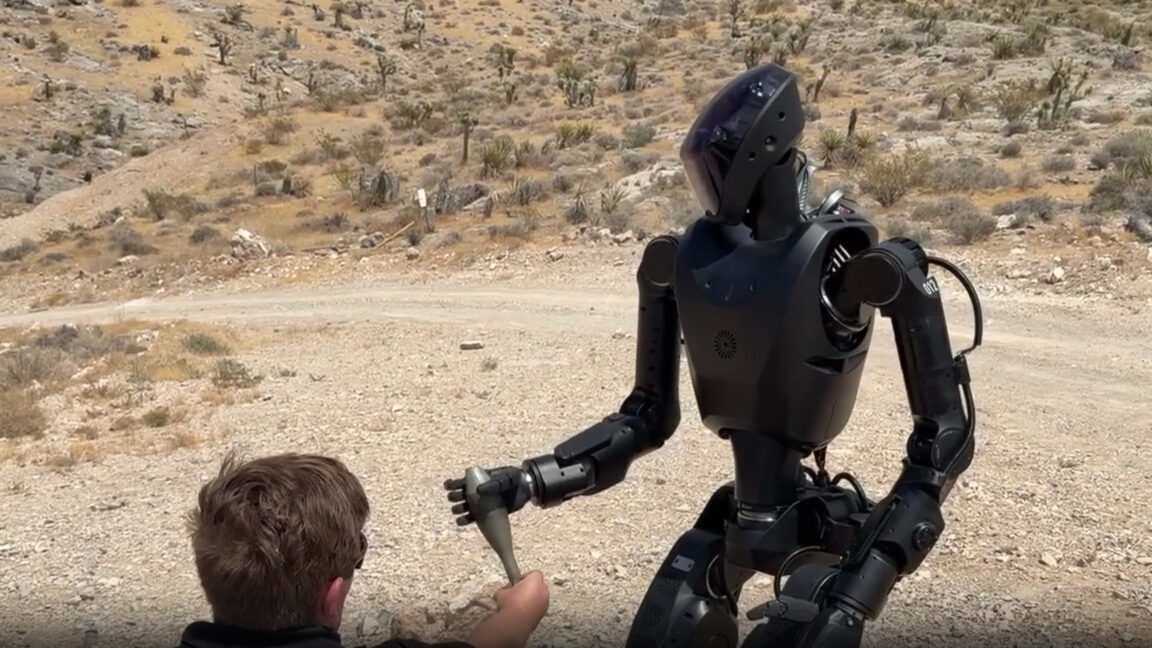
Promotional videos showing Foundation’s humanoids have not provided evidence that the robots are ready for battlefield deployments. For example, a “mortar demo” video on the company website dated to May 2026 shows a person handing a mortar shell to one of the humanoid robots, which slowly lowers the shell over the muzzle of a mortar weapon before finally dropping it in.
The real battlefield robots
Whatever happens to Foundation, humanoid robots remain largely unproven technology and have yet to fulfill company promises that they can become general-purpose robots handling many different tasks. Companies have just begun testing and deploying such robots in greater numbers within relatively controlled environments such as factories and warehouses.
Similarly, humanoid robots have not yet had any impact on the battlefield. Instead, pioneers in robotics warfare such as the Ukrainian military have focused on developing and deploying unmanned ground vehicles (UGVs)—robotic vehicles that roll along on wheels or tank-style caterpillar tracks.
While defending against the Russian invasion of Ukraine, the Ukrainian military has increasingly deployed more ground robots along with swarms of flying drones to make up for a shortfall in human soldiers compared to Russia. Such ground robots have typically been tasked with performing risky supply runs or evacuating wounded soldiers from frontline positions, but have also entered combat while wielding projectile weapons or even explosives when equipped as roving bombs.
Most recently, Ukraine has deployed armed ground robots directly into combat through both amphibious landings and through airdrops. In 2026, part of Ukraine’s counteroffensive success in rolling back Russian territorial gains has included dropping military robots from drones in airborne assaults behind Russian frontline positions.
KioskNews shows a cleaned-up reading view extracted from the publisher’s page — the original always lives on their site, not ours.