Palestinians favor Eisenkot over Netanyahu. That does not mean they trust Israel - opinion

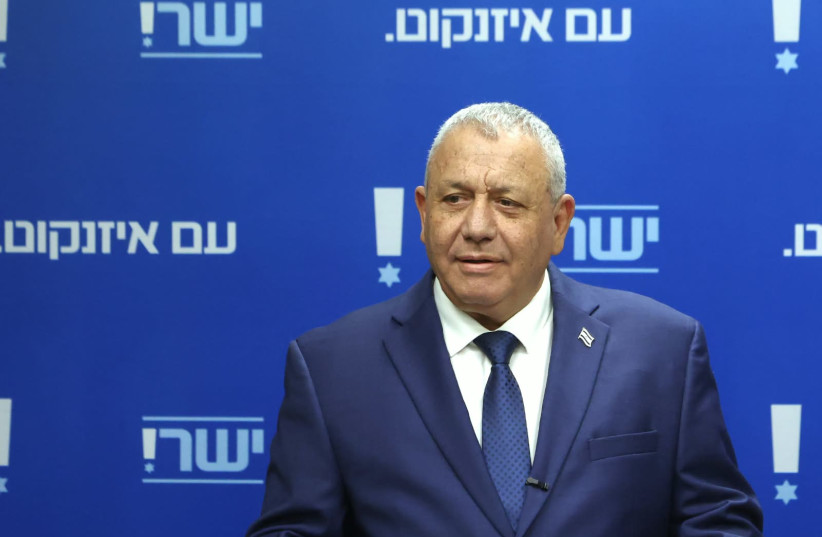
A new survey conducted by the Palestinian Center for Public Opinion (PCPO) between November 6 and 18, using Computer-Assisted Telephone Interviewing (CATI) and Random Digit Dialing (RDD), found that 59% of respondents preferred Gadi Eisenkot as Israel's prime minister, compared with just 2.6% who preferred Benjamin Netanyahu. Another 37.4% preferred neither candidate, while 1% remained undecided.
The survey included 305 Palestinians, comprising 50.8% men and 49.2% women, with 62.3% residing in the West Bank and 37.7% in the Gaza Strip. The response rate was 62%, and the theoretical sampling margin of error was ±5.61 percentage points at the 95% confidence level.
These findings raise a political question that goes beyond a comparison between the two figures: Does the preference for Eisenkot reflect Palestinian confidence in his ability to change Israeli policies, or does it express a desire to see different leadership from Netanyahu?
Interpreting the findings
The distinction is fundamental. Preferring one political figure over another does not necessarily imply support for that person's political agenda or confidence in their position on Palestinian national rights. Nor does a desire for new leadership automatically mean that respondents expect a fundamental change in Israeli policies.
One striking finding is the remarkable similarity between responses in the West Bank and Gaza Strip. Eisenkot was preferred by 58.9% of respondents in the West Bank and 59.1% in Gaza. Despite the different political, humanitarian, and living conditions in the two territories, these figures may suggest similar assessments of the Israeli alternatives presented. They do not, however, establish that respondents share the same motivations.
Equally important, the 37.4% who preferred neither candidate deserve as much analytical attention as Eisenkot's lead itself. This substantial proportion highlights the limits of the options presented and raises the possibility that many respondents do not regard either figure as a political alternative that meets their aspirations.
This points to an important analytical distinction. Eisenkot's considerable lead over Netanyahu in this particular question should not automatically be interpreted as Palestinian support for his political program or confidence in his ability to achieve a political settlement. The survey measures preferences between two specific political figures, not approval of their policies or assessments of their prospects for achieving peace.
In my assessment, the deeper significance of these findings lies in the possibility that Palestinians distinguish between a change in Israeli leadership and a change in the political reality they experience. A preference for Eisenkot may reflect a desire to move beyond policies associated with Netanyahu, but it does not establish that respondents necessarily expect a transformation in the fundamental issues of the conflict.
The opportunities that open through a change in leadership
From a broader perspective, a change in leadership may create opportunities to reconsider certain policies, but it does not, by itself, guarantee political transformation.
The issue concerns not only who becomes Israel's prime minister but also the decisions that leader makes, the political and institutional constraints surrounding those decisions, and the willingness to address issues shaping the future of Palestinians and Israelis.
Nevertheless, the findings do not directly reveal why respondents preferred Eisenkot or rejected both candidates. Interpretations involving a desire for change or political confidence therefore remain analytical possibilities requiring additional evidence.
Ultimately, the more important question is not simply whom Palestinians would prefer to lead Israel but whether a change in leadership would be accompanied by tangible policies that help address the causes of the conflict and open a path toward security, rights, freedom, and dignity for both Palestinians and Israelis.
Political names may change, but the value of political change is measured not by who comes to power but by what actually changes on the ground.
Dr. Nabil Kukali is the founder and president of the Palestinian Center for Public Opinion (PCPO) and a specialist in public opinion research and survey methodology. He has more than three decades of experience in social, political, and economic research and has supervised numerous national and international studies throughout Palestine and the Middle East.
KioskNews shows a cleaned-up reading view extracted from the publisher’s page — the original always lives on their site, not ours.