Awaab’s law is not working, say social housing tenants stuck in mouldy homes

Sarah Killick has been battling problems in her social home for months, including mould and damp. She says the anxiety has been insufferable and she has permanently damaged her teeth from grinding them due to stress.
She thought help would come in the form of Awaab’s law, new legislation designed to force social housing landlords in England to fix dangerous hazards, which came into effect in October last year.
But it did not. Killick said her landlord, Clarion Housing Association – the largest social housing provider in the UK – sent contractors to do a mould wash, but claimed they did nothing to address the root causes of the damp. This was despite surveys showing outside cracks, as well as guttering and drainage problems that could be contributing to the issue.
“We have to leave the mould on the walls, because if they turn up and we’ve wiped it, they say there’s no mould, so you have to start the process again. You have to leave the mould growing until it’s really furry and it’s awful,” she said.
The housing ombudsman has just concluded maladministration and service failure on the part of Clarion in Killick’s case, and said the landlord “did not recognise that it failed in its duty to fully comply with Awaab’s law”. Clarion said it did not agree with the ombudsman’s conclusion and would appeal against the decision.
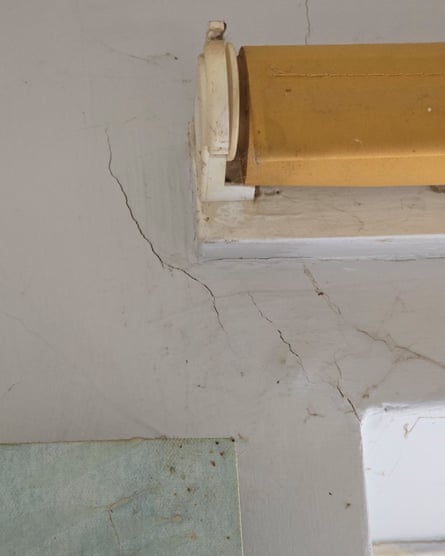
Social housing residents living in homes managed by a number of providers, as well as campaigners, have raised concerns that Awaab’s lawis not working and people are still stuck living in mouldy, damp and dangerous homes.
The law was named in memory of two-year-old Awaab Ishak, who died in December 2020 from a severe respiratory condition caused by prolonged exposure to black mould in his family’s social housing flat.
Suzanne Muna, a co-founder of the Social Housing Action Campaign (SHAC), said that while Awaab’s law had introduced timelines for hazards to be fixed, it was difficult for tenants to enforce this.
If landlords do not adhere to the law, tenants can take them to court for breach of contract, and the housing ombudsman can publicly name noncompliant landlords, order apologies, repairs and compensation.
But Muna said many tenants struggled to navigate the complexities of court action, especially when up against housing associations with a team of solicitors.
“We haven’t really seen any improvement, because it’s no easier now for people to enforce their legal rights than it was prior to Awaab’s law,” said Muna. “The law says landlords have to make things fit for human habitation within these timescales, but it did nothing to address the enforcement gap.”
She believes some landlords would rather pay compensation than spend potentially larger amounts of money on repairs to make properties compliant with Awaab’s law.
In Killick’s case, Clarion was ordered to pay her £1,175 in compensation, provide a formal written apology, and complete the full repairs by 9 November. If it does not do so, it must explain to the ombudsman why.
“I just don’t think it’s going to happen, it’ll have to go to court,” said Killick, who is a full-time carer for her disabled son and also struggles with mental health issues.

Clarion claimed that Killick had repeatedly denied it access to the property. The ombudsman found that Killick’s temporary refusal to allow access contributed to delays, but there was no evidence “the landlord took steps to obtain access to complete any of the other outstanding repairs”.
The ombudsman said that, as of 15 July 2026, it had received more than 400 cases where Awaab’s law was relevant, and there was a finding of maladministration in 97% of completed cases.
Damp, mould and fungal growth accounted for the largest number of cases, and the most common failings were not realising that Awaab’s law applied, failure to investigate emergency hazards within the set timeframe, and not keeping records.
Complaints to the ombudsman take an average of nine to 12 months to be resolved, although its interim head, Andrea Keenoy, has said the organisation is working hard to reduce the backlog, including hiring 77 new case workers.
Muna said it was hearing multiple reports of landlords doing minor fixes, such as applying mould washes and mould-resistant paint, to meet Awaab’s law deadlines but failing to stop problems recurring.
“People are still having to throw out clothes, worrying about the impact on their children – all of the things that were happening before are still happening,” she said. “Landlords might do things a bit quicker now, but that’s no comfort if they’re not solving the problem.”
Khayriya*, a single mother with five children living in Sheffield, has struggled with serious problems in her council home for years, including living without a working shower and toilet.
She said the mould and damp in the property was so severe that she believed it led her children to become ill with respiratory conditions, and addedthat they were bullied at school because of hygiene issues caused by the faulty shower.
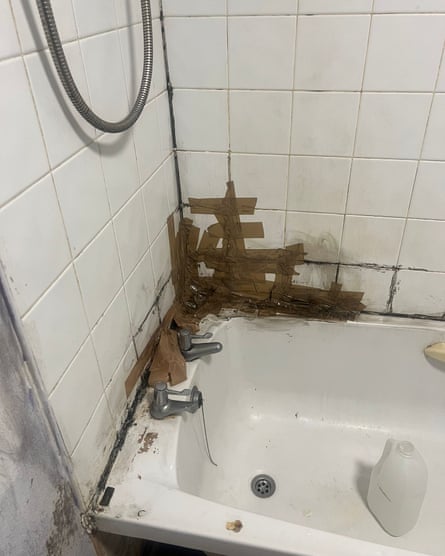
Even after Awaab’s law came into effect, she said it took months for problems to be addressed. Local campaigners at the community union Acorn confronted Sheffield council’s housing policy committee chair at a Green party event in July to spur them into action.
Repair work then took place, but Khayriya said she was concerned mould had just been painted over in some places.
“Awaab’s law doesn’t feel like it’s made any difference yet,” she said. “[Landlords] have still got the money, the power, the responsibility, but there’s not enough accountability. Tenants still need more protection.”
A spokesperson for Clarion said: “Resident safety is our top priority, and we take all reports of damp, mould and repairs needed within properties seriously. We are sorry that Ms Killick has been experiencing issues with her home and have been working hard to provide a resolution.
“Over the last nine months, five senior colleagues have been focused on Ms Killick’s case with a dedicated single point of contact liaising with her to try to resolve her concerns. We have attempted to make multiple appointments with Ms Killick to complete works, and have repeatedly been refused access. We have also paid for an independent survey and facilitated an inspection by the local authority’s environmental health team when she remained dissatisfied with our assessments.
“Whilst we acknowledge that Ms Killick remains dissatisfied we do not agree with the ombudsman’s recent determination and will be taking up our right to appeal this decision. We remain confident we have complied fully with Awaab’s law, and have tried to provide a range of options for third-party support to allow Ms Killick to be confident in the safety of the approach that we are taking.”
A government spokesperson said: “Everyone has a right to a safe and secure home, free of damp and mould, and it is completely unacceptable for any social landlord to ignore fixing these issues.
“If social landlords fail to meet the proper safety and quality standards for their property, they can face strong punishments including an unlimited fine, and Awaab’s law aims to further empower social tenants to hold their landlords to account using the full force of the law if they fail to investigate and fix hazards on time.
“We’re ensuring that these rogue landlords cannot dodge their legal responsibilities by working with councils to ensure they know how to enforce Awaab’slaw, and investing up to £50m to modernise courts so that it’s simpler to hold landlords accountable.”
KioskNews shows a cleaned-up reading view extracted from the publisher’s page — the original always lives on their site, not ours.