Turkey signed US-led Artemis Accords. Its moon rovers will hitch a ride with China
Turkey has signed America’s rule book for the moon, but its first ride to the lunar south pole – the icy region both Washington and Beijing are racing to reach – will probably come from China.
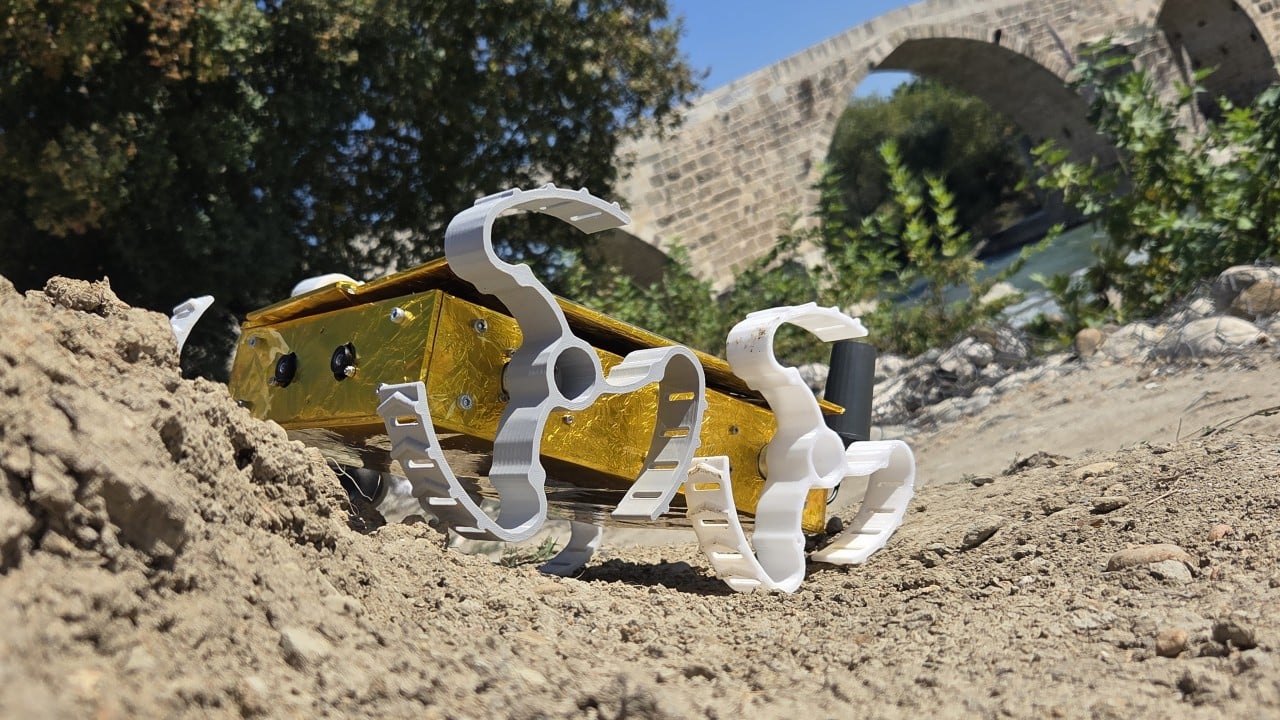
A team of more than 120 students and professors at Middle East Technical University (METU) in Ankara has built prototypes of two AI-powered rovers for Chang’e-8, a Chinese mission originally planned for 2028.
Turkey is not part of the International Lunar Research Station, a base China plans to build on the moon with Russia and other partners. In August, it signed the US-led Artemis Accords, joining more than 70 countries that have pledged to follow principles for lunar exploration.
METU president Ahmet Yozgatligil said that academia and science “know no borders” and “are above all political tensions”.
As a Nato member, Turkey had long stayed on good terms with both superpowers, he said. It also belongs to the Asia-Pacific Space Cooperation Organisation, a regional group headquartered in China whose members include Pakistan and Iran.
“China and the US are both strategic partners of Turkey,” Yozgatligil said. His university works with China’s leading institutions on Chang’e-8 and runs joint programmes with American colleges – but as far as he knows, it has no projects in Nasa’s Artemis programme.
The rovers’ timeline had slipped as Beijing overhauled its moon programme, but the pair should still be on their way by the end of the decade, said Halil Ersin Soken, an associate professor of aerospace engineering who leads the project.
The mission was put on hold in May, after China decided to merge its robotic and crewed programmes. “Most probably [the launch] will be 2029 to 2030, not later than that,” he said. “This is what we hope.”
Soken said the partnership began in 2023, when the China National Space Administration invited foreign teams to propose payloads for Chang’e-8. His group sent in a letter of intent, and the following year Pei Zhaoyu, the mission’s chief designer, came to see their laboratory.
03:54
The race for the moon’s south pole: can China beat Nasa’s 2028 deadline?
“He told us that his colleagues are very positive,” Soken said. In April 2025, the rovers were named among 10 foreign projects picked for the mission, including instruments from Italy, Russia and Egypt.
Though tiny – each weighing under 5kg (11lbs) and roughly the size of a shoebox – the Turkish rovers carry an on-board artificial intelligence (AI) “brain” that lets them plan their own routes and map the terrain together. Star Vision, a Chinese commercial space company, is supplying that computing module, while nearly all the other parts are made at home, according to Soken.
Building machines this small brings plenty of engineering challenges. One is getting around the rugged polar landscape. Instead of wheels, the robots move on spinning, J-shaped legs that can climb over rocks while keeping the body steady enough for the cameras to capture sharp images.
Getting off the lander is another hurdle. The pair will ride on the side of the Chinese spacecraft – about 1.7 metres (5.6 feet) above the ground – and be pushed off by springs.
“We have to be sure that they land with the correct orientation,” Soken said. If one did tip over, its solar panel could flip it back upright, his team wrote in a paper presented at the International Astronautical Congress in Antalya in October.
To work out those details, the team has relied on the Beijing Institute of Control Engineering, China’s lead technical partner on the project. The institute built the mini rover that snapped a photo of the Chang’e-6 lander on the moon’s far side in 2024, and has shared those lessons with the Turkish engineers.
The pair will explore the area around the lander and look for signs of water, which could one day help sustain a moon base.
They are designed to work for about two weeks, though Soken hopes to carry them through the lunar night, when temperatures plunge below minus 200 degrees Celsius (minus 328 Fahrenheit).
For now, the prototypes are being tested on sandy fields in and around Ankara and in two indoor sandpits at METU’s robotics and AI centre. A new test bed filled with simulated lunar soil was under construction, he said.
His group had planned to hand over flight-ready versions by the end of 2027, but is now waiting for word from the China Manned Space Agency.
Whenever they fly, the rovers – named CHERI after the Janissaries, the Ottoman Empire’s elite troops – would be “frontier soldiers” on the moon, Soken said.
KioskNews shows a cleaned-up reading view extracted from the publisher’s page — the original always lives on their site, not ours.