3 years, 14 protests: Why Madhya Pradesh CM Mohan Yadav has blinked time and again
Former CM Chouhan, who represented the neighbouring Budhni constituency for years before becoming a Union minister, intervened publicly. He visited the affected families, criticised the officials responsible and pushed the state government to act.
The families began a march towards Bhopal after a five-day sit-in, demanding land titles, compensation for their homes and crops, rehabilitation and action against officials. Yadav agreed to address their demands, ordered an inquiry and assured the delegation that the matter would be resolved. The protesters called off their march after the meeting.
For Yadav, the episode was another instance of a protest forcing his government to the negotiating table. An examination by The Indian Express of 14 protests and agitations during Yadav’s tenure so far, from December 2023 to October 2026, found repeated instances of the government withdrawing proposals, revising decisions, accepting some demands or offering assurances after public mobilisation.
The protests have varied enormously in scale — from statewide farmers’ agitations that brought thousands to Bhopal to protests against India’s first river linking project held by tribals.
Their outcomes have varied, too. In some cases, the government reversed a decision; in others, it conceded part of a demand or agreed to further talks.
For a first-time CM, the concessions Yadav gave are significant. The BJP government is known for not bending under pressure and pushing tough decisions by weathering the storm and using back channel talks.
However, Yadav’s stint at the helm shows a “CM on the backfoot”, several BJP functionaries said. Officials from the Chief Minister’s Office (CMO) have however maintained that the Mohan Yadav government always “listens to legitimate demands of people and acts in their interest”.
Here is a look at the 14 protests the Yadav government has faced.
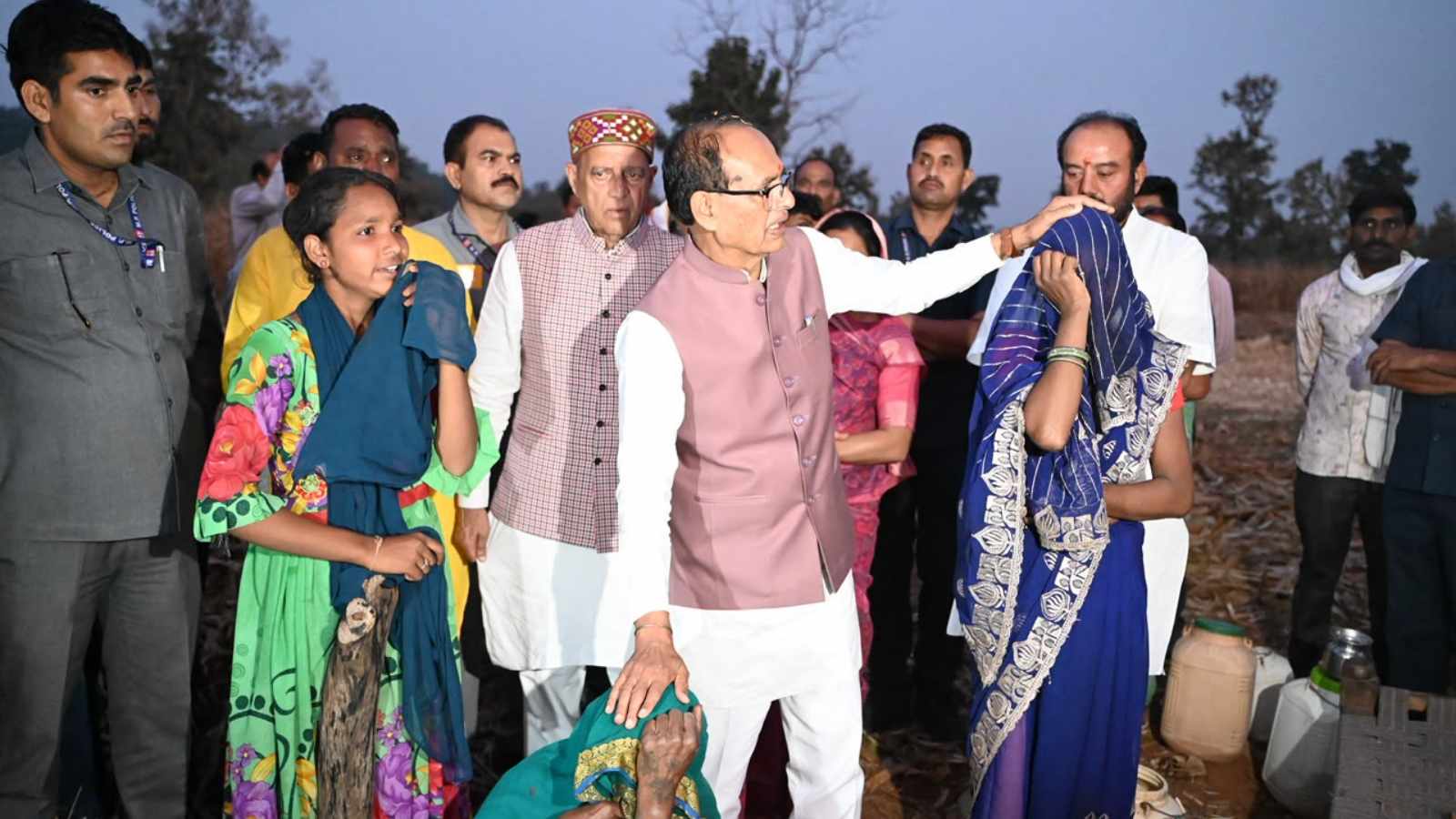 Shivraj Singh Chouhan described the destruction of the families’ homes as the crushing of years of hard work by poor tribal farmers. (Express Photo)
* Bhopal tree-felling protests (June 2024)
The proposed re-densification of Shivaji Nagar and Tulsi Nagar in Bhopal triggered one of the first major public controversies under Yadav’s tenure. Residents, environmentalists, students and activists opposed the plan, warning that the redevelopment could result in felling of more than 27,000 trees. Demonstrations and public campaigns brought the proposal under sustained scrutiny, turning an urban-planning decision into a wider dispute over green spaces and the future of the state capital. The government eventually scrapped the proposal.
* Guest teachers’ agitation (September 2024)
Thousands of guest teachers gathered in Bhopal to press for improvement in service conditions, greater job security and regularisation. Their demands included a longer service contract, changes to the system used to calculate experience-based marks and protection against being removed during the academic session.
The agitation led to negotiations with the School Education Department. The government agreed to eight demands, including a 10-month service contract and safeguards against mid-session removal.
* MPPSC aspirants’ protest (December 2024)
Candidates preparing for recruitment examinations conducted by the Madhya Pradesh Public Service Commission (MPPSC) staged a prolonged protest in Indore, raising concerns about recruitment delays, vacancies, examination processes and the publication of results.
The protest ended after discussions with the district administration, with a delegation subsequently meeting Yadav. While a section of the protesters complained not all their demands were met, the stir ended after the key demands were met.
* Indore farmers’ agitation (February 2025)
Farmers whose lands were affected by the proposed Outer Ring Road in Indore objected to land acquisition and survey-related decisions, demanding clarity on compensation and infrastructure for access to their remaining land. They feared that the project could impose a disproportionate burden on farm families without adequate safeguards.
The agitation brought farmers to the District Collectorate and led to negotiations with the administration. The protest was suspended after assurances that the survey was halted and further discussions held on their demands, including compensation and access roads.
*Tribal stir against Sehore wildlife sanctuary (June 2025)
The proposed Sardar Vallabhbhai Patel Wildlife Sanctuary in Sehore became the focus of protests by tribal residents over their concerns about the impact of the forest department’s action on their homes and livelihoods.
The row intensified after reports of the demolition of tribal homes in the Khivni Wildlife Sanctuary area. Residents argued that they had longstanding claims over the land and faced the prospect of losing their homes and access to agricultural plots.
Chouhan intervened and criticised the forest department. The state government subsequently put the process on hold. An inquiry was ordered and a divisional forest officer was transferred.
* Farmers’ stir against Simhastha land-pooling (November-December 2025)
Preparations for the 2028 Simhastha Kumbh Mela in Ujjain triggered a sustained confrontation between the government and farmers over a land-pooling scheme intended to facilitate the development of a permanent sacred city and associated infrastructure.
Farmers feared that the agricultural land across several villages would be absorbed into the development plan. The Bharatiya Kisan Sangh (BKS), an RSS-affiliate, opposed the scheme and accused the government of going back on its promise to withdraw it.
The dispute became politically sensitive as the opposition came from an organisation associated with the Sangh Parivar, as well as farmers who supported the BJP.
The government initially modified the proposed schemes, but the changes failed to satisfy the farmers. The BKS subsequently announced plans for a large-scale agitation in Ujjain. The government then withdrew four proposed town-development schemes.
* Private bus operators’ stir bid (March 2026)
Private bus operators threatened a statewide strike over proposed changes to passenger-bus taxes and the permit system. They argued that the proposed measures could disrupt the existing operating model and impose additional financial pressure on operators. The prospect of a strike raised the possibility of disruption to passenger transport across the state.
The operators held discussions with the government, after which two key proposed notifications were put on hold.
* Vocational trainers’ agitation (June 2026)
Vocational trainers employed in government schools staged an agitation over appointment orders, pay, job security and service conditions. Their concerns included the uncertainty created by contracting arrangements and the possibility of losing their jobs when companies managing vocational education programmes changed.
After discussions with the Director of Public Instruction, the trainers ended a two-day agitation following an agreement on issuing appointment orders and beginning the process of contracting with new companies.
*Farmers’ protest over moong and fertiliser (July 2026)
One of the most disruptive agitations during Yadav’s tenure came in July, when moong growers converged on Bhopal over its procurement at the minimum support price (MSP) and difficulties in obtaining fertiliser. Farmers wanted the government to procure their entire eligible crop and withdraw the e-token system for fertiliser distribution, which they said had made access more difficult.
The protest escalated over three days. Farmers gathered near Veer Savarkar Setu, staged demonstrations and marched towards the CM’s residence. They also demonstrated outside Chouhan’s residence, turning the agitation into a political issue involving both the state government and the Union Agriculture Minister.
The state government had initially limited procurement to 25% of eligible produce. Following negotiations at the state secretariat, it raised the limit to 60%, extended the procurement deadline and suspended the fertiliser e-token system. The farmers then called off the agitation.
*Ken Betwa Link project (July 2026)
On July 3, 2026, Jai Kisan Sangathan leader Amit Bhatnagar began an indefinite hunger strike at Kupi village in Chhatarpur district, alleging irregularities in compensation and rehabilitation surveys, and claiming that eligible families had been left out while some ineligible beneficiaries had received assistance.
On July 23, after 18 days of fasting, Bhatnagar suspended his hunger strike after the administration agreed to conduct fresh village-level surveys to identify families allegedly excluded from compensation and rehabilitation. On October 16, the Chhatarpur district administration approved supplementary rehabilitation awards worth Rs 9.625 crore for 77 adult beneficiaries from Kakra and Kadwara villages whose payments had remained pending because they lacked documents establishing their age.
* MBBS interns’ protest (September 2026)
Medical interns staged a three-day protest over their monthly stipend, demanding an increase from Rs 14,337 to Rs 30,000. The agitation intensified after police used water cannons against protesters, bringing the conduct of the police into the dispute alongside the question of remuneration.
The government agreed to raise the monthly stipend to Rs 21,500, a substantial increase but less than the amount sought by the interns. It also ordered an inquiry into the police action, and two policemen were removed from their posts over their alleged use of force.
* Aspirant teachers’ agitation (September-October 2026)
Candidates seeking more vacancies in teacher recruitment staged a prolonged sit-in and hunger strike in Bhopal. They demanded an increase in the number of posts, arguing that the available vacancies were inadequate and that recruitment opportunities had not kept pace with the number of candidates.
The protest continued through meetings and attempts to secure political intervention. The hunger strike was called off after a meeting with Yadav, who promised to work on their demands.
* Patwaris’ agitation (October 2026)
Patwaris across Madhya Pradesh stopped work over concerns about legal protection while carrying out duties under the Swamitva scheme and departmental action initiated against them. This threatened to affect land record work and other revenue-related services, giving the dispute wider consequences.
After meeting Yadav, the Patwari Sangh agreed to suspend its agitation and resume work. The government agreed to address key concerns, including legal protection and departmental action, while pay anomalies and other financial demands were left for further consideration.
* Kosmi tribal families’ protest (October 2026)
The demolition of 12 tribal homes in Kosmi brought the sequence of protests back to Sehore, Chouhan’s home turf. The affected families said their ancestors had cultivated the land for generations, that wells had been filled with soil and that the demolition had destroyed their homes and crops. Following Chouhan’s intervention, Yadav moved to address the tribals’ demands.
KioskNews shows a cleaned-up reading view extracted from the publisher’s page — the original always lives on their site, not ours.