To Hold a Mountain review – a spectacular setting for tough savvy woman’s fight against the government
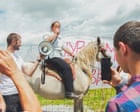
An award-winner in Sundance, where it premiered earlier this year, this slow-burn documentary follows a middle-aged Montenegrin livestock farmer called Gara and her 13-year-old daughter Nada. The two of them eke out a hardscrabble living on Sinjajevina, a breathtaking mountain plateau on which Montenegro’s government would like to conduct training exercises for its own army as well as Nato’s. This goes down about as well as a wolf in the sheep pen with flinty Gara, who rallies her neighbours as well as the local media to fight the proposal. She displays a savviness that’s somewhat surprising, even if her fortitude and strength of conviction seem completely in character.
However, that fight against the state is just one element of a film that, through long, languid takes, reveals the women’s stately pastoral existence, one taken up above all with care for their menagerie of animals (cows, sheep, goats, cats and dogs) and each other. Co-directors Petar Glomazić and Biljana Tutorov gradually reveal the family setup isn’t exactly what it appears at first. Although Gara calls Nada her daughter, the young girl is actually her niece; Gara adopted her after her sister, Nada’s mum, was killed by a violent husband. Gara’s profound grief and loss haunt her every day, felt most painfully, perhaps, when an animal dies on the heath, reminding them of the fragility of life.
Thankfully, that anguish is balanced out with some spectacular landscape photography as the camera drinks in Sinjajevina’s nearly treeless grasslands, sinuous peaks and troughs, and milky summer light.
KioskNews shows a cleaned-up reading view extracted from the publisher’s page — the original always lives on their site, not ours.