Median income of lower-income families on ComLink+ up 31%, but half yet to achieve overall stability
SINGAPORE – More lower-income families on a national scheme to support them had stable jobs, higher incomes and relied less on financial help in 2025 compared with the year before.
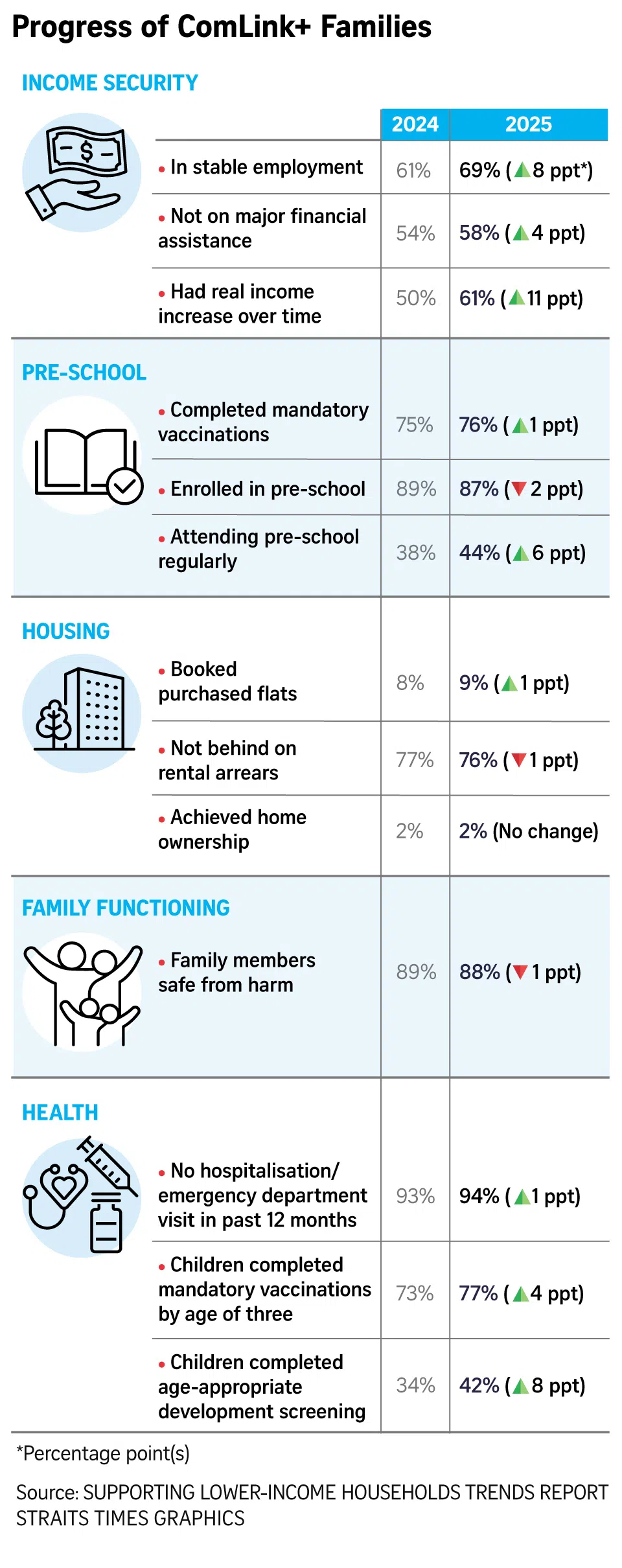
As at December 2025, 36% of ComLink+ families had achieved these milestones, from 28% in 2024. This is around 1,104 more families.
The Ministry of Social and Family Development (MSF) considers families to have made progress towards social mobility in income security if they have steady employment, are not relying on major forms of financial assistance and see their real incomes grow over time.
Incomes also grew. Median real household income among ComLink+ families rose 31% between 2024 and 2025, after adjusting for inflation.
These figures were released on Nov 16 in MSF’s Supporting Lower-Income Households Trends Report 2026, which highlights the outcomes of ComLink+ families in areas like social mobility.
As at December 2025, 11,006 families were on ComLink+, up from 10,219 a year earlier. About 21% had joined only in 2025 and therefore received support for a shorter period.
The ministry said the findings were encouraging, with the first cohort of ComLink+ families having received about two years of support and making sustained progress.
Announced in 2023, ComLink+ provides longer-term support to lower-income families in different aspects of their lives, rather than focusing only on financial assistance. The scheme aims to boost social mobility by spurring needy families – through financial incentives and other forms of support – to take steps to improve their lives.
Families work with family coaches, case workers and volunteer befrienders on action plans in areas like employment, children’s education, housing, and financial resilience.
“Overall trends are moving in the right direction,” MSF said in response to queries from The Straits Times.
The findings suggest sustained support can make a meaningful difference to lower-income families over time, although families have different starting points and progress can take time, it added.
Half of the families who joined ComLink+ in 2023 and remained on the programme at the end of 2025 had achieved overall stability, up from 43% in 2024.
This meant 432 more families had met this milestone.
The proportion of families achieving self-reliance in preschool education doubled from 15% in 2023 to 30% in 2025. This means all their pre-school-aged Singaporean children were enrolled, had completed mandatory vaccinations and attended school regularly.
Over the same period, the share of families who moved from public rental housing into homes they owned rose from zero to 4%.
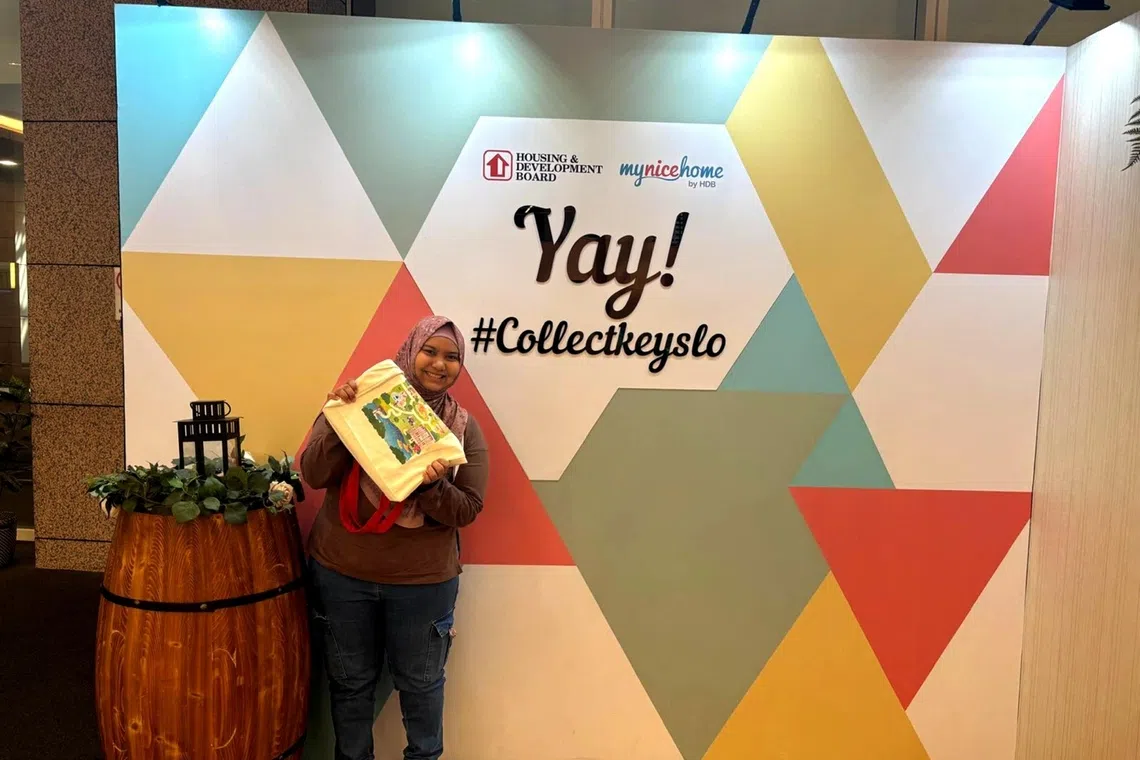
Nuraszlynn Yusof collecting the keys to her three-room flat in November after living in a rental unit since 2022.
PHOTO: COURTESY OF NURASZLYNN YUSOF
Nuraszlynn Yusof, 34, a single mother of two who joined ComLink+ in August 2023, collected the keys to her own home in 2026, after working towards the goal with a family coach.
She had moved into a public rental flat in 2022 after her divorce while pregnant with her second child.
At the time, Nuraszlynn was working as a locum nurse. She had flexibility to look after her children but the job lacked the income stability or regular CPF contributions of a permanent position.
“I wanted a more stable job, but I also needed to make sure my children were taken care of.”
She had aimed to find more stable work, build her savings, own a home and ensure her children had access to education.
In February, she landed a permanent position as a hospital nurse, working a regular morning shift. Her mother now helps with caregiving by going to her home to take her younger son, now aged three, to pre-school.
Nuraszlynn said moving into permanent work required her to become more organised in managing her children’s routines, work schedule and household responsibilities.
“It was not always easy, especially when I had to balance (between) being a working mother and being there for my children,” she said.
She also worked towards home ownership, voluntarily setting aside about 20% of her monthly salary in her CPF while she was a locum nurse.
Through the ComLink+ Progress Package for Home Ownership, she saved an additional $5,000 in her CPF Ordinary Account and received $10,000 in matched savings. She collected the keys to a three-room HDB flat in November.
She said her 10-year-old daughter was very excited when they first visited their new home, talking about playing along the spacious corridor and planning what she wanted in her room.
“For me, stability is also about knowing that my children have a more settled environment to grow up in.”
MSF tracks families’ progress across different categories in three stages – stability, self-reliance and social mobility. Stability refers to meeting basic day-to-day needs, while self-reliance is relying more on one’s resources and abilities. Social mobility refers to families improving their circumstances over time and creating better prospects for their children.
Despite the improvements, more than half of ComLink+ families had yet to achieve overall stability in 2025.
Those in this group were more likely than stable families to have young children, be single-parent households or have a family member with a recent incarceration history.
More than a quarter, or 27%, faced more than one of these characteristics, compared with 13% among families that were stable.
MSF said such families often face multiple related challenges, including caregiving responsibilities, health problems and lower educational qualifications that can make it difficult to find and keep suitable employment.
Among families who joined ComLink+ from 2023, 21% had no family member in stable employment with regular income from 2023 to 2025.
MSF said it would continue exploring ways to help families overcome barriers to stable employment while supporting them in other areas, such as ensuring that their children attend pre-school regularly.
The ministry is also working out a framework to determine when families are ready to leave ComLink+.
This will take into account their progress towards stability, self-reliance and social mobility, as well as any support they may continue to need.
KioskNews shows a cleaned-up reading view extracted from the publisher’s page — the original always lives on their site, not ours.