Slain terrorist Lateef Bhat's funeral held amid tight security, 160 km away from his village
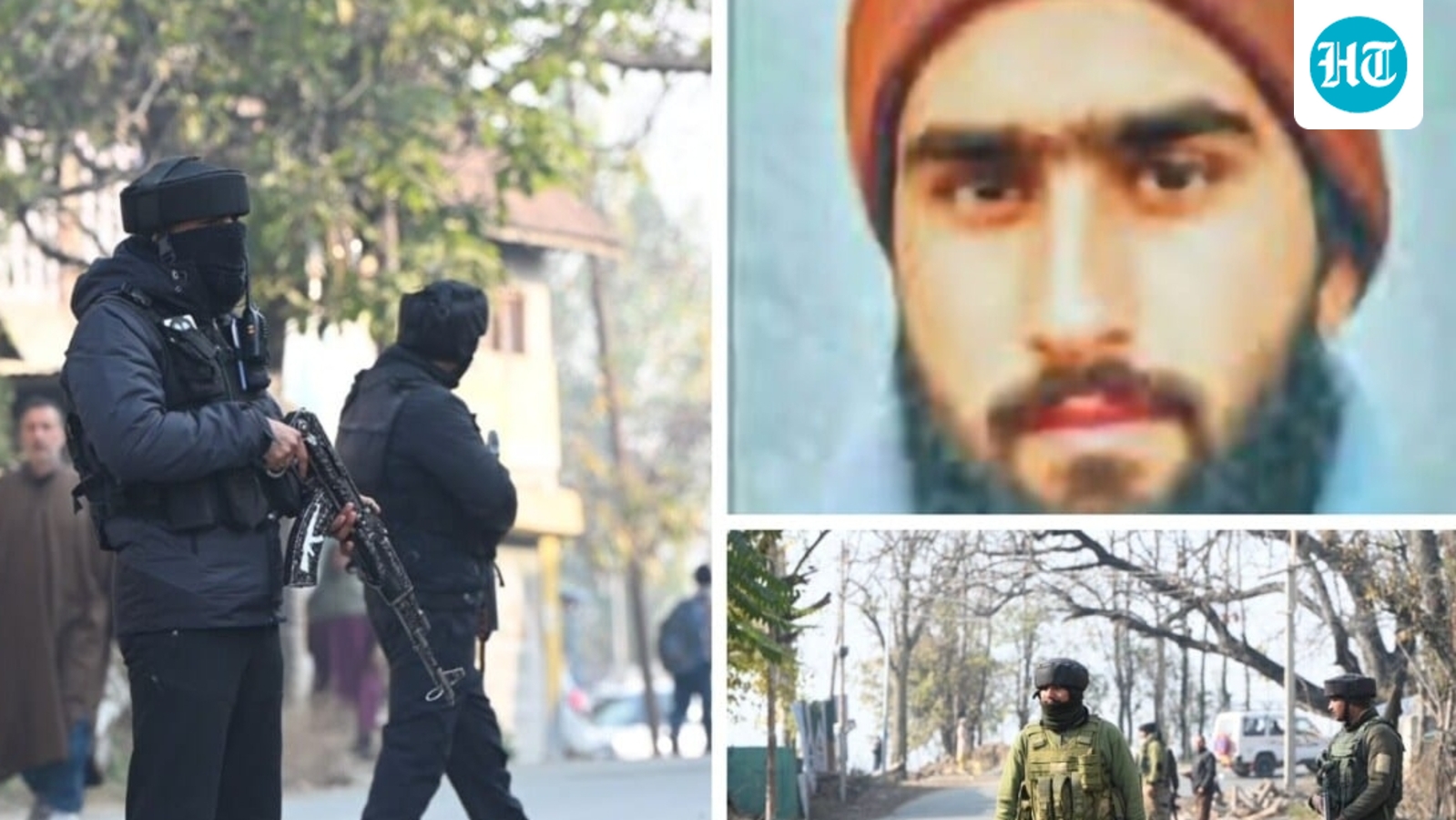
Around 10pm on Wednesday, nearly 160km from the one-storey house of slain Lashkar-e-Taiba commander Lateef Bhat, his body was buried by family members in the presence of security forces.
In keeping with the government’s policy of not handing over the bodies of slain terrorists to their families to prevent public funerals and the glorification of militants, Bhat’s family was taken to a village in the Bangus valley of Jammu and Kashmir’s Kupwara district for the burial. The family lives in Khrewan village in Kupwara.
In the past, the killing of terrorists, insurgents and Naxals in security operations has often been followed by large public funerals.
HT spoke to Bhat’s family members, who confirmed that the burial took place nearly four hours’ drive from their home. They said the funeral was conducted according to religious and customary rituals, but without mobile phones or photography, in the presence of security personnel.
Bhat’s maternal uncle, Mohammed Altaf, who spoke to HT while returning from the funeral, said eight male family members attended the burial. Altaf confirmed that all the customary funeral rites were performed.
“We were not allowed to take photographs. Security forces took our phones about 10km away before driving us to a cemetery in a village in Bangus, Handwara, Kupwara district. I was there along with his father, Mustaq Ahmed Bhat, two maternal uncles, his three paternal uncles and one brother-in-law. He is buried there,” he said.
Centre's policy on terrorist dead bodies
The Centre has reiterated on several occasions that it would not hand over the bodies of slain terrorists to their families.
“Now, wherever a terrorist is killed, he is buried right there. In Narendra Modi’s rule, there is no permission to take out a funeral procession to glorify any terrorist,” Union home minister Amit Shah said in the Lok Sabha on June 29, 2025, during a special discussion on India’s successful Operation Sindoor.
Last year, when Maoist leader and CPI (Maoist) chief Nambala Keshava Rao, alias Basavaraju, was killed, his body was cremated in Bastar and not allowed to be transported to his hometown in Andhra Pradesh.
There have been similar instances in the past. Afzal Guru, convicted in the 2001 Parliament attack case, was buried inside Delhi’s Tihar jail after his execution. His body was interred in an area of the prison that is out of bounds for inmates. Tihar jail also houses the grave of separatist Maqbool Bhat, who was executed there in 1984.
Kulgam encounter
22-year-old Mohammed Lateef Bhat, a local Lashkar-e-Taiba terrorist commander described by the Union government as the terror outfit's last known active local recruit in Jammu and Kashmir, was killed in an encounter with security forces in Kulgam on Wednesday, police said. For the last week, since the attack on 3 CRPF personnel, who sustained bullet wounds and are recuperating, a joint team of security forces led by the Indian Army's Victor Force under the 9 Rashtriya Rifles (RR) had been leading the operations to find Bhat.
The Victor Force is the RR's counter-insurgency unit in J&K.
The forces had rounded up hundreds of people and were conducting door-to-door searches. On Wednesday morning, when he was traced to a location, Bhat refused to surrender despite video calls by the police and was later shot dead.
At around noon, Altaf, along with Bhat's father, Mushtaq Bhat and other family members, was allowed to leave an interrogation centre where they had been questioned and housed since the attack on the CRPF personnel on November 11. They were first taken to Srinagar, a medical facility of the security forces where the body had to be identified. Bhat's father identified the body as his son, whom he had reported missing a year ago.
In the last year, Bhat has been involved in two terror attacks - the murder of a J&K police official and the killing of two migrant workers from Chhattisgarh. The family said they had not heard from Bhat for the last year, but a close family friend denied this and claimed that Bhat had come to the Khregan village sometime in July (after he had joined the terrorist outfit but was yet to execute the twin terror attacks).
KioskNews shows a cleaned-up reading view extracted from the publisher’s page — the original always lives on their site, not ours.