[Interview] When the world looked away from atrocities in Sudan, two journalists listened to survivors
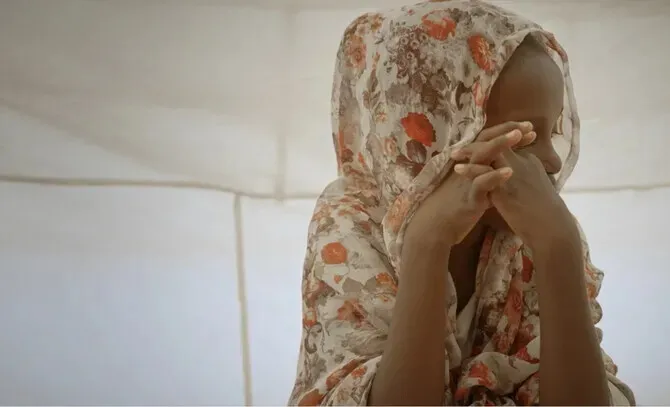
Still from the documentary film “Sudan: Narrowly Escaping Death,” in which Otour, orphaned by the war, pauses while talking to the documentarians.
“I said not to take this. She’s being ridiculous.”
A husband reprimands his wife for trying to bring more essential supplies as they flee. In a war zone, married couples argue not over what more they should own, but what more they should leave behind.
Some people fleeing war are unable to find drinking water and have resorted to drinking water from car radiators or even their own urine.
Every single moment of war puts the dignity of humans to the test. How much can it strip away? It can take your home, food, water, bodily integrity, family, and, ultimately, life itself.
“Sudan: Narrowly Escaping Death,” a documentary by independent French journalists Charles Emptaz and Olivier Jobard highlighting the grim reality of Sudan’s civil war, won the Hinzpeter Award for Features & Documentaries on Thursday.
The Hinzpeter Awards honor Jürgen Hinzpeter, who reported on the May 18 Democratization Movement in 1980, and are awarded to journalists who address the values of democracy, human rights, and peace in their work.
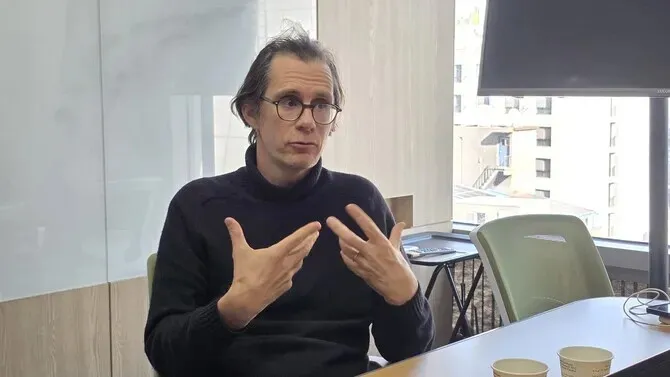
Charles Emptaz speaks to the Hankyoreh at a shared office space near Shinchon in Seoul on Nov. 2, 2026. (courtesy Korean Video Journalists Association)
Emptaz entered Sudan in December 2025 and covered Sudan’s civil war, which is often called a “forgotten war,” from an insider’s perspective for three weeks. We met with Emptaz, who came to Korea for the Hinzpeter Awards ceremony, in a common space near Seoul’s Shinchon area on Monday.
“We saw the drama coming with the fall of El Fasher, and we knew it was going to be tragic. Then came the satellite images showing basically 60,000 people dying in maybe one, two, three days. You have to realize, at the time, that was the number of people killed in Gaza over two or three years, and here it happened in one or two days. It made the news in France for maybe a week, and not as big news, as small news,” he said.
“This is my personal view, but while I have plenty of respect for all the journalists covering Gaza or Ukraine, I kept feeling this revolt in me: something is happening, and nobody cares,” he said.
Sudan’s civil war was triggered three years ago, when the Sudanese government forces and the Rapid Support Forces (RSF) clashed over control of the country. So far, the war has killed at least 150,000 people and displaced 12 million.
However, the interest that the international community has shown is exceedingly negligible.
“It’s one of the most un-covered conflicts in the world, for many reasons. There are historical reasons: Western countries, especially France, are not very close to Sudan. There are resources like gold, but they’re not linked to our countries; the gold goes somewhere else,” he said.
“And it’s a complicated conflict, because the two [sides] used to be aligned. They worked together, and then they fought for power. It’s not something you can explain in a minute,” he went on.
“And I must say, these are Black people, and people have the kind of racist biases we often see when we work in Africa. They don’t feel close to it,” he added. “So for all of those reasons, the Sudan conflict joined the big category of forgotten wars, which in a way is my specialty.”
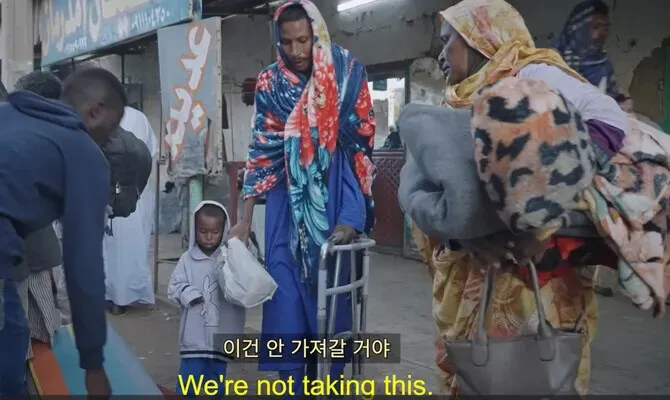
Still from the documentary film “Sudan: Narrowly Escaping Death.”
Emptaz and his colleagues miraculously managed to secure press visas, which were notoriously difficult to obtain during the civil war. They then headed to the Al Dabbah refugee camp, where they interviewed more than 65 residents and featured the stories of around 10 in their documentary.
These people had lost children, been raped by soldiers, sustained injuries in bombings, or were suffering from hunger. The eyes of all interviewees stared listlessly out into the distance. Long silences punctuated their speech. All they could talk about was the pain they had gone through.
“We interviewed more than 65 people, and the sound of their voices was maybe the first thing that struck me,” said Emptaz. “It was like coming back from hell. There was a gravity in their voices from what they had lived through. Immediately after the first interview with Olivier, everything changed. We realized we had entered the tragedy through their voices.”
Otour, a child who lost her mother in the war, remained vividly in Emptaz’s mind.
“She was playing like any other kid, and then we interviewed her. When she talked about her mother, there was that feeling you know from grief: life before was good, and then all of a sudden, it’s over. She lost her mother and her father because of the war. Her mother was hit by a bomb at the market,” he said. “She died within a day or two, but she had time to say something to her daughter, something like, ‘Be nice to your brother, don’t fight.’”
“It’s what any mother says to her kids, but she was probably conscious that these would be her last words. So it’s something that little girl will keep forever. It was really emotional for me,” he added.
Children put school and studying behind them to enter the workforce. Entire families spent all day washing dishes and carrying goods at markets to earn one or two euros a day. Parents were harsh with their children, afraid that they would become fussy or demanding.
“Go to the market. Try to work there, or come home. And don’t tell me you’re exhausted,” the parents would say, while children often recollected going to school before the war.
“For me, this is the reality of war. When we think of war, we think of fighting, of people dying. But the vast majority of war, the reality of war, is people walking, people going hungry, people struggling to find something to eat, people sleeping on the floor,” he said.
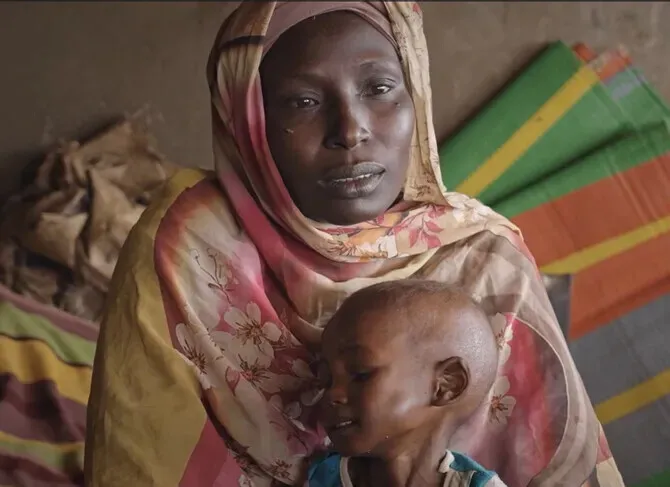
A woman speaks about the effects of the war on her child. Still from “Sudan: Narrowly Escaping Death.”
As a conflict zone correspondent, Emptaz had long reported on soldiers — those who had armed themselves with the belief that they must kill so as to not be killed. But civilians saw the war in a whole new way.
“The number one thing for civilians is simply to survive and escape,” he said.
But the survival of civilians cannot be separated from soldiers. It is soldiers who sometimes deliberately target civilians, while villages are all too often hit by stray bombs or gunfire intended for enemy forces. At one point in the documentary, a military drone meant to take down a military vehicle ends up bombing more than 50 village residents who had been holding a funeral.
“Someone had died, and everyone was mourning at the house. Then a car came, and a soldier said to be careful; there was a drone. Three seconds later, it struck,” he said.
Aerial warfare does not distinguish between civilians and soldiers. Both Sudan government forces and the RSF are making extensive use of drones in combat.
“What doesn’t change is that war from the air is always, in military terms, indiscriminate. People don’t make the difference between civilians and military. It’s very difficult from up there, so it means more civilian casualties. That’s the main risk,” Emptaz said.
The introduction of drones is also making the war grow protracted.
“When two opposites have the same level of control in the air, the wars get longer. So that’s bad for peace,” he said. “They’re small devices, not your own airplanes flying strikes. So a big power can act discreetly and not engage officially.”
While the United Arab Emirates has been called a proxy for supplying battle drones to the RSF, they have officially denied involvement.
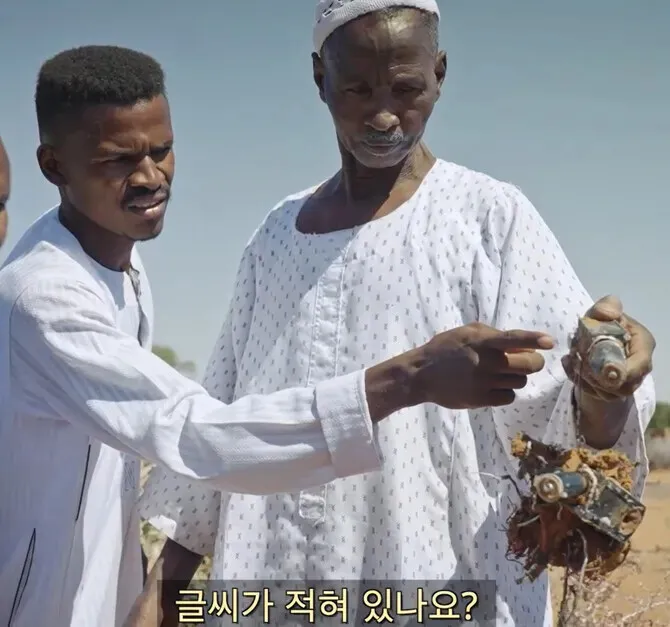
Villagers show the journalist the remnants of a drone they found. Still from “Sudan: Narrowly Escaping Death.”
Is there any end to the bloodshed in Sudan? After capturing so much despair, the documentary ends with a glimmer of hope. Issa, the lone survivor of a massacre in his village, arrives in the relatively safe Khartoum and is reunited with his family in a scene full of hugs and tears. After surviving by playing dead during the massacre, he sets out to flee the city of El Obeid, where the threat of airstrikes looms. After escaping the bombs and hail of bullets and finally reaching safety, Issa breaks into an overwhelmed, tearful smile.
“It was particularly important for us to end with this image. It was important to show that a future is possible for Sudan. A different story is possible for Sudan. Peace is possible for Sudan,” said Emptaz. “Having this man go from a war zone to a safe city is a way of saying: remember, another story is possible. There’s always an end, and we must keep that in mind. In a way, that’s the message.”
Emptaz expressed hope that other journalists would cover the atrocities in Sudan.
“When you cover an issue that’s uncovered or very poorly covered, what’s important is that you really feel a sense of the journalistic community. You do the report, and in fact not that many people are interested. But some journalists, maybe younger ones, will watch it, feel something, and feel the need to go there, cover it, and take their part in telling the story. It’s very important for me to think of journalism as a relay race. There’s a young journalist I know who came to us the first time we did a report on Sudan some years ago, and he’s now working in Sudan. It’s a great feeling to say, well, now someone else is taking on the burden. And for me it’s always important to have the story covered,” he said.
For Emptaz, reporting on war is a way of bestowing dignity to the people who suffer through conflicts.
“That creates a connection. I think the real goal of war reporting is to give dignity to the people you’re filming. It’s not just a tragedy. These are human beings who deserve respect,” he said.
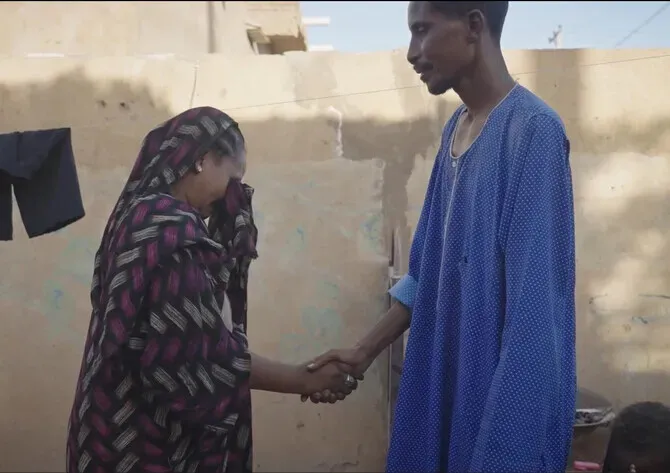
Issa is reunited with family in Khartoum. Still from “Sudan: Narrowly Escaping Death.”
Furthermore, reporting that exposes the horrors of war can also become a force for change, he said.
“When you do this kind of report, you really feel that we’re living through a big change in how humanitarian crises and wars are treated, especially with Donald Trump in power. USAID, which was a big deal in Africa, especially in Sudan, was stopped,” he said.
“You get the feeling that countries now just want to race ahead and leave behind the weak, the people in need. So for me it’s also important to make a record of this, to capture the story and say: maybe one day things will change, and we’ll stop forgetting the ones who need help,” Emptaz said.
KioskNews shows a cleaned-up reading view extracted from the publisher’s page — the original always lives on their site, not ours.