Jesse Kline: Canada should have been selling more arms to the Saudis
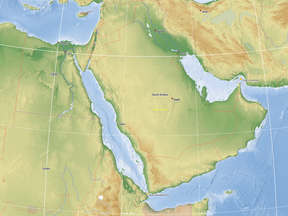
Ever since the Conservatives inked a deal to sell light-armoured vehicles (LAVs) to Saudi Arabia in 2014, Ottawa has been hounded by opponents arguing that Canada shouldn’t be transferring arms to the kingdom, largely because they could end up being used in Yemen’s civil war. Given the destruction wrought by the Houthis over the past three years, it’s now clear that we should have been selling the Saudis more military equipment, not less.
Sign In or Create an Account
There is, of course, good reason not to trust the Saudis. Fifteen of the 19 9/11 hijackers were Saudi born. The kingdom was also responsible for the brutal 2018 murder of journalist Jamal Khashoggi.

Columnist Jesse Kline keeps you up to date with what’s happening in Israel and the effects of antisemitism on life here in Canada. Friday mornings.
By signing up you consent to receive the above newsletter from Postmedia Network Inc.
A welcome email is on its way. If you don't see it, please check your junk folder.
The next issue of Channel Israel will soon be in your inbox.
We encountered an issue signing you up. Please try again
But the primary rationale for blocking arms sales to Riyadh was its involvement in the Yemeni civil war, where a Saudi-backed coalition led a military campaign in support of the country’s internationally recognized government.
There’s no doubt that the war has been particularly brutal, resulting in the deaths of an estimated 377,000 people between 2015 and 2022, or about 54,000 fatalities a year. (In Gaza, by comparison, even going by Hamas’s questionable numbers, around 24,000 have died each year — remember that the next time someone claims Israel is committing “genocide.”)
Yet despite all the lawsuits, activist campaigns, fear-mongering reports and a clause within the contract that forbade the Canadian equipment from being used in Yemen, there was very little discussion about whether the Saudis were right to try to prevent an Islamist terrorist organization from taking over a country that’s strategically situated next to a critical Red Sea choke-point and within striking distance of both the kingdom and Israel.
Despite Saudi Arabia’s problems, and there are many, there is little question that it has taken meaningful steps toward westernization and ending its support for Wahhabism since 9/11, a process of reform that accelerated after Crown Prince Mohammed bin Salman (MBS) assumed effective control in 2017.
The Houthis’ motto, on the other hand, is “God is the Greatest, Death to America, Death to Israel, Curse be upon the Jews, Victory to Islam,” which should have given us a clue that these may not be the most savoury of characters. Not to mention that the group is backed by Iran, the world’s leading exporter of terror and an enemy of the West.
By 2019, the Saudi-led coalition — which includes Egypt, Morocco, Jordan, Sudan and the United Arab Emirates, along with support from a handful of other countries — reached a stalemate. In 2020, facing increasing international pressure and a seeming inability to retake Houthi territory without causing more death and destruction, the Saudis declared a unilateral ceasefire. A general ceasefire took effect two years later, with the Houthis maintaining control over Yemen’s north, including the capital, and much of the west.
The western activists appeared to have won and Saudi Arabia lost interest in what was seen as a key flank in its proxy war with Iran, especially after the two countries re-established diplomatic relations through a Chinese-brokered deal in March 2023. But the Islamist chickens came home to roost, so to speak, following Hamas’s brutal October 7 massacre and the ensuing war in Gaza.
In November 2023, the Houthis started attacking ships transiting the Red Sea that had even a superficial connection to Israel and targeting the Jewish state with missiles. The group was temporarily subdued by an American and British air campaign but came to Iran’s defence when the United States and Israel began attacking in February.
Recent weeks have seen the collapse of the 2022 ceasefire, and on Sept. 10, the Houthis captured the port city of Mokha, followed by Perim Island, which sits in the middle of the Bab al-Mandeb strait, allowing the terrorist group to threaten ships entering and exiting the strategic choke-point that’s used as a gateway between the Arabian and Mediterranean seas.
The terrorists simultaneously began attacking Saudi Arabia’s East-West pipeline, a critical piece of infrastructure used to route energy supplies around the Strait of Hormuz, causing the kingdom to shut it down and global oil prices to skyrocket.
This, of course, is the real reason that fighting has once again flared up in Yemen. The U.S. and Iran are locked in an economic war, with the Americans trying to strangle the Iranian economy through sanctions and a blockade, and the Islamic Republic attempting to cause maximum damage to the global economy by cutting off oil supplies. With the Strait of Hormuz on Saudi Arabia’s east coast effectively blocked, Tehran is using its terrorist proxies in Yemen to halt exports from the west coast and further choke global shipping.
Throughout last week, the Houthis have escalated attacks against the kingdom, launching drones and missiles at Saudi military bases, oil infrastructure, ports and border towns, while fortifying its control over the Bab al-Mandeb strait by capturing more strategic islands.
When a drone was intercepted on Wednesday south of Mecca, Islam’s holiest city, the Saudi-led coalition described it as a “red line,” which makes sense given that MBS has staked his legitimacy on being the “custodian of the two holy mosques.”
But whether this, along with reports that U.S. President Donald Trump refused MBS’s request to intervene militarily, finally spurs the Saudis to take matters into their own hands with more than token airstrikes remains to be seen.
The kingdom has a clear interest in asserting its military dominance in the region and not looking weak in the face of Iranian aggression, but so far, its response has been lacklustre, perhaps because Saudi leaders are worried about tarnishing the softer image they have worked so hard to portray in recent years with a mounting death toll in Yemen.
In this, Canada’s anti-development activist class, the same sort of people who have continually stood in the way of this country realizing its potential as an energy superpower, are at least partially to blame. Canadian LAVs likely would not have made much difference in Yemen, but it’s clear that the Saudis need all the help they can get.
Rather than hand-wringing over the potential uses of our military equipment — news flash: it’s all designed to kill; arms dealing is not for the faint of heart — Ottawa should be doing all it can to ensure Riyadh has the tools it needs to confront the terrorist threat in Yemen and the wider danger posed by Iran, because in this case, we are very much on the same side.
National Post
This column was originally published in the Channel Israel newsletter. Sign up now.
Join the Conversation
This website uses cookies to personalize your content (including ads), and allows us to analyze our traffic. Read more about cookies here. By continuing to use our site, you agree to our Terms of Use and Privacy Policy.
KioskNews shows a cleaned-up reading view extracted from the publisher’s page — the original always lives on their site, not ours.