US, Japan rehearse coordinated strikes to challenge PLA control of waters near Taiwan
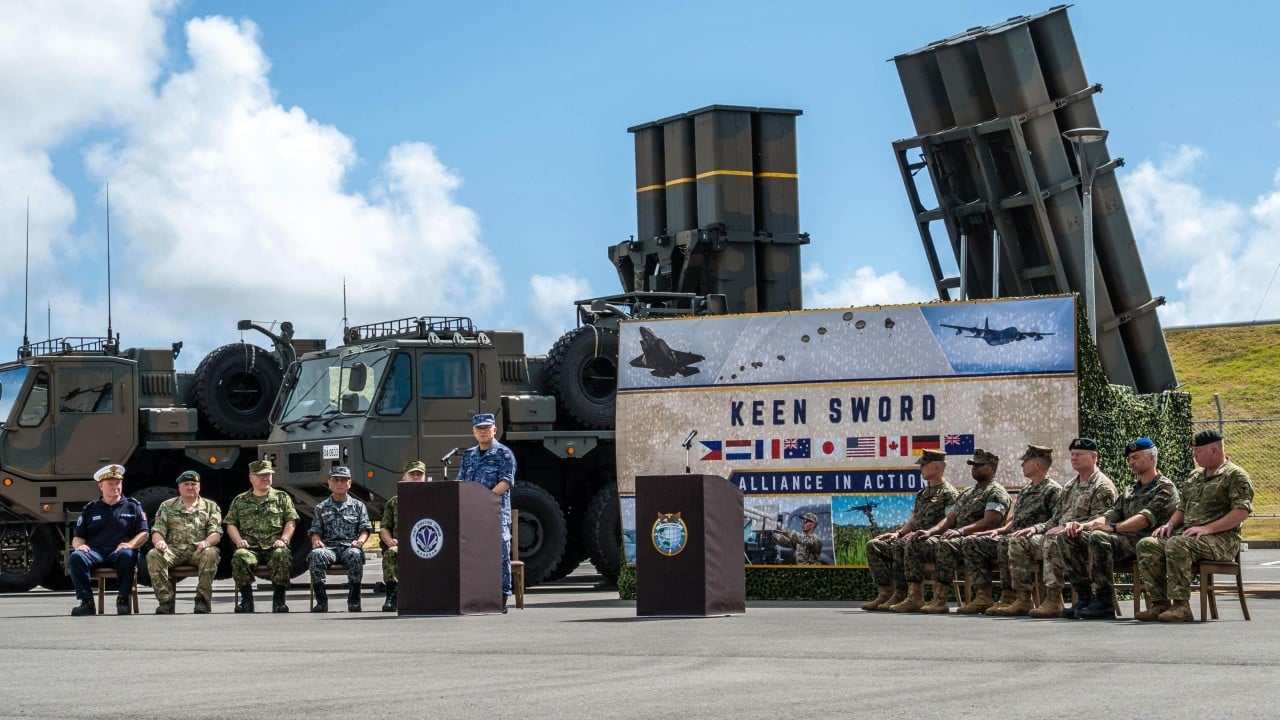
US and Japanese forces have rehearsed coordinated anti-ship strikes and mobile missile deployments across Kyushu and Japan’s southwestern islands, testing tactics designed to challenge Beijing’s ability to control surrounding waters in a conflict over Taiwan.
Now in its second week, the 11-day Keen Sword 27 exercise has tested how the allies could threaten Chinese warships from multiple directions while keeping their own forces harder to target.
They have also practised repairing runways and maintaining maritime supply routes to sustain operations in the event of attacks on bases and disruptions to supply lines, according to statements from both the US and Japanese sides.
09:58
Will Batanes become the next South China Sea flashpoint?
Analysts said the tactics employed could make it harder for the People’s Liberation Army (PLA) to locate and neutralise United States and Japanese forces during a conflict, potentially forcing Chinese commanders to devote more resources to reconnaissance and targeting.
However, the allies’ ability to sustain dispersed operations under attack would depend on reliable communications, supplies and infrastructure, they said.
During training on October 23–24, US Navy F/A-18 and F-35 aircraft and Marine Corps ground-based launchers simulated coordinated missile strikes against an inflatable maritime target in the Sea of Japan, also known as the East Sea.
Two Japanese Aegis-equipped guided-missile destroyers, Kongo and Maya, played the opposing force, while the US Space Force helped protect communications.
The allies also tested how quickly they could move major weapons and surveillance systems across the islands.
Japanese C-2 and C-130 transport aircraft were used to move American NMESIS anti-ship missile launchers, MADIS air-defence vehicles and TPS-80 surveillance radars to the Sakishima Islands, southwest of Okinawa. Exercise plans called for the NMESIS and MADIS systems to be positioned on Yonaguni, about 110km (70 miles) east of Taiwan, and Ishigaki, farther northeast, with surveillance radars also assigned to Miyako.
Sebastian Maslow, an associate professor at the University of Tokyo, said the deployments being tested could require the PLA to account for “a more robust defence line along the first island chain”, with American and Japanese forces operating closer to Taiwan.
Japan’s Ground Self-Defence Force also moved its new Type 25 anti-ship missile system from its base in Kumamoto, central Kyushu, to a training area farther northwest on the island for its first large-scale exercise since being deployed there in March. On October 25, personnel brought a launcher into firing position in about two minutes.
With a reported range of about 1,000km, the missile could threaten PLA Navy warships across much of the East China Sea, including approaches to Taiwan, while placing parts of mainland China’s coastline within reach.
Beijing sees Taiwan as part of China to be reunited by force if necessary. Most countries, including the US, do not recognise Taiwan as an independent state, but Washington is opposed to any attempt to take the self-governed island by force and is committed to supplying it with weapons.
Keen Sword 27, which runs until Thursday, has involved about 45,000 Japanese personnel and 11,000 American troops, along with forces from Australia, Canada, France, Germany, the Netherlands, New Zealand and the Philippines. Britain and South Korea are attending as observers.
It is the biennial exercise’s first iteration since Japan established its permanent Joint Operations Command in March last year. The command was created to coordinate Japan’s ground, maritime and air forces under a single operational headquarters to enable faster, more coherent joint responses during crises.
This growing coordination was visible during the drills when Japanese units used targeting information from US forces and higher headquarters to simulate anti-ship attacks. Although no live missiles were fired, the exercise pointed to allied efforts to integrate their targeting and strike operations.
At the exercise’s opening, Lieutenant General George Rowell, deputy commander of US Pacific Command, said the allies aimed to identify weaknesses in their military cooperation, including how they communicate, share information and coordinate operations before a conflict.
The allies also conducted runway-repair drills at four airbases across Japan, including Kadena on Okinawa, where engineers practised restoring damaged airfields to keep aircraft operating after simulated attacks.
Misato Matsuoka, an associate professor at Teikyo University, said “dispersal can improve survivability, but it does not guarantee it”, pointing to the vulnerability of airfields, ports and supply networks needed to sustain operations under attack.
Even if individual missile launchers remained operational, their effectiveness “may be reduced” if surveillance networks, communications or supply routes were “disrupted”, Matsuoka said.
A statement issued by Kagoshima prefecture on October 7, before the exercise started, said a planned American uncrewed maritime resupply operation was cancelled and a commercial vessel had been substituted for a US Army landing craft, without specifying the reasons.
Trump praises Takaichi ahead of Xi’s US visit
Other training on Tanegashima, about 40km south of Kyushu, was reduced for reasons including transport difficulties, while Typhoon Champi separately disrupted military flights and amphibious training.
Maslow said the disruptions had provided “valuable data points” for military planners, particularly on the use of commercial vessels to sustain operations. He cautioned against interpreting the changes as evidence of inadequate American or Japanese deployment capabilities.
He said that beyond its military objectives, the exercise had helped “normalise” American and Japanese military presence across Japan’s southern islands, despite opposition from some local communities.
The key to “sustaining deterrence” would be closer allied integration of military and civilian infrastructure, he said.
KioskNews shows a cleaned-up reading view extracted from the publisher’s page — the original always lives on their site, not ours.