Winter may bring snow and rain to some drought-stricken U.S. states
The winter season may bring much-needed rain and snow to parts of the United States where both have been lacking, according to the National Oceanic and Atmospheric Administration's latest winter weather outlook. But wetter conditions expected in much of the South will unfold alongside drier-than-average winter months across the northern tier of the country, largely as a result of the exceedingly strong El Niño.
NOAA's winter outlook, released Thursday, centered on temperature and precipitation forecasts for the U.S. from December to February. El Niño, a shifting climate pattern dictated by ocean temperatures in the tropical Pacific Ocean, influences weather around the world. Forecasters said it's going to play a significant role in how Americans experience the upcoming winter.
Where to expect more snow and rain
Although El Niño is considered the "warmer" phase of the El Niño-Southern Oscillation cycle, opposite the "cooler" La Niña, that doesn't necessarily mean its existence will lead to milder winter weather across the board, experts said.
"A strong El Niño does not reduce the severity of winter weather risks," said Ken Graham, director of NOAA's National Weather Service, at a briefing Thursday.
Decades of observations taken from previous El Niño events point to stormier weather across the southern U.S. this winter, Graham added, increasing the chances that some areas plagued by drought earlier in the year will see relief in the form of rain and snow. But, he warned, "too much precipitation on dry soil can fuel destructive flash floods and mudslides," so communities in regions that could be affected are advised to prepare accordingly.
The southern band of the U.S., including the Southwest, Southeast and portions of the East Coast, will likely experience wetter-than-average conditions through the winter as a result of El Niño, the outlook said. Meanwhile, portions of the Great Lakes, the northern Mountain West, Hawaii and much of Alaska may see drier-than-average winters this year.
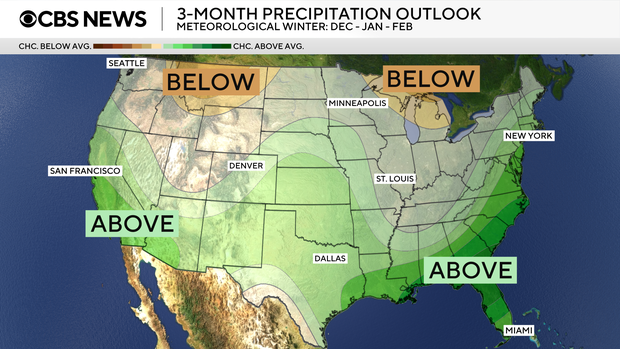
In some places, El Niño may not substantially impact the amount of rain or snow they receive in the coming months. According to the outlook, parts of the Intermountain West, northern Plains and Ohio Valley have equal chances of experiencing below-average, near-average or above-average amounts of rain and snow throughout the season.
Warmer winters, for some
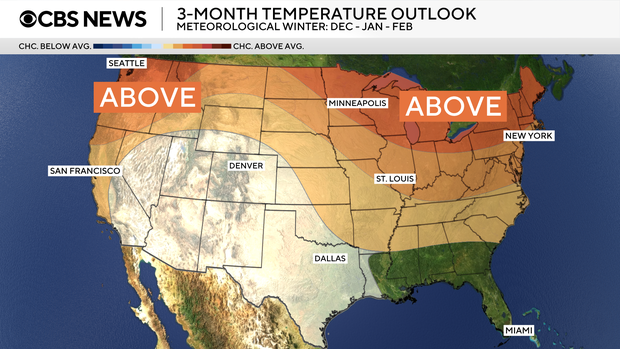
For some states, the winter season will bring more heat than usual. NOAA's outlook forecasts warmer-than-average temperatures for large swaths of the country, including parts of northern California, the Pacific Northwest, Midwest and Mississippi Valley, as well as much of the eastern U.S. Alaska will also see warmer conditions than usual.
The lower half of the country is primarily expected to see temperatures hover around, or potentially just below, normal, with the outlook predicting near-normal temperatures across portions of the Southeast, including Florida. It said there are equal chances of below-average, near-average or above-average temperatures for much of the Southwest and Hawaii.
Easing drought
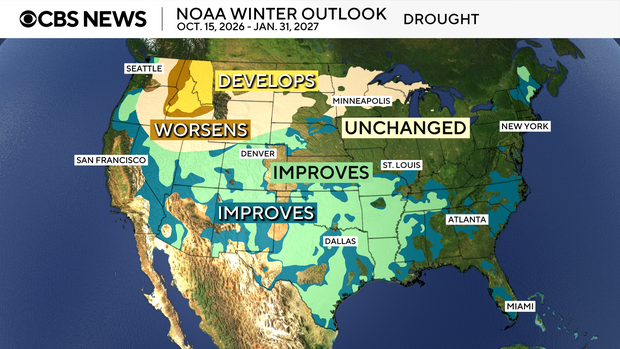
The upcoming winter weather is expected to ease drought conditions for huge stretches of the country, including drought-stricken portions of the Southwest, the southern Great Plains and parts of the East Coast. It may even bring drought to an end in some places, forecasters said.
But drought conditions could also develop or worsen in other areas, including in some that have suffered the repercussions of long-standing periods without enough water, like Oregon and eastern Washington, as well as parts of the northern Rockies.
Nikki Nolan contributed to this report.
In:
KioskNews shows a cleaned-up reading view extracted from the publisher’s page — the original always lives on their site, not ours.