‘Would I sit down with Tommy Robinson? It’s not a definite no’: lessons from people who fought the far right in the 70s, 80s and beyond
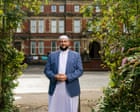
‘If you’re not organised, you get picked on. When you’re organised, often they flee’
Tariq Mehmood encountered the far right early – at primary school. “When white children surround you in the playground and sing, ‘God made little black people, he made them in the night, he made them in a hurry, and forgot to paint them white’, and the school doesn’t clamp down on that, then you’re living within the far right. It’s not one organisation, it’s a mass movement.”
I think it’s likely those kids used another word for “black people” but I can’t quite find the stomach to ask. Mehmood is speaking to me on a video call from Beirut, where he teaches at the American University. Now 70, he migrated, in 1967, from Pakistan to Bradford, where his grandfather and uncles worked in the textile mills, and immediately experienced racism. “The headmaster would tell us to be grateful to be in England, we were beaten up by white boys on the way to school, there was an intense violence and a feeling of helplessness.”
Until he realised he wasn’t helpless, or alone. “We knew we couldn’t come to school on our own, so we assembled somewhere, got off the bus together and walked together to the classroom.”
Later, when he was himself working in a mill in Otley in the late 70s, Mehmood was one of the founders of the Bradford Asian Youth Movement. The AYMs were a network of anti-racist groups demanding equal rights and a fairer world as well as defending their communities against attacks from groups such as the National Front (NF) and the British Movement (BM).
Following disagreements within the AYM, Mehmood was part of a splinter group, the United Black Youth League, that broke away in 1981. “The police tried to paint that our split was because the UBYL wanted violence, but this is anything but the truth,” he says. “Some wanted to work within the system – one of the founders of the AYM became an MP, something I fundamentally disagreed with then as I do now.”
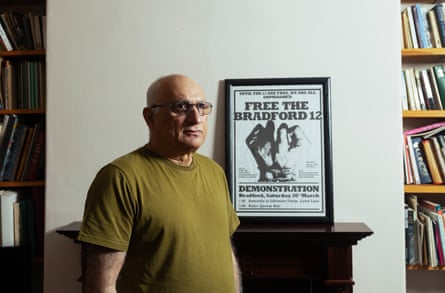
There were frequent attacks on the south Asian community in Bradford. “Whenever the National Front had a demonstration, you could always bet that after the pubs closed they would attack us, groups of skinheads – five, six, seven of them in a car, going around, seeing what they could do.”
So, as Mehmood had done at school, the UBYL organised themselves. “If you’re not organised, you get picked on. When you’re organised, often they will flee and you don’t have to fight. We couldn’t trust the police; either they were incapable, or they didn’t care, or they harassed us.”
When they learned that a lot of fascists were planning to go to Bradford, they got ready. “We mobilised hundreds, many of them white, walking around, making sure people knew we were out, they didn’t have anything to fear. We said we’d arm ourselves if need be. Some of us made petrol bombs.”
The petrol bombs require some context. “Remember, it was the year of the massacre of the teenagers in London,” he says, referring to the New Cross house fire in which 13 young black people died (even though it was never proved to have been a racist attack). “Members of the UBYL were blocking up their own letter boxes in case someone poured petrol in and set fire to their houses. That was a reality, and we said no, we will defend ourselves.”
In summer 1981, 12 members of the UBYL, including Mehmood, were arrested after a police raid discovered 38 milk bottles filled with petrol. The Bradford 12, as they became known, were charged with conspiracy to cause explosions and endanger lives. They didn’t deny making the molotov cocktails, but said it was a precaution for self-defence.
In jail, awaiting trial, Mehmood discovered another weapon: the pen. He wrote his first novel, Hand on the Sun, about a young immigrant experiencing racism. “Stories make us human. I wanted to share with future generations that we were proud industrial workers, we weren’t just going to have crumbs, we were politically conscious and had hope. I still have that hope.” After an active campaign and a lengthy trial, on 16 June 1982 Mehmood and the rest of the Bradford 12 – who had argued self-defence – were acquitted by a jury.
The situation with the far right is no better today, he says. In fact, the opposite: “The atmosphere is more vicious than it was in the 80s, primarily because we were dealing with old-style racism born out of British colonial history. Today’s Islamophobia is a more violent, virulent form; it has always been there, under the surface, since the Crusades, but not at a scale you see today. The far right at that time were a few thousand demonstrators here and there, not 100,000, half a million. And they’re not just in Britain, but across Europe.”
He sees it as a failure of the left, of the labour and trade union movements, to educate the white working class that “the real enemy is the billionaires at the top”. Plus, the loss of community organisations. Mehmood’s message about what to do about the far right today is to do as they did: organise and fight back. “The most important lesson is that if you believe there is an injustice, then fight against it.”
Tariq Mehmood’s memoir, Rebellion: Self-defence and the Story of the Bradford 12, is published by Daraja Press. A documentary, also titled Rebellion and co-directed by Mehmood, premieres at the BFI London film festival on October 14 and 15
‘The idea was to harness music and politics together to fight fascism and racism’
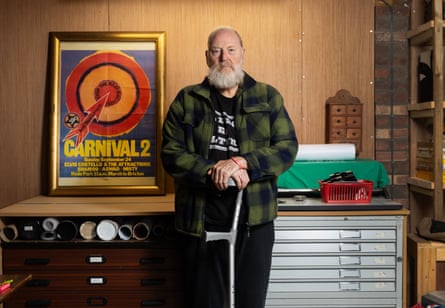
It was half a century ago, the hot summer of 1976, but Red Saunders remembers it clearly. A photographer and at the time also a member of a radical theatre group, he was in a rehearsal at a studio in Soho, London. “Someone came in and said: ‘Have you seen this shit about Eric Clapton?’”
An article in a music magazine said that at a concert in Birmingham, the musician had told his audience to vote for Enoch “rivers of blood” Powell in order to stop Britain from becoming “a black colony”, as well as chanting the NF slogan: Keep Britain White.
“I was a Clapton fan, I’d been to his gigs, had the albums. I couldn’t believe it,” says Saunders, now 80 and talking to me from his Suffolk home. He wrote a letter to the music press, and got some of his like-minded friends, including Roger Huddle and Jo Wreford to sign it. The letter pointed out Clapton’s hypocrisy, that he was “rock music’s biggest colonialist” and that his own music had its roots in blues, R&B, reggae. And it concluded with a rallying call for musicians and fans to rise up: “Keep the faith, black and white unite and fight.” (Clapton later apologised and expressed deep shame for the ouburst.)
With that letter, Rock Against Racism was born. “The idea was that if we harnessed music and politics together, it might be a powerful combination to fight fascism and racism.” Music was the key, to get the youth on board. The first event was a gig with jazz singer Carol Grimes at a pub in Forest Gate, east London. “We chose the Princess Alice because it was in an area where the National Front were getting substantial votes in local elections,” says Saunders. He admits they were anxious about getting attacked by the NF or the violent neo-Nazis of the British Movement, so they got a bunch of dockers in as security.
In the end, it passed off without incident, apart from the usual disagreement with the pub over money. Rock Against Racism grew and grew from there, fighting racism through live music and putting black and white bands on stage throughout the country. Saunders remembers one gig especially, at the Polytechnic of Central London, featuring the reggae band Misty in Roots and the punk band Sham 69, a lot of whose fans were skinheads. In fact, Saunders says, although the band’s frontman Jimmy Pursey was strongly opposed to far-right politics, some people around the band were members of the British Movement.
Saunders remembers the tension backstage. “Misty had a reading of the King James Bible, while getting into the mood of their music and culture. And they played dominoes, in the most theatrically aggressive way, slapping down the dominoes hard, all directed at these fascists and skinheads standing around watching. It was electric, I thought at any second it was going to kick off.” Somehow the gunslinger tactics defused the situation and the gig ended with the two bands on stage together in a show of solidarity.
The gigs grew into full-scale carnivals, most famously one in London’s Victoria Park featuring the Clash, Steel Pulse, the Tom Robinson Band and more; it began as a march from Trafalgar Square and is thought to have been attended by 100,000 people. But the movement was just as much about small, grassroots responses around the country. Saunders remembers hearing from a kid in Aberystwyth. “She said she’d read my letter in the music press, and that one of her teachers was a Nazi, what could she do? I wrote back and said: ‘You are now Rock Against Racism Aberystwyth.’ When we next heard from her, she’d set up a club – all the local punk bands were playing.”
Saunders says the far right today, with their black balaclava brigades, are more frightening than ever. “The hypocrisy – saying they’re looking after women and children, then we find out many have been reported to police for domestic abuse.” His rallying cry is to recognise the far right for what they want and who they are, and to call them out for it. “They’re looking to rid Britain of black and brown people. They’re flat-out, 100% racists.”
‘Our football tournament was huge. Peter Cook came down and refereed’
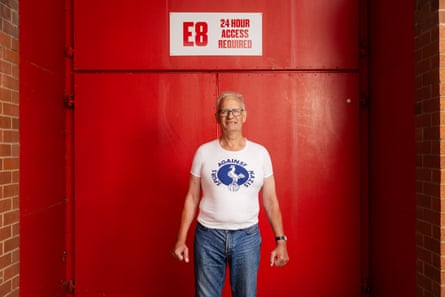
You could say that in 1977 the NF and Tottenham Hotspur FC were heading in opposite directions. The NF, led by John Tyndall, was still on the rise, resurgent in elections for the Greater London Council. Spurs, meanwhile, were relegated to the old second division; the terraces at White Hart Lane weren’t a happy place. “When the team is doing bad, the community does bad,” says fan Richard Buckwell, who was in his mid-20s at the time, and is speaking to me today on a video call from Nottingham, where he now lives.
The NF campaigned and recruited in and around football. “I suppose it’s historically the leading leisure activity of white men,” says Buckwell. When Spurs were back on the up and signed the Argentinians Ossie Ardiles and Ricky Villa, there was a lot animosity. Buckwell, who was active with the Anti Nazi League, and a few like-minded supporters, felt the opposite. “We handed out leaflets that said, ‘They’re welcome here’. And that’s what kicked off Spurs Against Nazis.”
It was launched with a public meeting, attended by about 60 people. In October 1978, they organised a five-a-side football tournament. “It was a huge event – we got 47 teams entering. Aswad participated, Bill Oddie played, Peter Cook came down and refereed.” Having the comedian Cook, a high-profile Spurs supporter, involved was helpful when the club initially tried to stop the use of its cockerel logo.
They printed T-shirts, made badges and banners, and handed out leaflets on match days, sometimes as the NF were doing the same. “I remember one day, leafleting outside the ground, suddenly seeing a load of youngsters running towards us. I thought, what on earth is happening? Is this the National Front?” But it was the opposite: they ran past to charge at and chase off the NF, who were campaigning behind. The message was getting across.
And the Football Fans Against Nazis message spread to other clubs: Leyton Orient, West Brom, Everton, Swansea City, Norwich, Arsenal. In all, about 11 clubs formed grassroots anti-fascist groups to counter the far-right infiltration of fanbases. The message even travelled abroad. “Some of our T-shirts got sent to the freedom fighters against white minority rule in what was then Rhodesia.” Buckwell still has a Spurs Against Nazis T-shirt, “for memory’s sake”. We’re joined on the call not by a Zimbabwean freedom fighter but by Buckwell’s wife, Jane, holding up this last surviving shirt. Plus, a nice cartoon of a footballer kicking a skinhead wearing an NF shirt into touch.
Buckwell remembers that when they saw NF graffiti, they used to alter it to read NF = No Fun. He says that anti-fascist campaigning – including by football fans – undoubtedly played a major part in the NF’s decline, though Tyndall and other members took its embers to ignite a new far-right flame in the British National party (BNP). Racism continued to rage, largely unchecked, through the football terraces, throughout the 80s.
And to this day it hasn’t been totally extinguished. “One thing that made a difference recently was taking the knee, which many clubs continued for a long time. And [former England manager] Gareth Southgate had a tremendous influence.” But campaigns, such as Kick It Out and Show Racism the Red Card, are underfunded, and he would like to see more support, from government and – particularly – from the clubs themselves. “They pay lip service. The amount of money swilling around the big clubs, they could do a lot more.”
At 74, Buckwell still fights the far right, working with Stand Up To Racism in Nottingham. He worries about Stephen Yaxley-Lennon (who goes by the name Tommy Robinson) and his lot. “It is frightening at the moment. But I went on the Together Alliance march, which was tremendous. Nottingham is very diverse and multicultural.”
‘I was stood in the middle of this room watching this horrific violence – this wasn’t the change I wanted’
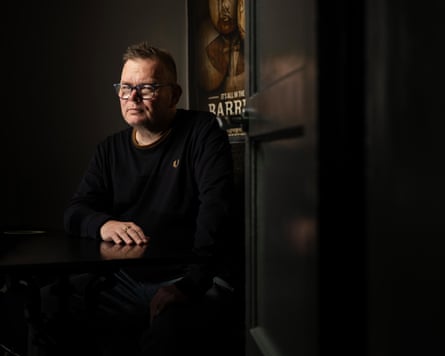
On a summer evening in 1989, at what became known as the Battle of Welling, Matthew Collins changed sides. As a “troubled and troublesome youth” growing up in south-east London, he’d joined the NF as a teenager. “I was horrendously and viciously racist. I didn’t like what I saw around me.” He became the NF’s south London organiser.
In the mid-80s, the NF was becoming splintered and disorganised and Collins was also volunteering with the emerging BNP, rising to become its south London chair. The BNP opened a bookshop in Welling to distribute far-right material, and a group of concerned locals held a meeting at the library to discuss what to do about it.
Forty neo-Nazis – including Collins – stormed the building and attacked them. It was, he remembers, a bloodbath. Nine people were hospitalised. Most people at the meeting were women, of south Asian heritage. “I was stood in the middle of this room watching this horrific violence, people assaulting women in a library, and realised I’d been looking in the wrong places – this wasn’t the change I wanted.” Sickened, the following day he phoned the anti-fascist magazine Searchlight, and told them who had been involved. Collins had flipped; he was now an informant.
Over the next two and a half years or so, he continued his far-right activities but reported back to Searchlight, building up intelligence, warning of attacks, identifying people. It was incredibly stressful, and he would have been killed if he’d been found out, “particularly towards the end when Combat 18 [the security wing of the BNP] were around and it was all about shipping guns and drugs”. And he couldn’t tell anyone, not his family, not his girlfriend. “It was impossible, because you still have to live that life as a race hater.”
Collins took part in a World In Action TV exposé of Combat 18, blacked out and with his voice replaced, but because of what he said it still placed him in the firing line. When he got a visit from special branch, telling him they had intel that there was a threat against him, it was time to get out. Collins went to Australia for 10 years, where he worked in the rag trade and got married.
Now 54, Collins is back in the UK, working for Hope Not Hate, the advocacy group that campaigns against fascism and was an offshoot of Searchlight. He’s head of intelligence, meaning he now runs informants inside extreme organisations. He ran Robbie Mullen, the whistleblower who helped bring down extreme rightwing group National Action, a member of which was plotting to kill then Labour MP Rosie Cooper, and the subject of ITV drama The Walk-In (Stephen Graham played Collins).
He’s not going to tell me all the tricks of the trade, but basically they identify people who are disappointed and disaffected. “They have constant schisms and fallouts because the far right in this country is now completely driven by drugs and alcohol. You just pick and choose and you find someone and you put pressure on them.”
Collins wants to smash today’s far right. “Destroy, disorganise and disorientate. And one of the ways I do that is by finding the better-quality people and getting them out. We’re putting better-equipped and better-behaved people back into society.”
He divides the misery caused by the far right into two: “The misery of being in hock to them, ideologically, socially, culturally. And the misery of the people who live in fear of them, because they might get their windows broken or get beaten up.”
‘I was really proud of what we delivered, keeping them out, squashing them’
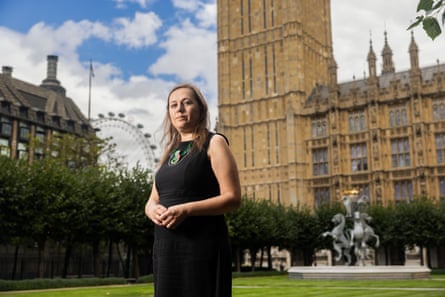
In the run-up to the 2010 general election, the far right were moving in on Jen Craft’s patch. “There were these, essentially, fascists not far from my home town and I wanted to do everything I could to stop them.”
Fortunately, she was in a position to do so. Craft (pictured page 23), born and raised in Thurrock in Essex, was working for the Labour MP, now peer, Margaret Hodge at the time, in Barking. The BNP had targeted the east London constituency as somewhere they could win. They’d done well there in the 2005 general election, and gained 12 council seats the following year.
Craft explains there was a lot of frustration in the area over lack of housing, drastically fewer jobs available with Ford in Dagenham, and rapid demographic change – from predominantly white working class to a significantly more mixed population. “It was a proper tinderbox.” A complacent local Labour party and council meant people “didn’t feel they had the ability to contact anyone or that politicians were on their side”.
The BNP were cleverer than the NF before them. “The way they approached people, they didn’t knock on your door and say, ‘You don’t like all these so-and-so people moving in, do you?’ They’d say, ‘That playground in the park looks a bit rundown, we’ll come and paint it. I bet you’ve not seen a politician in years, tell us what’s worrying you.’”
Craft, whose formative years had coincided with a Blair government and who saw herself as significantly left of him, knew what the BNP were all about. She believes they were targeting Hodge personally, “because she’s Jewish, and because she’d just lost her husband. They thought they could capitalise.”
Craft, who was 25 in 2010, ran Hodge’s campaign. “If you’re going to throw everything at defeating the far right, that’s a good time to do it – when you’ve no real responsibilities and can spend 80 hours a week going for it.”
How do you go about it? “If you knock on someone’s door and find they’re voting for the BNP and you say, ‘Did you know they’re a bunch of racists?’, what that person hears is you’re calling them a racist.” Nor did they begin with, “Hi, I’m from Labour … ” because, such was the mistrust, they would often end up with the door slammed in their faces. So they adopted tactics not unlike those of their opponents. “It was, ‘I’m out with your local team, what issues have you got, what can we fix? Not trying to convince them that our way of seeing the world is right, but just to open that door by saying, ‘We’re here, we’re listening, we’re on your side, how can we deliver for you?’” They organised coffee afternoons and street meetings to find out what it was people cared about.
Later, there was a bit of “Do you know who the BNP are?” And that was the approach in recruiting volunteers and building a campaign team. “This is who they are, this is the threat they pose, come and help us, because if they do win here, where are they going to go next? They won’t stop … ”
The BNP didn’t win. Though Labour lost nationally, in Barking Hodge increased her share of the vote, and the BNP were pushed into third place. It was a turning point for their support; the party fragmented, losing members to new parties emerging on the right, such as Ukip. “I was really proud of what we delivered, keeping them out, squashing them,” says Craft.
After that, she became a civil servant, and took a break from politics for a while. In 2024, she stood for Labour in Thurrock, and won. Now an MP, we’re talking in her Westminster office. The incumbent Tory was beaten into third place, behind Reform’s candidate.
The same issues – migration, economic uncertainty and insecurity, disaffection with politics – mean that “in my area, those far-right messages are taking hold again”. The difference now is social media. “In Barking, it was analogue – letters, leaflets. We just had to have a faster printer than theirs, more things to put through doors and more boots on the ground. But the advent of social media means people can spread untruths and distortions very, very quickly – like net migration is rising or there are more small boat crossings, when actually it’s the opposite.”
Craft thinks that to fight the far right today, what’s mostly needed is more regulation of social media companies, and their owners. “Elon Musk wants us to turn against and fight one another. The fact we are not regulating against him is stepping away from our duty to keep this country safe.”
That’s going to be more effective than some tactics she sees. “If you go with a placard and shout, ‘Nazis!’, you probably feel good about yourself, but you’ve done nothing to fight them where it counts, which is at the ballot box.”
‘You’ve heard of the concept of breaking bread and the way to a man’s heart is through his stomach … ’
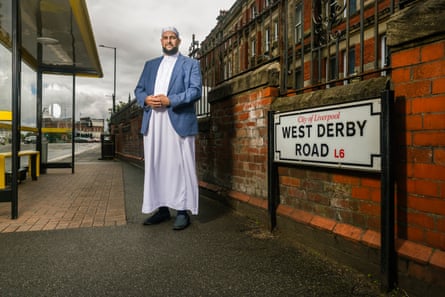
In the summer of 2024, after the murder of three girls at a dance class in Southport, misinformation and violence spread across the UK. Mobs smashed windows and cars, attempted to set fire to hotels housing asylum seekers and desecrated Muslim graves, while far-right keyboard warriors poured petrol on the flames from their sunloungers abroad.
On the night of 2 August in Liverpool, an angry crowd gathered outside the Abdullah Quilliam mosque, the oldest in the country. Against police advice, Adam Kelwick, one of the imams, crossed the road to talk to them. He took food – burgers and chips – and drinks. “You’ve heard of the concept of breaking bread and the way to a man’s heart is through his stomach,” Kelwick says, on the phone from his Liverpool home. There is a famous picture of Kelwick talking to one man in particular. “I spoke to him for five minutes, we connected, built some kind of relationship, call it a friendship if you like, then I gave the guy a hug.”
It takes two to hug. “So he had it inside him. After coming to the mosque to protest, he could reach out and hug me as well – the same people he was manifesting enmity towards.” Later, when it had quietened down and the cameras had gone, Kelwick sneaked him into the mosque. “I took him in, we walked around, and had an interesting conversation.”
Kelwick thinks “the vast majority of people you see at these protests are just genuine, regular people who’ve been dragged into something they might not understand fully”. Which is why conversation is important. “You have to engage, otherwise you’ll go further apart, then it’s easy to hold enmity and hostility.”
Since that time, Kelwick has been devoting energy to building these links. He tells me about a coach trip they had to north Wales soon afterwards – a bunch of families who’d attended the Liverpool Save Our Kids protest, which kicked off violently, along with families from the Muslim community. “We mixed everyone up together on two coaches; you should have seen the looks on the faces of the locals in north Wales when the doors opened and all these scousers got off along with some quite conservative-looking Muslim families. I think the academics call it contact theory – that you’re less likely to have negative feelings towards each other or uphold negative stereotypes if you have in-person interaction.”
The paranoia cuts both ways. “A lot of people in the Muslim community think everyone at these protests wants to hang, draw and quarter them – so I’ve been working with both sides.”
Kelwick travels a lot, and says the narrative – pushed and funded from above by far-right campaigns and individuals – is the same everywhere: “Immigration is bad, it’s an invasion of military-aged men, they don’t integrate, they’re committing all these crimes and raping our girls … it’s the same in the US, France, Germany, all across Europe.”
But Kelwick has faith in people. “We’re all human, bleed the same blood, have the same issues in life. It doesn’t matter how many billions are pumped into this, if you can facilitate genuine interactions between people from different communities, that has the ability to make these hugely funded efforts irrelevant.”
Would he sit down for a chat with Tommy Robinson himself, I wonder? “It’s not a definite no. I almost arranged to visit him when he was in prison. I think that would be the ideal meeting, without cameras, without anything to prove to anybody, just a genuine sit down where we don’t have to pull any publicity stunt – that would be beneficial.”
Discussion rather than debate is the aim. “I don’t like to be the attacker; it pushes people away. The whole purpose of having this interaction is to come closer. When you strip things down to a human level, that’s where beautiful things can happen. You can do that with every single person – even Tommy Robinson.” Over to you, Mr Yaxley-Lennon, the invitation is there. There might even be a hug in it for you.
KioskNews shows a cleaned-up reading view extracted from the publisher’s page — the original always lives on their site, not ours.