China’s export boom is becoming its Achilles heel
China is rapidly approaching the point where its strengths become its weakness.
Data released this week shows its economy is growing strongly. GDP growth of 4.5 per cent in September and 4.6 per cent for the first nine months of the year are keeping it on track to meet Beijing’s target of between 4.5 per cent and 5 per cent growth this year. The figures were stronger than economists had predicted.
While that might appear to demonstrate Chinese exceptionalism in a global economy spluttering under the weight of debt, wars and trade wars, it also highlights the ever-growing imbalances within Asia’s biggest economy.
For the past five years – ever since President Xi Jinping implemented his “three red lines” policy that curbed property developer’s leverage and triggered a crash in the country’s property market that continues today -- China’s domestic economy has stagnated.
That has left China increasingly reliant on exports for growth - and that dependence has been steadily increasing.
In September, exports grew 36 per cent – their fastest pace in more than a decade and a half – and generated a trade surplus of $US938 billion ($1.34 trillion). The country is on track to beat last year’s record surplus of $US1.2 trillion.
As with Trump, Xi is leading China’s economy into dangerous territory.
And that’s where the vulnerability lies.
With domestic demand weak – retail sales were up only 1.1 per cent in September compared with the same month last year, and have been near-stagnant since the start of the property market’s collapse – China has become increasingly dependent on exports to soak up the over-capacity that is now rife within its factories.
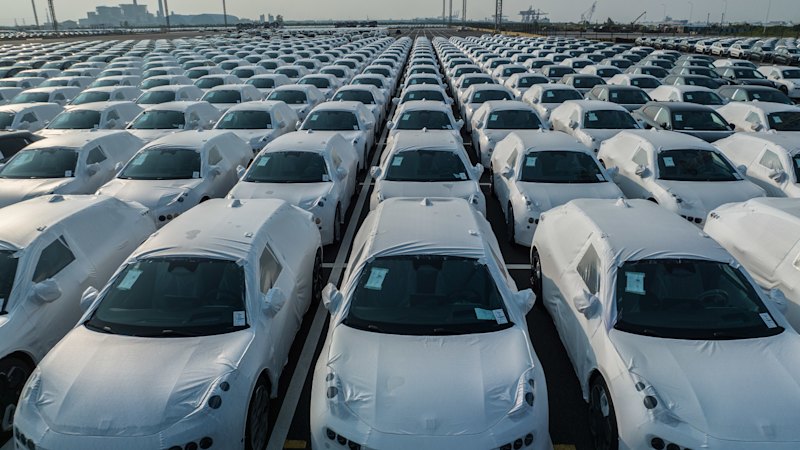
Donald Trump’s trade war has crimped exports to the US. China has responded by diversifying the markets it is targeting, with a surge in exports to other economies within Asia, emerging markets in Eastern Europe and South America, and a massive increase in exports to the European Union.
It is the EU, by far the biggest market open to China, that now represents the most direct and significant threat.
While there has been some pushback against the tide of Chinese products elsewhere, China needs the EU to remain open to its industries to sustain the mercantilist model it is pursuing to offset the absence of domestic growth.
Europe, where key manufacturing industries are being overwhelmed by Chinese imports -- imports from China are running 36 per cent higher this year than last with more than €1 billion ($1.6 billion) worth of goods a day – is running out of tolerance as plant closures and job losses mount.
The EU reached an agreement with Beijing this month to cap imports of Chinese hybrid vehicles at roughly half their existing levels after Germany joined France in seeking greater powers for the European Commission to curb the flood of Chinese cars that has been causing increasing damage to the European auto sector.
France and Germany – a late convert to the resistance to Chinese imports because of its extensive investments and markets within the country – are also spearheading a proposal to create new powers for the European Commission that could completely shut off a country’s access to the European market in circumstances where that country (read China, even if it weren’t named) was seen to be damaging the EU economy.
The so-called “kill switch” could also be deployed in response to coercive trade measures, like the threat China wielded against the US – cutting off access to the rare earths essential for most advanced manufactures– to (successfully) force Trump to back down from his most punitive proposed tariffs.
The Europeans want to slash China’s trade surplus with the EU, and are also considering whether the caps in hybrid imports can be replicated in other sectors.
China’s sensitivity to the threat posed by the EU’s newly assertive stance was demonstrated by the alacrity with which it acceded to the cap on hybrids. A complete shutdown of the EU market for its exports, while so drastic a prospect that it is unlikely, could destroy its economic model.
What the angst within the EU and the measures it is prepared to contemplate say is that China has pushed the export model – fuelled by subsidised loans, direct funding, preferential tax treatments, export rebates and state-directed equity injections – too far.
Other countries, and the EU bloc is by far the most important, don’t want their industries wiped out by becoming the safety valve and dumping ground for Chinese over-capacity.
It’s not just the potential for trade retaliation and the loss of market access that makes China’s export-led strategy vulnerable.
Increasingly, its export growth is being fuelled by high-tech exports and semiconductors, or chips, in particular.
The boom in artificial intelligence has seen those exports soar to the point where they now account for roughly a third of its export growth.
The US-centric AI boom is built on fragile and shifting foundations as its voracious appetite for capital is running up against increasing awareness, and pricing, of the risks involved by those supplying it.
The deliberate shift in China’s manufacturing and export strategies towards high-tech and AI means that, along with the US, any material slowdown (or bust) in the deployment of AI would have very destructive consequences.
So far, China has done little to try to rebalance its economy away from its over-reliance on exports.
There have been very modest attempt to stimulate domestic consumption – cuts to mortgage rates and deposits, and subsidies for trade-ins of old autos and appliances – but nothing meaningful.
China’s urban households have been seen their wealth, much of it exposed to property, ravaged by the collapse in the real estate market.
While that market is showing some signs of stabilising after its hefty price falls – property prices are down about 40 per cent since the three red lines policy was introduced – property investment continues to tumble, down another 20.6 per cent in the first nine months of this year.
What the angst within the EU and the measures it is prepared to contemplate say is that China has pushed the export model too far.
That also has implications for local governments and their capacity to spend and generate domestic economic activity, given that they were reliant on property sales and taxes for much of their revenue before the sector imploded.
The bright spot in the data released this week -- although it is tied into the increased trade vulnerabilities because it highlights how China continues to produce at a rate well above Chinese consumers’ capacity or willingness to buy -- was a 5.5 per cent rise in industrial production in September and, within that number, a 14 per cent increase in high-tech manufacturing output.
The gap between the growth rates of flat-lining domestic consumption and increasing exports is blowing out, swelling the imbalances within China’s economy.
China’s exports, and its strategy for moving up the value curve and dominating advanced manufactures, is Xi’s recipe for achieving the country’s global economic and geopolitical leadership.
As with Trump, who has presided over blow-outs in America’s debt and deficit to unsustainable levels, and whose war in the Middle East and trade wars are mauling US consumers and companies, Xi is leading China’s economy into dangerous territory.
Any significant closure of export markets and subsequent contraction of China’s exports could, given the state of its domestic economy, have over-sized and unpleasant impacts on its economy and stability.
So far, Xi has shown no signs of deviating from the course he set in 2015, when the release of the “Made in China 2025” strategy first broadcast his ambition of dominating global manufacturing.
The rest of the world has allowed that to happen, but that tolerance is now being severely tested.
The Market Recap newsletter is a wrap of the day’s trading. Get it each weekday afternoon.
More:
KioskNews shows a cleaned-up reading view extracted from the publisher’s page — the original always lives on their site, not ours.