Quad nations renew push for Indo-Pacific security on ASEAN sidelines
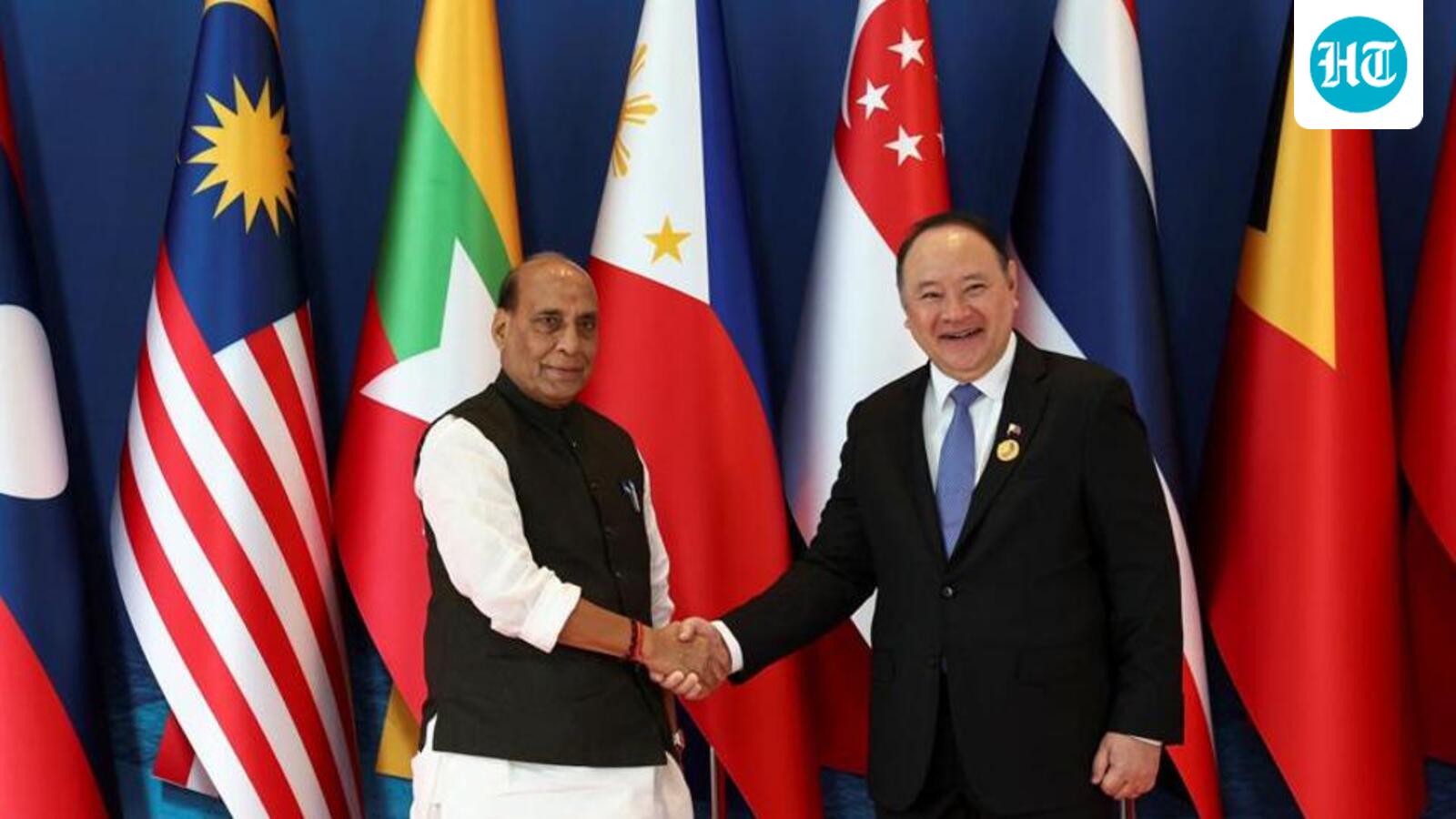
Security in the Indo-Pacific figured prominently in separate talks between defence minister Rajnath Singh and his US, Japanese and Australian counterparts on the sidelines of an ASEAN summit in the Philippines, as the Quad partners underscored their commitment to peace, stability and respect for international law across the vast maritime expanse.
“Our robust partnership continues to be a cornerstone for a free, open, and secure Indo-Pacific,” Singh said after talks with US secretary of war Pete Hegseth on the sidelines of the 13th ASEAN Defence Ministers’ Meeting (ADDM)-Plus at Cebu in the Philippines from October 28-29.
The Quad is closely tracking China’s expanding military footprint and influence across the Indo-Pacific. The US war department’s 2026 National Defense Strategy aims to deter China in the Indo-Pacific through strength, not confrontation. India and the US signed a 10-year framework last year to strengthen defence ties, with joint efforts to promote peace and security in the Indo-Pacific as a key priority.
Singh and his Japanese counterpart Shinjiro Koizumi also reviewed regional security challenges and underlined their commitment to boosting defence cooperation to promote security and stability in the Indo-Pacific. “Our shared commitment remains vital for a free, open, and peaceful Indo-Pacific region,” Singh said.
Also Read: Rajnath takes stock of flood-hit areas in Lucknow, directs officials to expedite relief
Regional Challenges and India’s Indo-Pacific Vision
India has consistently called for a free, open and inclusive order in the Indo-Pacific region, pivoting on respect for the sovereignty and territorial integrity of all nations while stressing the peaceful resolution of disputes through dialogue and under the framework of international laws. Challenges in the Indo-Pacific include China’s carefully calculated power play for influence and defending the rules-based international order.
Singh reviewed regional security in his talks with Australian deputy prime minister and defence minister Richard Marles. “We had productive discussions on reviewing our bilateral defence cooperation, enhancing military interoperability, and addressing regional security challenges. India places great value on its comprehensive strategic partnership with Australia for a free, open, and secure Indo-Pacific,” Singh said.
Also Read: India needs more than Quad revival
Quad Cooperation with ASEAN
Quad nations are Comprehensive Strategic Partners of ASEAN and back the bloc’s outlook on the Indo-Pacific. In a joint statement issued in Manila on cooperation with ASEAN, the Quad foreign ministers said in July, “We are united in our conviction that peace and stability in the Indo-Pacific maritime domain underpin the security and prosperity of the region.”
India seeks an Indo-Pacific where all countries can make their own choices, protect their interests, and pursue development in peace, Singh said on October 14 at the inaugural session of the ASEAN-India Defence Think Tank Forum at the Manohar Parrikar Institute of Defence Studies and Analyses in Delhi.
“We believe that security is strengthened when countries build capacity together, respect international law, and maintain trust through dialogue,” he said at the time. China has longstanding territorial disputes in the South China Sea with several ASEAN members, including Malaysia, the Philippines and Vietnam.
Also Read:The economic centre of gravity is moving East
About the ADMM-Plus
The ADMM is the highest defence consultative and cooperative mechanism in ASEAN. The ADMM-Plus brings together the 11 ASEAN member states—Brunei, Cambodia, Indonesia, Lao PDR, Malaysia, Myanmar, the Philippines, Singapore, Thailand, Timor-Leste and Vietnam—and eight dialogue partners—India, the US, China, Russia, Japan, South Korea, Australia and New Zealand—to strengthen security and defence cooperation.
KioskNews shows a cleaned-up reading view extracted from the publisher’s page — the original always lives on their site, not ours.