HSBC Sets Its Sights on Becoming the Leading Corporate & Institutional Bank in Taiwan
HSBC is leveraging its global network and local expertise to strengthen its corporate and institutional banking business in Taiwan, supporting companies expanding overseas and investors seeking new opportunities amid growing artificial intelligence (AI) investment, financial markets and the energy transition. Adam Chen (陳志堅), chief executive officer at HSBC Bank (Taiwan) Ltd (滙豐台灣商業銀行), discussed the bank’s strategy and outlook to its corporate and institutional banking business in an exclusive interview with Taipei Times staff reporter Crystal Hsu in Taipei on Nov. 11.
Taipei Times: What were HSBC’s key achievements and milestones in Taiwan’s corporate and institutional banking (CIB) business this year?
Adam Chen: HSBC’s CIB business in Taiwan received 10 industry awards this year, reflecting positive customer feedback and recognition of our capabilities across banking coverage and products. Highlights included Euromoney’s best bank for large corporates award for the first time, best cash management bank for the third consecutive year, and best investment bank for debt capital markets. We also received recognition for securities services, fund administration and sustainable finance.
These awards reflect our ability to combine local market knowledge with international connectivity and expertise across financing, markets, payments, securities services and sustainable finance. Our focus is to remain a trusted, future-ready partner, helping clients move, invest and grow with confidence.
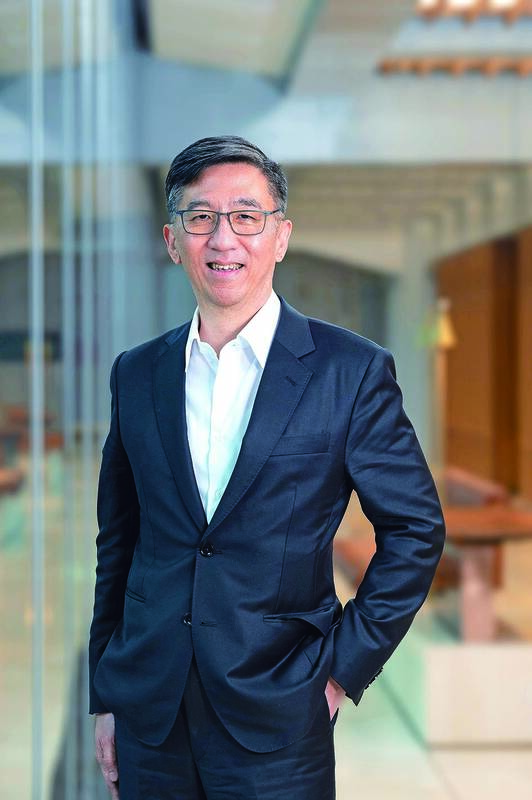
Adam Chen, chief executive officer at HSBC Bank (Taiwan) Ltd, is pictured in an undated photograph.
Photo courtesy of HSBC Bank (Taiwan) Ltd
TT: What were some of the most significant transactions or client engagements this year?
Chen: We helped Asustek Computer Inc’s (華碩) wholly owned Singapore subsidiary secure US$2 billion in its first offshore syndicated financing, acting as global sole coordinator, mandated lead arranger and bookrunner, and facility agent.
The transaction involved teams in Taiwan, Singapore and Hong Kong and demonstrated how our cross-border platform can support Taiwanese companies’ international expansion.
In renewable energy, HSBC acted as debt financial adviser, mandated lead arranger and bookrunner, and hedging bank for the Hai Long offshore wind project financing. This was our first incremental financing advisory transaction in Taiwan’s offshore wind sector.
We also served as joint global coordinator for ASE Technology Holding Co’s (日月光投控) US$1 billion Euro-Convertible Bond (ECB) issuance, joint bookrunner for United Microelectronics Corp’s (UMC, 聯電) US$1.8 billion ECB offering and as one of the bookrunners for Nan Shan Life’s (南山人壽) US$333 million bond issuance.
These transactions demonstrate our ability to connect clients with international financing and capital markets while providing tailored solutions for their strategic needs.
TT: What are the key growth drivers for Taiwan’s corporate and institutional clients in 2027, and how will HSBC support them?
Chen: Taiwan’s trade momentum with the US, Europe and ASEAN is expected to remain healthy, supported by continued AI-related capital expenditure by major cloud service providers. AI investment is creating opportunities across the wider supply chain, from semiconductors and advanced manufacturing to data centers, energy and logistics.
Beyond project financing, companies need support with cross-border payments, trade finance, foreign exchange, interest-rate management, capital raising and strategic advice. HSBC aims to connect these needs across markets through its international network and comprehensive services.
TT: What are the main challenges facing corporate and institutional clients in 2027, and what advice would HSBC offer?
Chen: Three potential challenges are the next phase of AI commercialization, inflation, and volatility in foreign exchange and interest rates, all of which could create uncertainty in capital markets.
Companies should look beyond immediate financing needs and assess how AI investment could affect their capital structures, liquidity, supply chains, energy consumption and cross-border operations.
They should also maintain visibility over liquidity, stress-test funding assumptions, review hedging strategies and preserve access to multiple sources of capital.
Our advice to customers is to prepare for uncertainty rather than wait for it to disappear. For us, resilience is not simply about avoiding risk, but also about understanding it well enough to continue making informed decisions and advising clients as conditions change.
TT: What opportunities do you see in sustainable finance and infrastructure development in Taiwan?
Chen: Taiwan is one of the major offshore wind markets in the Asia-Pacific area, providing opportunities for HSBC to apply its financing and advisory expertise to major renewable energy projects.
Nowadays, sustainability is both a corporate responsibility and a business opportunity. We continue to believe that the greatest contribution we can make to real world emission reductions is to deploy our strengths in support of our customers’ transition. Financing the transition requires long-term planning, credible structures and cooperation among governments, project sponsors, lenders, investors and communities.
We aim to help clients navigate this transition commercially by supporting viable projects and advising them on financing, risk management and disclosure requirements.
TT: How is HSBC positioning itself to capture opportunities from Taiwan’s expanding financial markets, particularly the ETF sector?
Chen: Taiwan’s financial markets are developing rapidly, with the ETF market creating new opportunities for global asset managers and local investors.
HSBC’s ETF platform solutions went live in 2025, providing technology and digital capabilities across the lifecycle of active and passive ETFs, from launch and administration to ongoing servicing.
We are also among the top three foreign custodian banks in Taiwan and the only custodian offering a comprehensive range of securities services, including custody, government-bond clearing, fund accounting and transfer agency.
As the market grows, clients will increasingly value partners that can combine international product knowledge with local market infrastructure. HSBC aims to help asset managers and institutional investors tap into Taiwan’s growth by providing services that can support their expanding business needs.
TT: What role does Taiwan play in HSBC’s global and Asia business strategy for CIB?
Chen: HSBC has been in Taiwan for more than 40 years, and our commitment to the market and Taiwanese clients remains strong.
Taiwan is strategically important because of its globally connected corporate sector, robust capital markets and central role in technology and advanced manufacturing. Its companies help shape global supply chains and investment flows, particularly as AI reshapes the global economy.
Our role is to serve as a long-term partner to Taiwanese businesses and institutions expanding internationally, while helping global clients access opportunities in Taiwan.
Through our international network, we connect Taiwanese clients with markets such as Southeast Asia, Europe and North America, while bringing international capital, expertise and products into Taiwan.
KioskNews shows a cleaned-up reading view extracted from the publisher’s page — the original always lives on their site, not ours.