The ‘Angry Nerds’ campaign exposing red flags in the Philippines’ 2027 budget

Just over a year ago, Carlo Ople was making YouTube videos about his two obsessions – trainers and action figures. These days, the 44-year-old former marketing executive uses the same channel to dissect national budgets and political issues, swearing profusely along the way.
Ople is part of a growing movement of unlikely civil society activists in the Philippines – software developers, gamers and online influencers who are turning their digital skills to the fight against corruption.

Known as the “Angry Nerds”, they have been poring over the country’s proposed 7.2 trillion peso (US$113 billion) national budget for 2027, flagging more than a trillion pesos in potentially questionable allocations as lawmakers debate how public money should be spent.
“My heart really is in this space,” Ople said, calling Creators Against Corruption, the informal group of YouTubers and online influencers he founded, his “passion project: I want to see change.”
Jason Torres, 43, a software developer and start-up founder based in London who organised BetterGov.ph – an initiative that processes technical government data to make it understandable to the public – said: “We’re really nerds. We’re gamers, software developers, programmers, we have our own communities, our own culture and attitude.”
Adolfo Jose Montesa, co-convenor of the People’s Budget Coalition (PBC), which engages lawmakers and coordinates with other civil society organisations, including Creators Against Corruption and BetterGov.ph, also embraces the label: “I consider myself a nerd – somebody that is very passionate about a certain sphere of knowledge or certain interest.”
The three and thousands of other Filipino volunteers, working both online and offline, have played a key role this year in identifying questionable allocations and helping lawmakers trim proposed spending in the 2027 national budget.
The term Angry Nerds is a play on Angry Birds, a video game in which furious avians battle greedy pigs. Montesa said the name cropped up during one meeting, while public finance specialist Zy-za Nadine Suzara – a former Department of Budget and Management official who now volunteers at the PBC – explained how the two groups worked together: “There are two major nerd groups – the PBC and the BetterGov.ph.”
Ople’s Creators Against Corruption works with both to disseminate their findings.
Making an impact
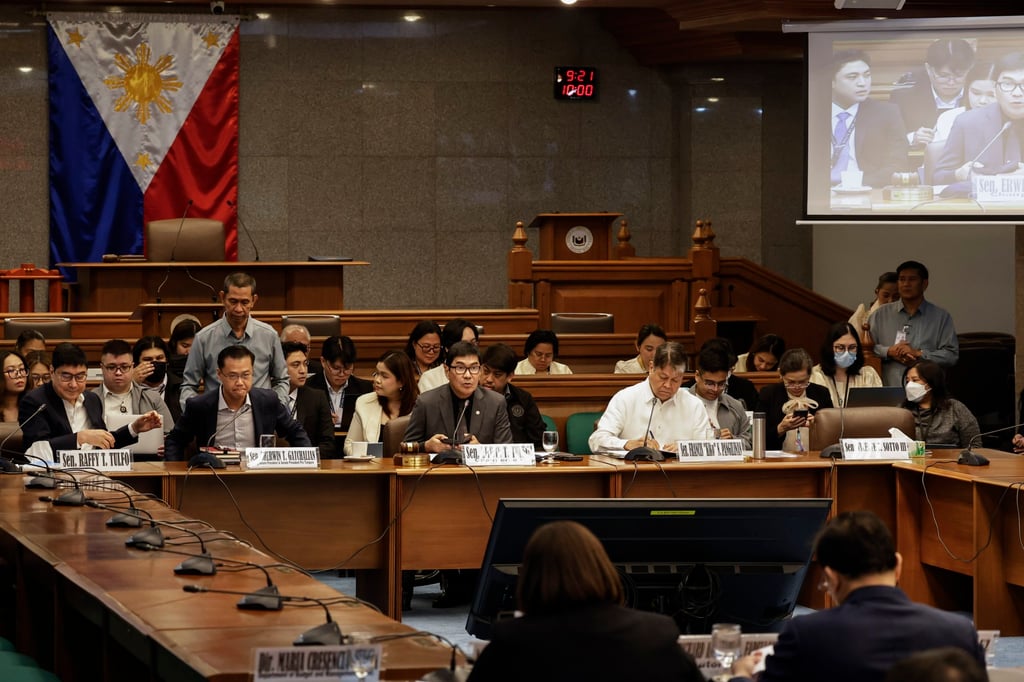
Senator Francis Pangilinan, who heads the Senate finance subcommittee overseeing agricultural infrastructure projects, acknowledged the activists’ impact: “I can only speak about the agencies under my subcommittee, but the civil society organisations’ contribution has been substantial.”
“They brought technical knowledge, careful scrutiny and a strong public-interest perspective to the budget review. Their questions helped us examine whether proposed projects were clearly identified, properly supported and responsive to actual needs,” he added.
Among the projects flagged by the Angry Nerds were two farm-to-market roads – intended to help farmers transport their produce to markets – whose coordinates placed them in Nigeria and in the sea near Brunei. Pangilinan said he had approved both projects after the Department of Agriculture “corrected” their “wrong coordinates”.
In all, Pangilinan said, his subcommittee had cut 3.6 billion pesos from the 19.6 billion pesos allocated by the House of Representatives for farm-to-market roads, bringing the total back to 16 billion pesos – the original Department of Budget and Management proposal.
Why they are angry
For many of the volunteers, the catalyst was a sprawling corruption scandal that erupted last year over government spending on flood-control infrastructure. In September 2025, Finance Secretary Ralph Recto told senators he estimated up to 118.5 billion pesos of taxpayers’ money had been lost from 2023 to 2025 due to ghost flood-control projects alone.
Investigators uncovered alleged schemes involving lawmakers, officials and contractors to divert billions of pesos into phantom or non-existent projects and pocket kickbacks.
Adding to the public outrage were revelations of vast sums of cash being transported in suitcases and the extravagant lifestyles of some of those implicated in the scandal.
Aircraft, luxury cars, mansions and expensive overseas trips taken by their children – dubbed “nepo babies” – became symbols of the excesses associated with the scandal, with some of the children publicising their lifestyles on social media, and some implicated politicians eventually leaving the country.
In 2025, just before the scandal erupted, Torres and a group of friends had set up BetterGov.ph as a more efficient alternative to the official Philippine government portal, which was intended to provide links to government agencies and information about their services.
Then the flood-control revelations poured in.
“People got angry. I got angry,” Torres said. “Like, why is this happening? Why are we allowing these things to happen?”
Cracking the budget
For years, Congress passed voluminous national budgets that defied understanding, with allocations for projects favoured by individual lawmakers buried in their pages.
Such spending, commonly referred to as “pork barrel” or simply “pork”, was previously formalised through the Priority Development Assistance Fund (PDAF), which allowed lawmakers to channel public money towards projects of their choosing until the Supreme Court declared PDAF unconstitutional in 2013.
Even after that ruling, concerns over lawmakers’ influence on government spending persisted, shifting towards last-minute budget insertions, vaguely defined infrastructure projects such as farm-to-market roads, unprogrammed appropriations – spending contingent on certain funding conditions – and help programmes for the poor in which individual representatives played a role.
According to Torres, the Angry Nerds had the skills to unravel the budget. “We can process data, we’re really good at it. We nerds, we’re really good at research, finding things. We obsess on these things.”
He pointed out how “government data, Excel spreadsheets, data inside a PDF, those are very difficult to view for a normal citizen, right? Like, you have to go to them, you don’t even understand them.”
“But for us, engineers, and even designers, we can parse those. We convert that complex data into something that the people understand.”
When the proposed 2027 budget of 7.2 trillion pesos was approved by the Lower House in October and sent for approval to the Senate, where floor debates opened on Monday, the Angry Nerds dissected it and announced they had found more than 1 trillion pesos in “budget red flags”.
The PBC said: “We have examined more than 18,000 projects and identified nearly 7,000 inserted infrastructure projects worth approximately 190 billion pesos without published supporting documents.”
The Senate said it would examine “questionable” items.
Suzara recalled how “the House leadership kept civil society out of the process – one legislator even called us ‘ignorant’ – but the movement’s pushback on this statement was strong.”
According to Suzara: “Legislators from different parties, including the Speaker of the House, reached out to us following this fiasco.”

Montesa said: “Even though we’re nerds, it’s not just [us] who are engaging this process [of understanding the budget]. It’s also every Filipino, the angry nanays (mothers), the angry titos (uncles), street vendors, jeepney drivers. And our nerdy skills are what are helpful to make it more accessible to them.”
Asked how long the groups could keep it up, Montesa gave a typically nerd response: “I will quote Captain America: ‘I can do this all day.’”
KioskNews shows a cleaned-up reading view extracted from the publisher’s page — the original always lives on their site, not ours.