Taiwan’s main opposition Kuomintang faces uphill battle in local elections
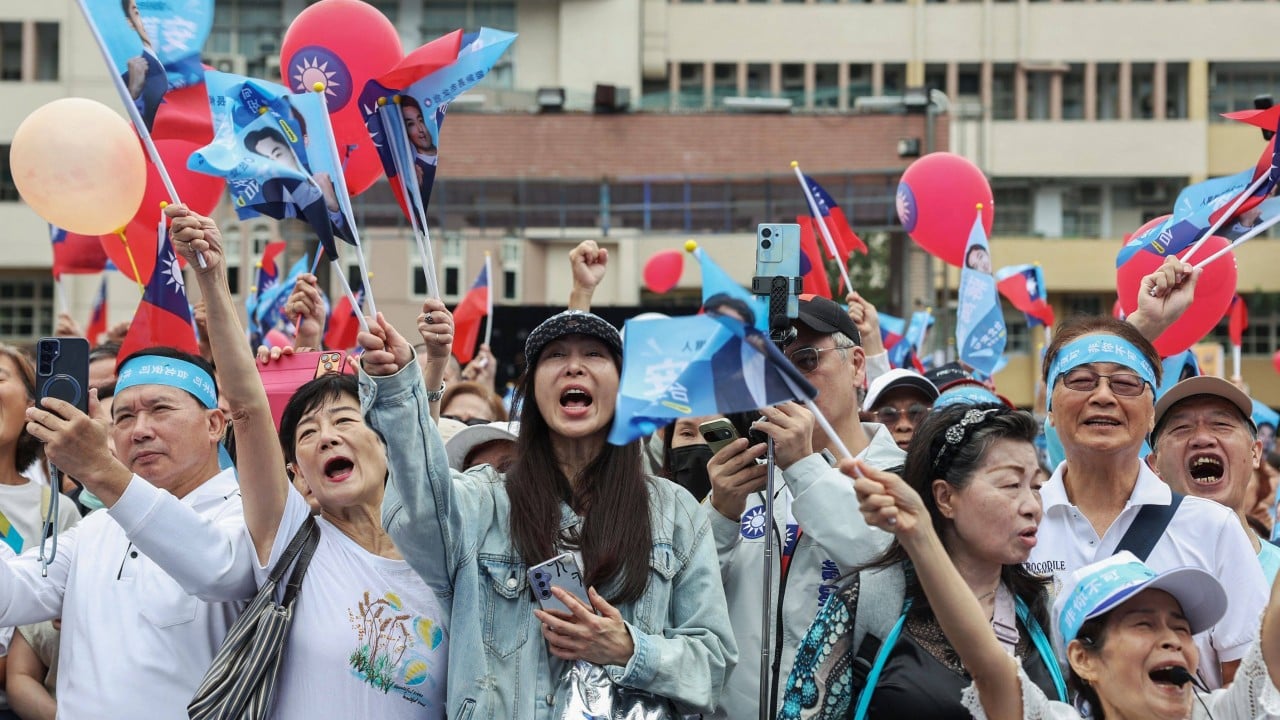
Adding to the party’s troubles are signs of voter disengagement, internal unease over chairwoman Cheng Li-wun’s political positions and allegations of judicial interference that have further polarised the electorate.
02:55
Peace is a ‘common wish’: Taiwan opposition leader meets Xi Jinping in Beijing in rare visit
In 2022, the KMT won 14 of Taiwan’s 22 city and county leadership races, increasing its tally to 15 after independent Miaoli county magistrate Chung Tung-chin returned to the party.
But party insiders have identified Yilan in the northeast, Changhua in central Taiwan, and Hsinchu in the north as particularly vulnerable, while holding onto Chiayi city in the southwest and managing an electoral alliance with the smaller Taiwan People’s Party (TPP) also pose a challenge.
Some within the KMT hope potential gains in the offshore islands of Penghu and Quemoy, also called Kinmen, or even an upset victory in the DPP stronghold of the southern city of Kaohsiung, could offset losses elsewhere.
More worrying for the KMT, however, are the increasingly competitive races in Taipei and neighbouring New Taipei City, two municipalities that account for nearly 30 per cent of the island’s electorate.
“If we lose Taipei and New Taipei, forget about whether the party chairwoman should resign. The entire KMT would go into meltdown,” said a KMT official who declined to be named.
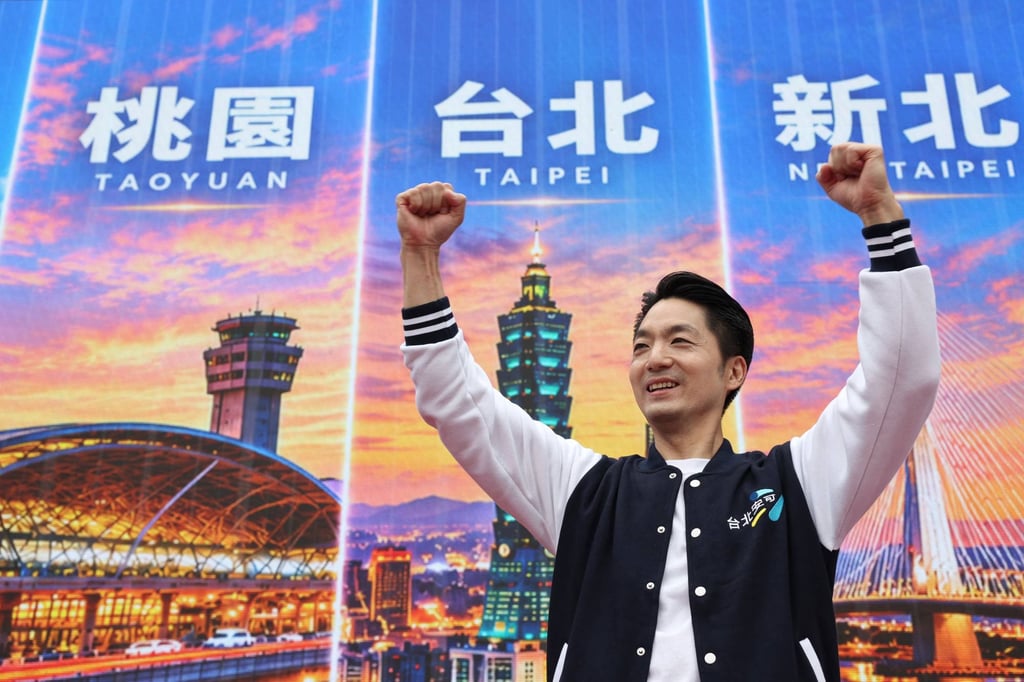
On Tuesday, Chiang launched a campaign motorcade through Taipei’s Songshan and Xinyi districts, drawing enthusiastic supporters ranging from office workers to a 104-year-old resident.
Motorists rolled down their windows to cheer the mayor, while shop workers and residents rushed out to wave or shake his hand.
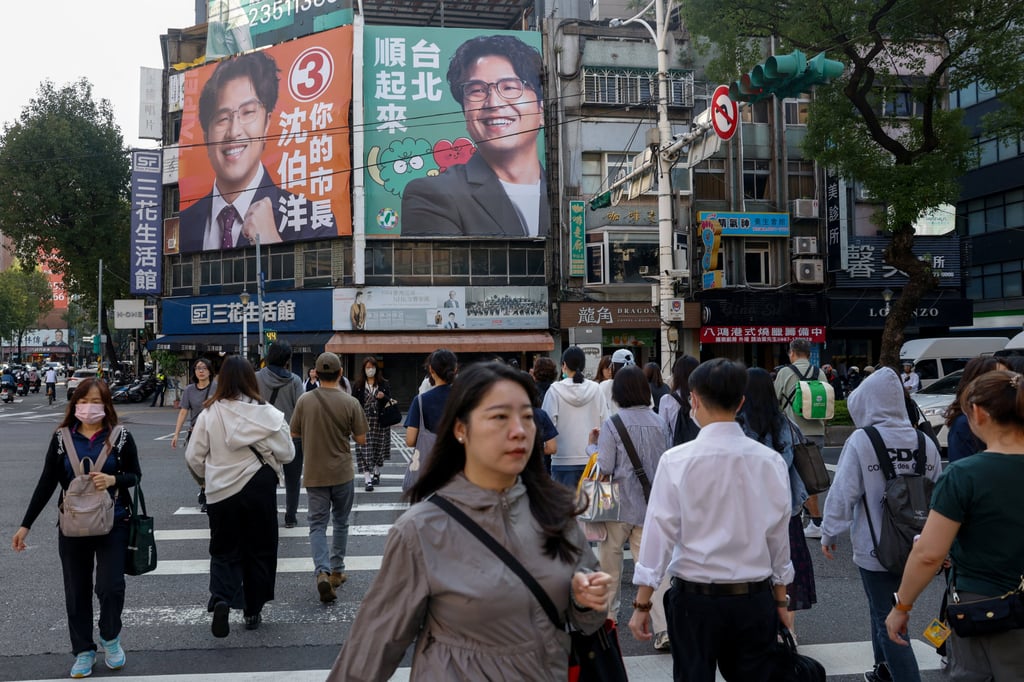
The scenes underscored the KMT’s reliance on traditional grass-roots mobilisation, in contrast to Shen’s unconventional campaign, which has used political memes, interactive activities and humour to engage younger voters and those previously indifferent to politics.
Chiang has also enlisted the help of TPP founder and former Taipei mayor Ko Wen-je, appearing alongside him at a campaign gathering on November 21.
Ko subsequently sent Chiang a copy of the Diamond Sutra, a sacred Buddhist text, dismissing the yangliu.
“Don’t be intimidated by the illusion of the ocean current,” Ko told Chiang.
In New Taipei, KMT candidate Lee Shu-chuan, who once enjoyed a comfortable polling lead, is facing an increasingly formidable challenge from DPP rival Su Chiao-hui.
Kharis Templeman, a research fellow at Stanford University’s Hoover Institution, described New Taipei as the most important barometer of Taiwan’s political direction.
With more than 4 million residents and relatively balanced partisan support, the municipality represented a direct test of the two camps’ political strength, with island-wide issues likely to play a greater role than elsewhere, he said in a keynote speech at an event in San Francisco last month.
Templeman argued that structural factors were also working against the KMT, which already controlled most localities it could realistically expect to win.
Compounding the challenge was the departure of numerous popular KMT mayors and county magistrates because of term limits, depriving the party of the electoral advantages of incumbency.
The KMT could consequently lose several local administrations even if its overall electoral support remained stronger than the DPP’s, he said.
An electoral liability?
Unlike previous elections in which KMT chairpersons were prominent campaign assets, Cheng has found herself overshadowed by Chiang and outgoing Taichung Mayor Lu Shiow-yen, with some party insiders describing her as an electoral liability.
Few candidates have appeared alongside Cheng on campaign billboards, while some have reportedly preferred that she either stay away from their rallies or appear early in the proceedings.
“If swing voters see a candidate standing alongside Cheng Li-wun, that candidate is as good as finished,” the KMT official said.
Liu Chao-lung, an associate professor at National Changhua University of Education in central Taiwan, said Cheng’s political rhetoric, which he characterised as leaning towards Beijing, including her assertion that Taiwan was not a country, was out of step with mainstream public opinion.
“Candidates seeking moderate voters are therefore inclined to distance themselves from her,” he said.
Beijing regards Taiwan as part of China to be reunited by force if necessary. Most countries, including the United States, do not recognise Taiwan as an independent state, but Washington is opposed to any attempt to take the self-ruled island by force and is committed to supplying it with weapons.
By contrast, Lu’s more centrist political image had made her one of the party’s most sought-after campaign figures.
Cheng has dismissed suggestions of internal divisions as attempts by political opponents to sow discord.
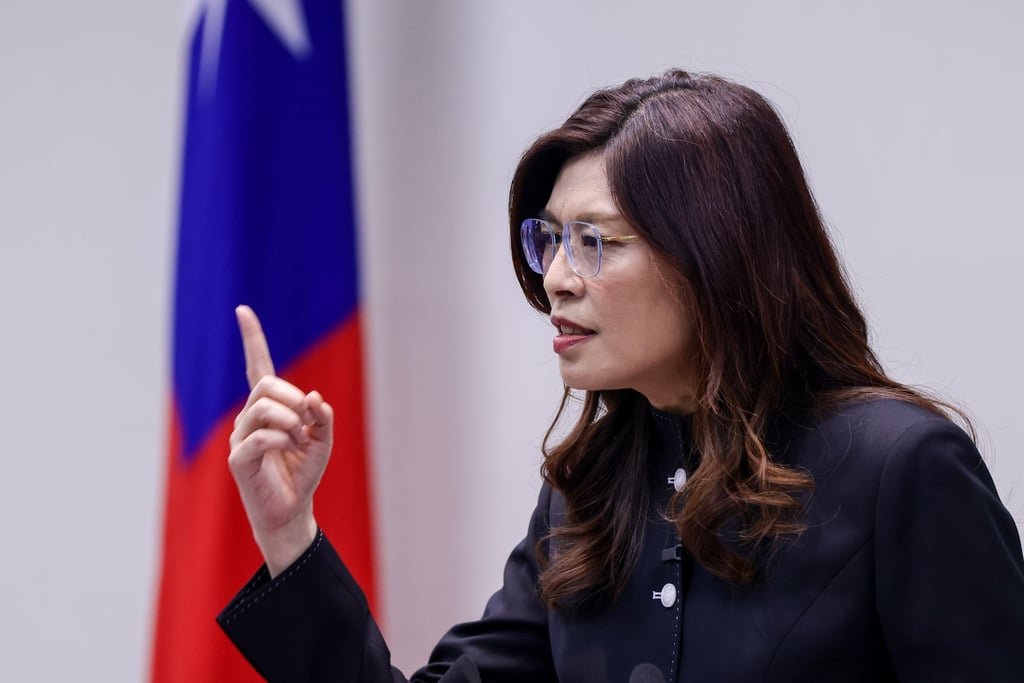
Asked earlier this month whether she would resign as chairwoman if the KMT failed to achieve its electoral objectives, Cheng replied: “No. I don’t think that will happen.”
She described herself as playing a supporting role in the elections and cautioned against looking for scapegoats.
But senior KMT figure and political commentator Jaw Shaw-kong said the chairwoman should take responsibility if the party suffered electoral setbacks.
Max Lo, executive director of the Taipei-based Taiwan International Strategic Study Society, offered a different perspective, crediting Cheng with securing a largely successful electoral cooperation agreement with the TPP despite disputes over some local nominations.
“The arrangement has overwhelmingly benefited the KMT, whose candidates in 19 cities and counties have the TPP’s backing,” he said.
Nevertheless, Lo said substantial losses could erode Cheng’s authority and intensify internal pressure on her, while unexpected defeats in traditional KMT strongholds could threaten her leadership.
Anxiety and the silent vote
Beyond the leadership controversy, the KMT faces uncertainty over whether its traditionally loyal supporters will turn out.
Cheng acknowledged in an interview with local media last week that even before the ocean current emerged, she had sensed “unusually subdued electoral enthusiasm”, with KMT supporters “becoming increasingly reluctant to disclose their political preferences”.
There have also been public expressions of disillusionment.
Wang Hung-pin, a cousin of KMT legislator Wang Hung-wei, declared on social media that after supporting Chiang in 2022, she would not vote for the mayor this time.
“I am not a mindless supporter,” she wrote, as she also withdrew support from several KMT city council candidates.
In another unexpected development, People First Party chairman James Soong Chu-yu, a veteran politician long associated with the Beijing-friendly pan-blue camp, publicly endorsed DPP Keelung mayoral candidate Tung Tzu-wei last week.
Although Soong had separately pledged to help Chiang, he attributed his support for Tung to long-standing personal ties with the candidate’s family and stressed the importance of transcending party divisions.
Yoshiyuki Ogasawara, a Japanese scholar specialising in Taiwanese politics, told Japan’s Jiji Press that swing voters had grown weary of confrontations in the legislature and increasingly believed the opposition had gone too far.
This had contributed to rising public approval of Taiwanese leader William Lai Ching-te, giving the ruling party greater electoral momentum, Ogasawara said.
The DPP has accused the KMT and the TPP, which together hold a legislative majority, of obstructing various government bills. Both opposition parties strongly deny the allegation.
Yet, some analysts cautioned against equating the DPP’s online popularity with voting intentions.
02:53
US midterm elections: What the results mean for mainland China, Taiwan and foreign policy
Du Sheng-tsong, the head of Ming Chuan University’s Department of Radio and Television, suggested that pan-blue supporters who felt increasingly unable to express their political views publicly “could channel their frustration into votes”.
The KMT has sought to tap into such grievances, accusing prosecutors on Tuesday of applying double standards in investigations into alleged campaign misconduct involving candidates from the two major parties.
KMT legislator Hung Meng-kai alleged that recent investigations had created a chilling effect, saying some supporters feared they could be questioned by investigators merely for attending opposition rallies.
According to Fan Shih-ping, a political science professor at National Taiwan Normal University in Taipei, turnout would be particularly important in Taipei and New Taipei, noting that participation exceeding 70 per cent had historically tended to favour challengers.
Chang Yu-tzung, a political science professor at National Taiwan University, said the elections would also test whether the KMT’s traditional mobilisation strategies remained effective in highly urbanised constituencies.
A defeat in either northern municipality could force the party to rethink its campaign methods, while retaining both would show the enduring influence of established political networks, he added.
For Cheng, however, electoral setbacks could have consequences extending well beyond Saturday.
Hung Yao-nan, an assistant professor at Tamkang University in New Taipei, said “a poor KMT showing could trigger a power struggle over the party chairmanship” and its 2028 leadership nomination, potentially delaying its election preparations by three to four months.
Templeman observed that local election defeats would not necessarily spell trouble for the KMT in 2028, particularly if they prompted an internal redistribution of power that ultimately put the party in a stronger position to return to power.
KioskNews shows a cleaned-up reading view extracted from the publisher’s page — the original always lives on their site, not ours.