CCP communique veils criticism of one-man rule
By William Hetherington / Staff writer, with CNA


The Chinese Communist Party’s (CCP) fifth plenum issued a communique containing detailed discussions of inner-party democracy that amount to veiled criticism of Chinese President Xi Jinping’s (習近平) one-man rule, China observer Willy Lam (林和立) said.
The communique was an important statement outlining the CCP’s goals, with its discussion of issues such as inner-party democracy being “unexpectedly detailed,” said Lam, a researcher with the Jamestown Foundation.
The communique said the plenum had made systematic arrangements for “consistently advancing full and rigorous self-governance of the Party,” emphasizing the need to bolster party members’ political character and strictly implement democratic centralism.
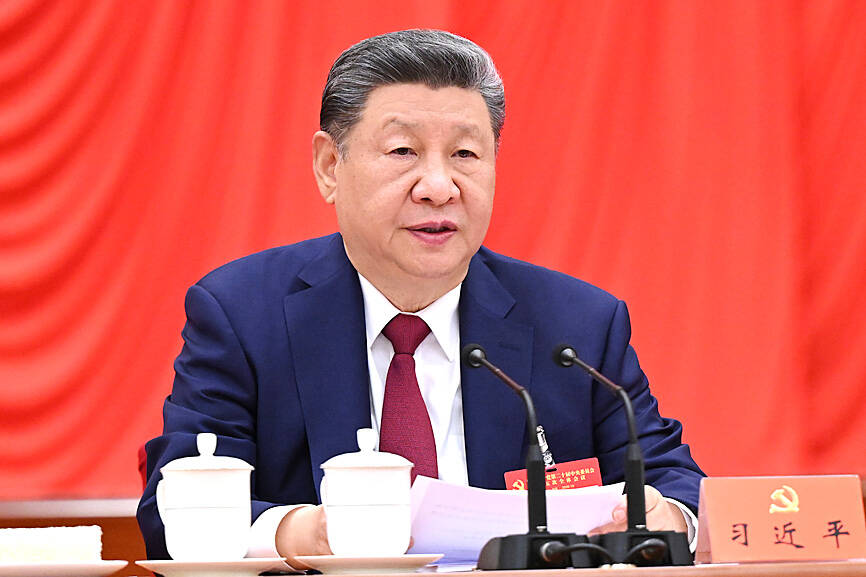
Chinese President Xi Jinping speaks at the fifth plenary session of the 20th Chinese Communist Party Central Committee in Beijing on Thursday last week.
Photo: Xinhua via AP
“Democratic centralism is the Party’s fundamental organizational principle and leadership system, and its implementation is essential to enforcing rigorous Party self-governance,” the communique said.
It also called for improving the systems governing democratic centralism, promoting inner-party democracy and ensuring proper centralization of power.
The communique further said that the party must bolster the centralized leadership of the CCP Central Committee, improve inner-party democracy, enforce rules governing leadership decisions and deliberations, and regulate how “top leaders” exercise their powers.
Lam said that the communique outlined several political reform issues that Xi had refused to consider, including a detailed discussion of inner-party democracy. Given Xi’s reputation for promoting centralized power and his complete disregard for democracy, Lam said that the communique amounted to veiled criticism of his one-man rule.
Xi was only adept at “self-reflection,” Lam said, referring to the CCP’s frequently invoked concepts of “self-improvement” and “self-revolution.” This form of self-improvement did not involve substantive reform, while the communique’s reference to “letting the people supervise the government” could be regarded as a reform, he said.
Although the communique praised Xi’s achievements, saying that the CCP Central Committee with Xi at its core had “fundamentally reversed the lax and weak state of Party governance and eliminated serious hidden dangers within the Party, the state and the military,” it made no reference to principles such as the “Two Establishes” (兩個確立), which Xi has used to demand absolute loyalty from officials, Lam said.
The main outcome of the fifth plenum was that Xi had secured approval to serve a fourth term beginning at the CCP’s 21st National Congress next year, he said, adding that Xi’s outdated model of one-man rule still had come under indirect criticism.
In a commentary published on Saturday, China’s Xinhua said that democratic centralism encompassed democracy and centralization, with the two serving as conditions for and complements to each other, and neither being dispensable.
The commentary said that the party must “uphold and strengthen the centralized and unified leadership of the Party Central Committee, deeply understand the decisive significance of the ‘Two Establishes,’” and ensure that the entire party maintains a high degree of unity with the CCP Central Committee with Xi at its core.
KioskNews shows a cleaned-up reading view extracted from the publisher’s page — the original always lives on their site, not ours.